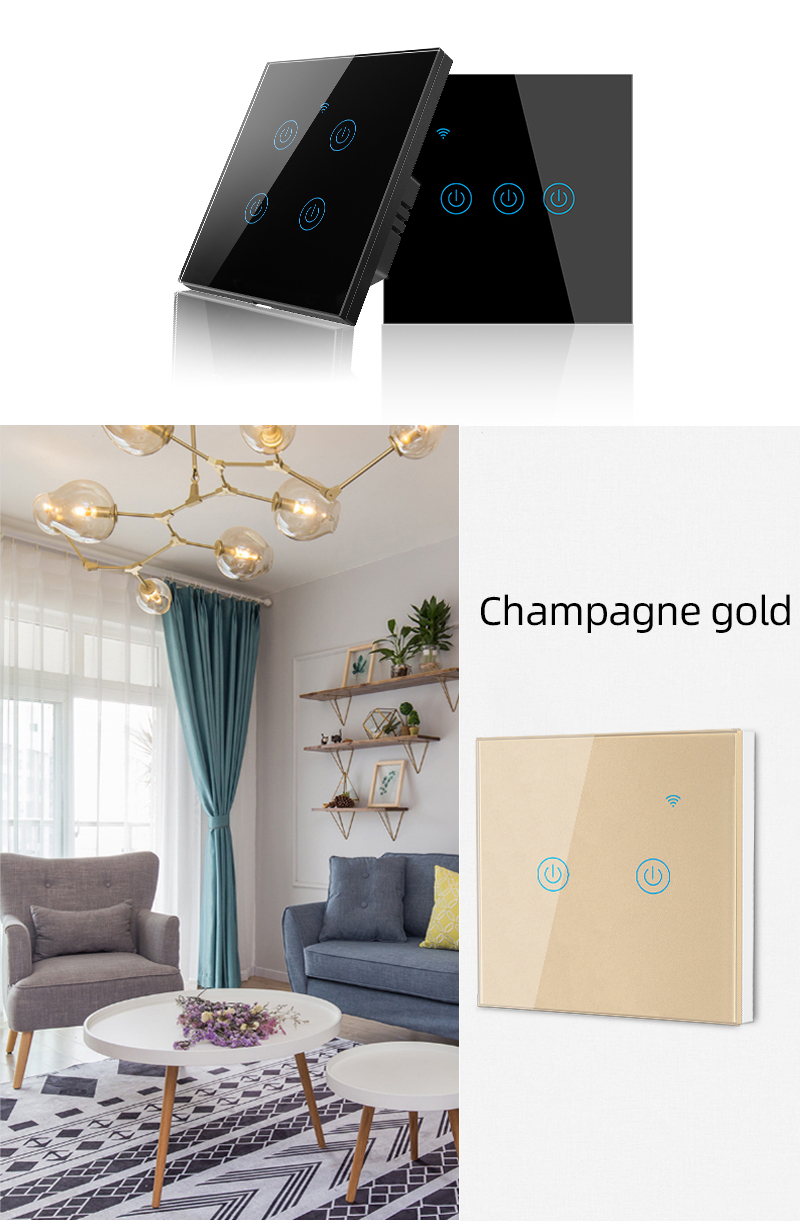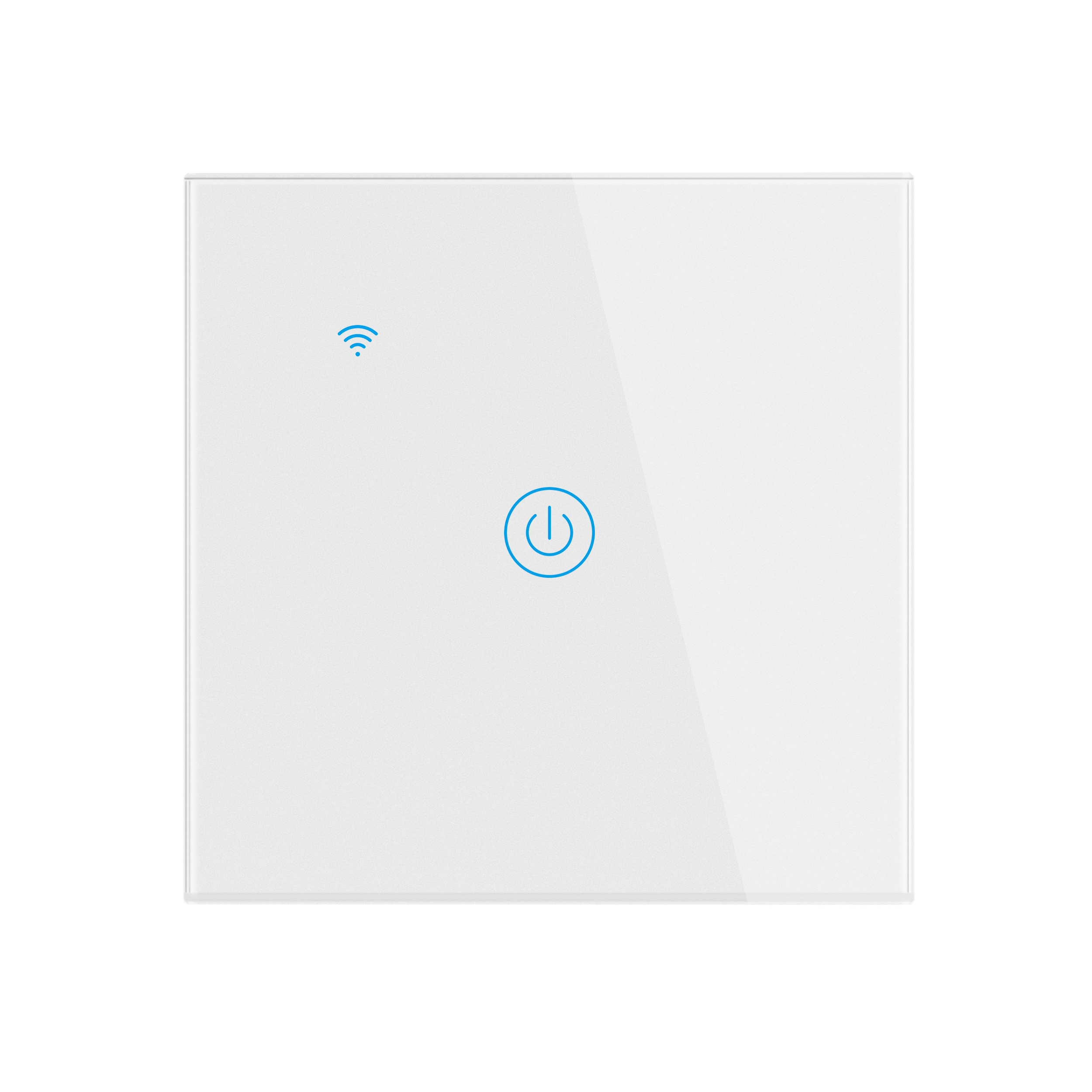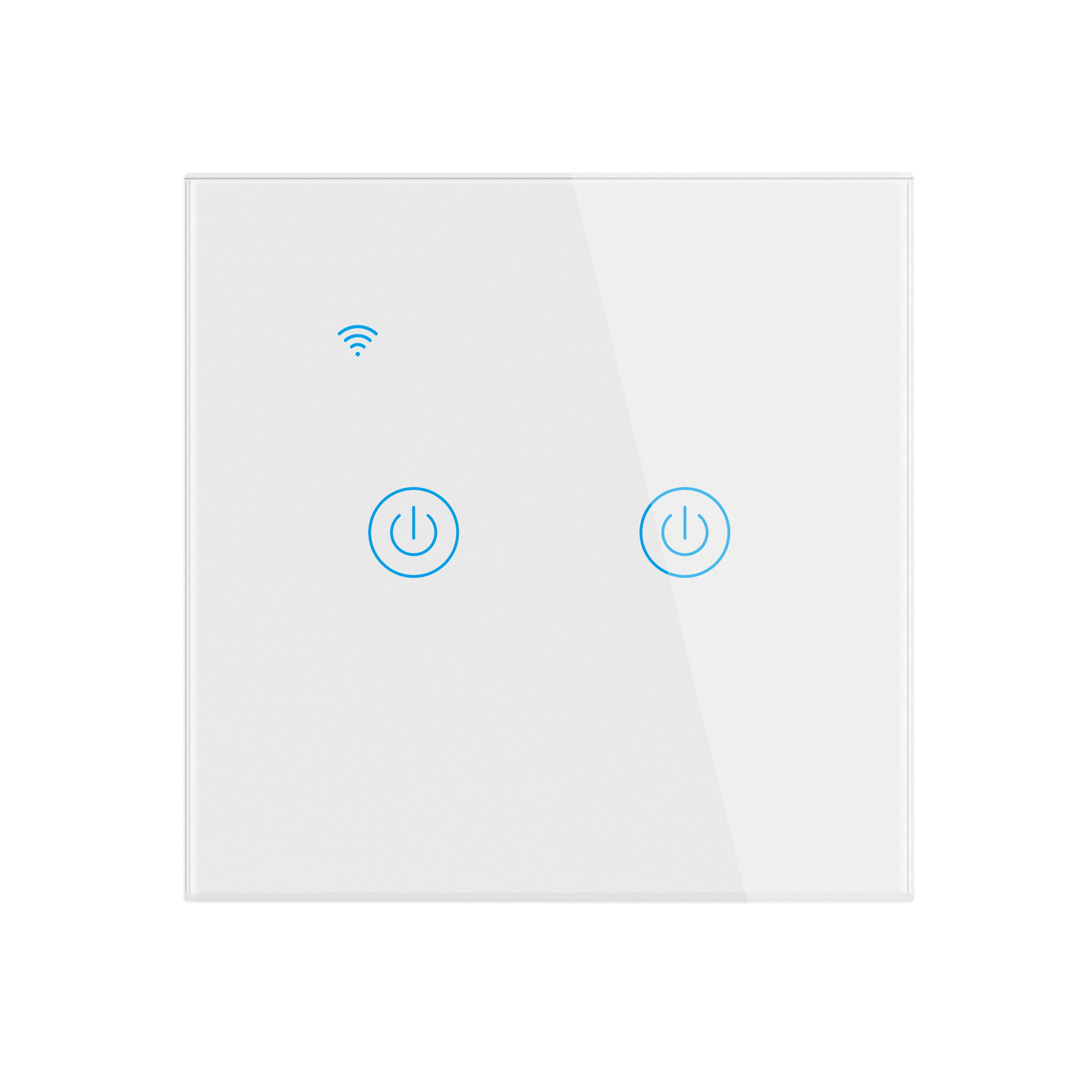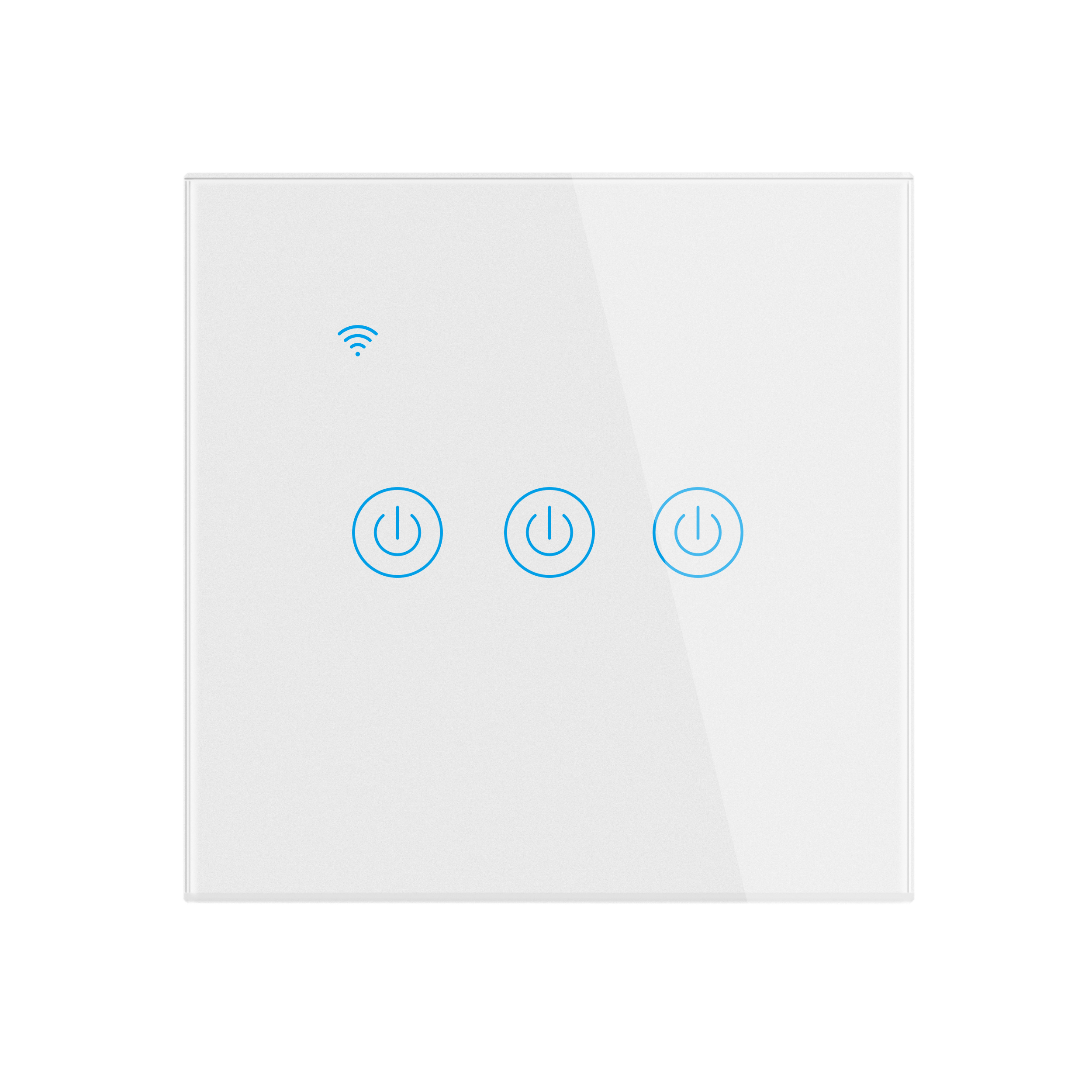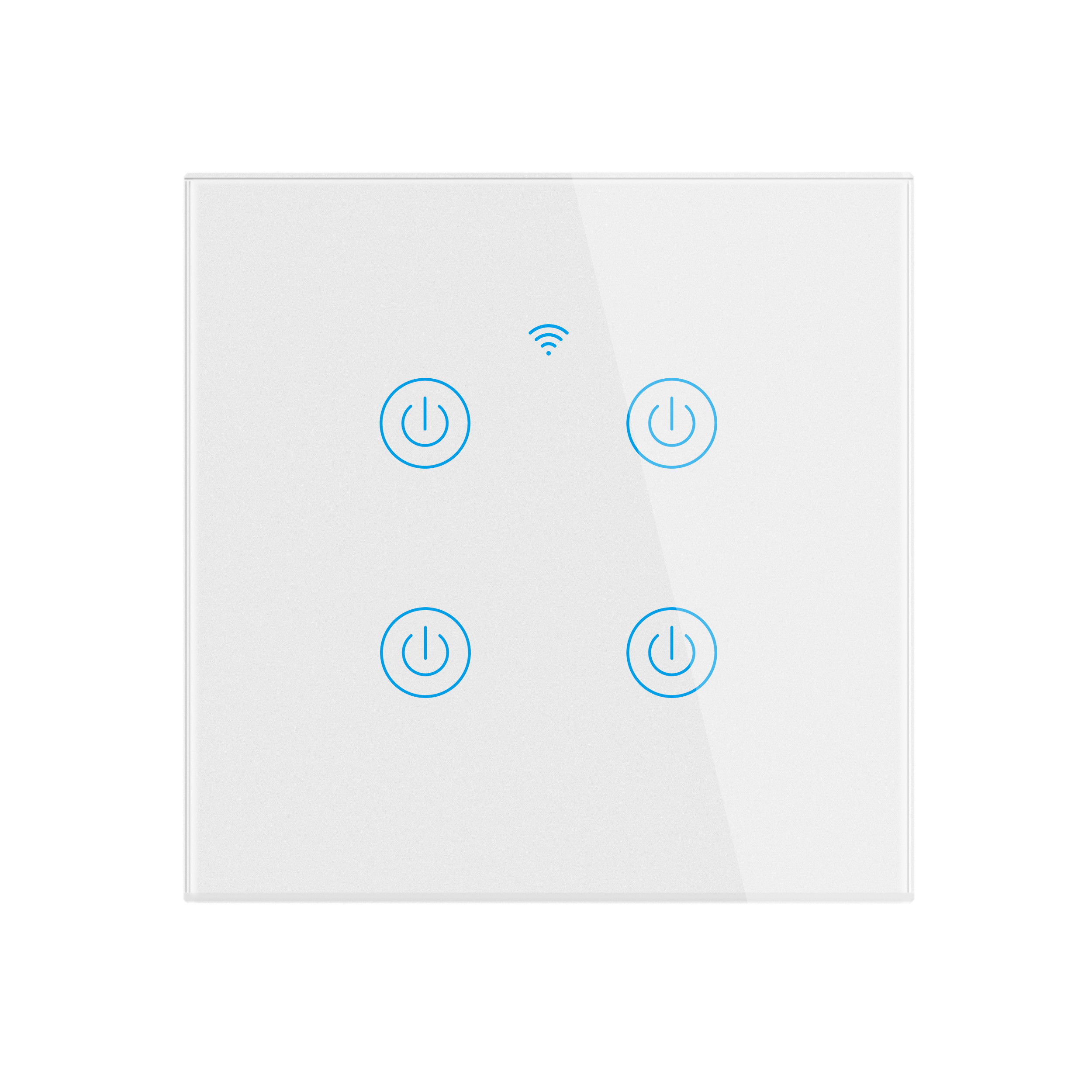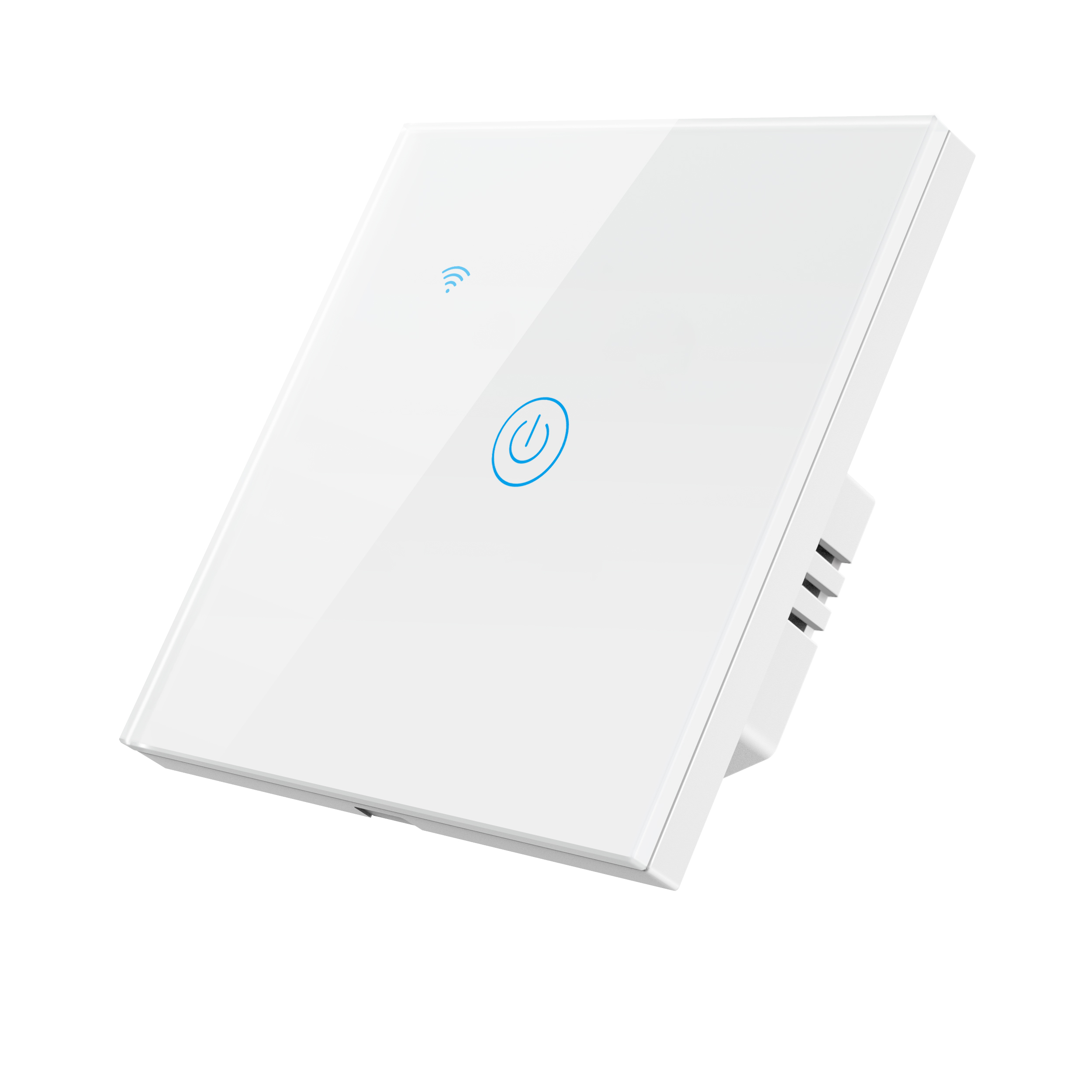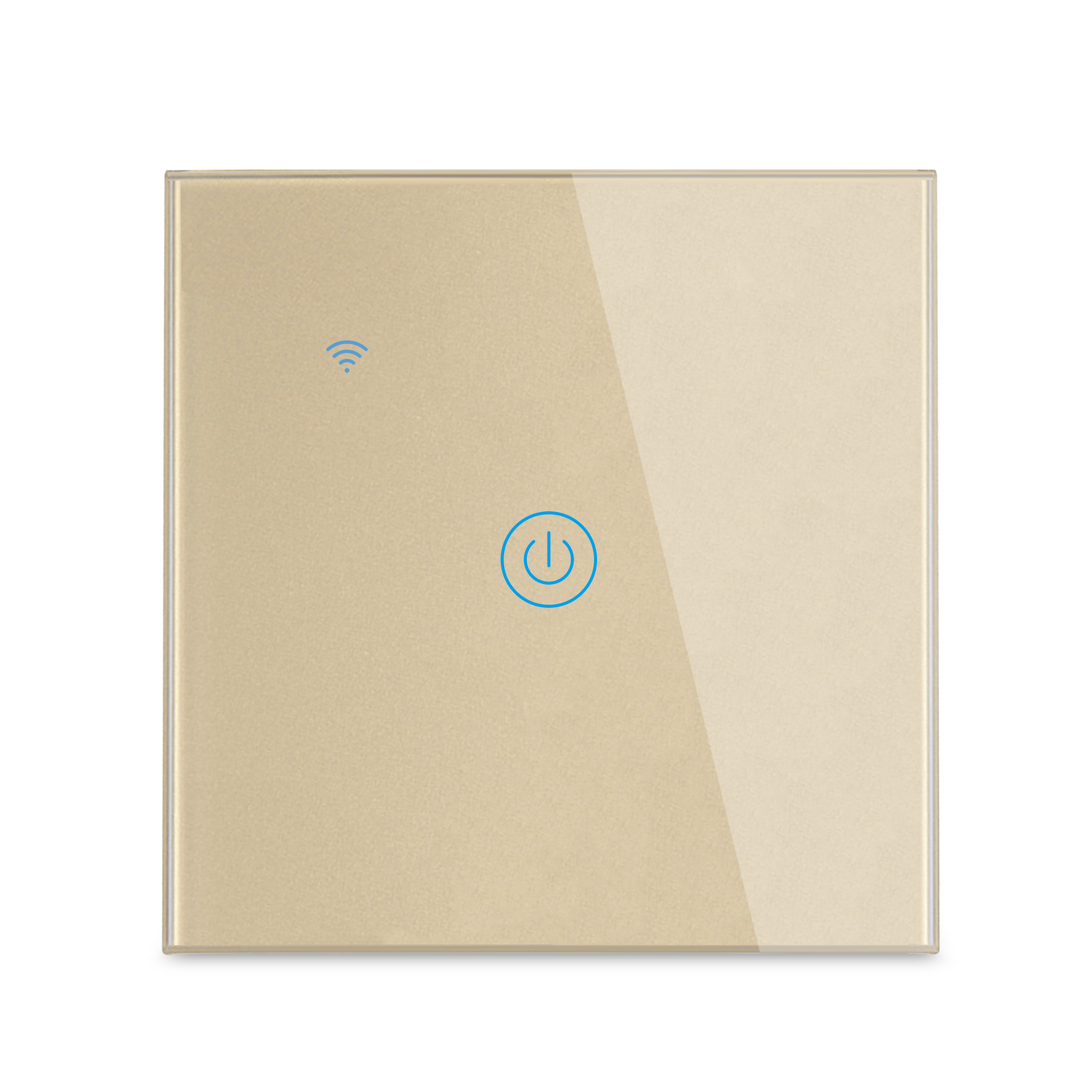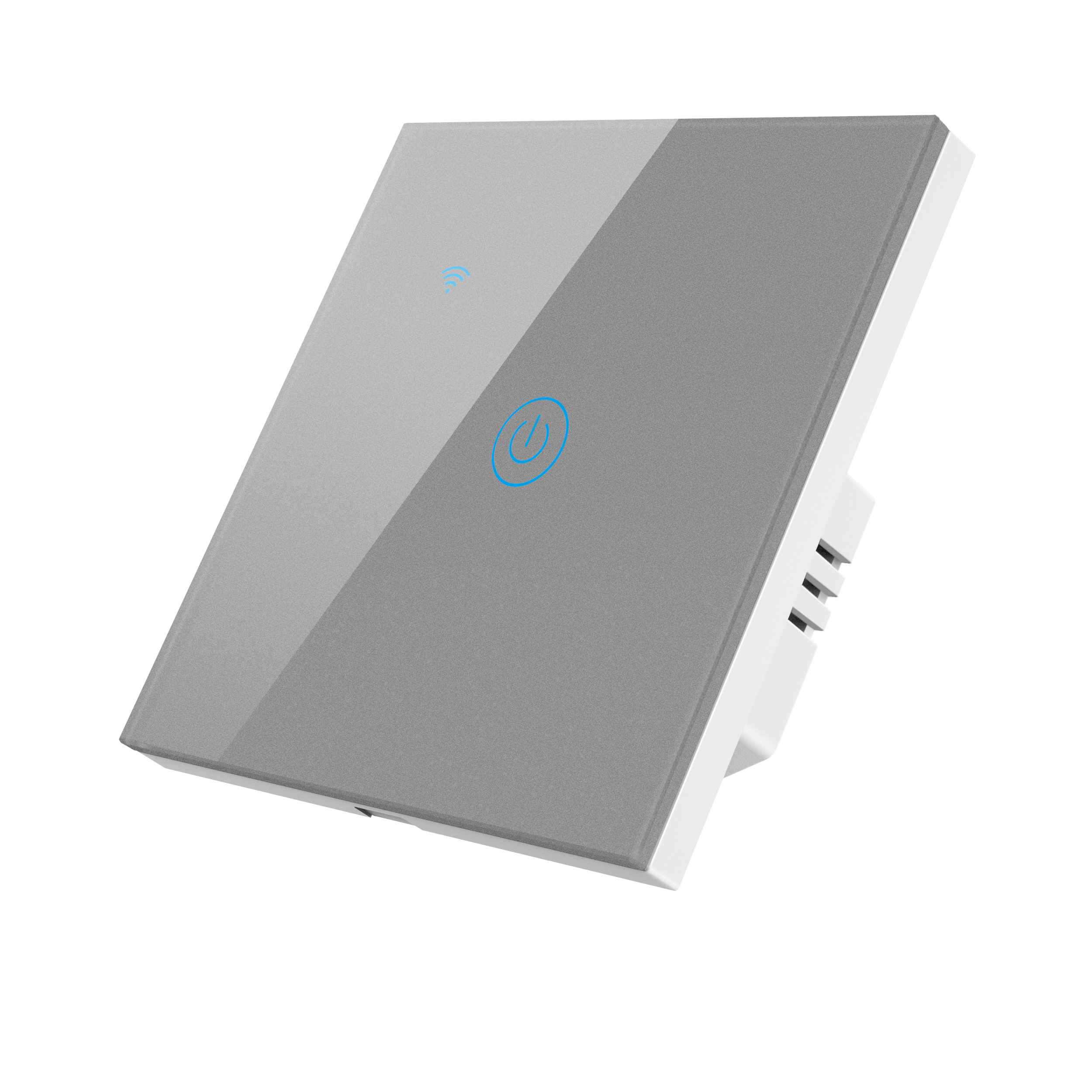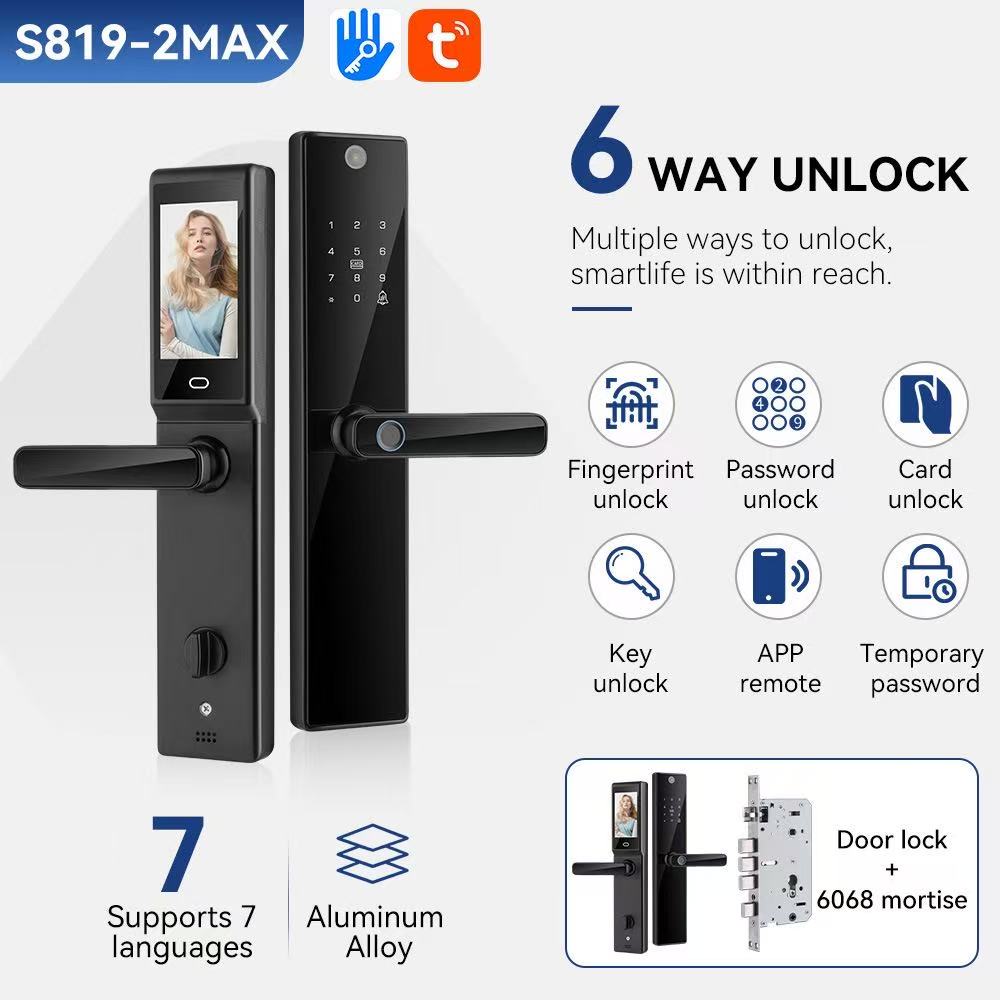
Shenzhen Xingliao Intelligent Technology Co., Ltd is a professional manufacturer of smart home hardware.
We supply smart wall switches, video doorbells, automatic pet feeders and various smart sensors.
We provide one-stop OEM & ODM services including appearance design, software & hardware development, mold opening and private packaging customization.
Our products support Tuya, eWeLink, Apple HomeKit, compatible with global multi-country power standards. Welcome global buyers for cooperation & sample testing.
Fingerprint locks have a dirty secret that nobody mentions in the advertising: they only Work well on a very specific kind of hand. Young, dry, unmarked skin with clear ridges. The rest of the population, which includes everyone who works outdoors, everyone over sixty, everyone with eczema, and every child under a certain height, gets an inconsistent experience and assumes the product is faulty.
It usually is not faulty. It is reading the wrong thing. A fingerprint sensor photographs the surface of the skin, so anything on that surface, whether sweat, dust, oil, flour or a healing cut, changes what it sees.
Palm vein recognition reads beneath the surface. Veins sit under the skin and do not change when your hands are wet, dirty or worn, which makes the technology far more forgiving in real households. This lock pairs that with 3D face recognition and five more conventional ways in, which is why it suits homes Where several generations share one front door.
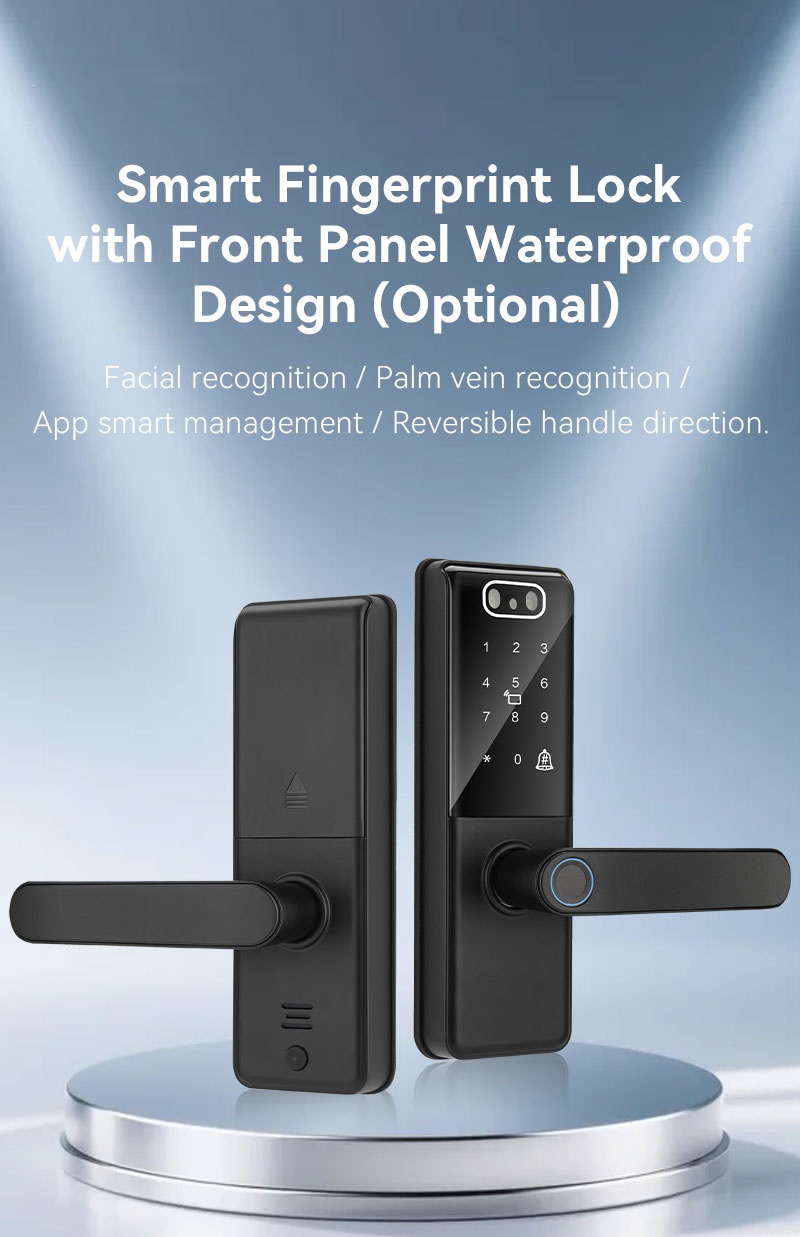
S850MAX 7-in-1 biometric Smart lock with optional front panel waterproof design, Tuya WiFi app control
Why Fingerprint Locks Let People Down
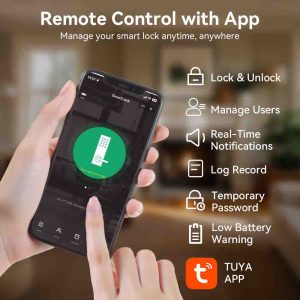
Lock, unlock, manage users and read access logs from the Tuya app anywhere
The failure modes are predictable, and they all come down to the same limitation.
Worn Prints From Real Work
Anyone who handles tools, cooks professionally, gardens, or works with chemicals gradually loses ridge definition. The sensor sees a blur and asks for a second attempt, then a third, and the user learns to carry a key instead.
Sweat, Oil and Dirt
Hands that are damp from carrying shopping, oily from cooking, or dusty from a worksite read poorly even when the print itself is intact. In hot climates this is a daily problem rather than an occasional one.
Dry, Cracked Winter Skin
Cold weather thins and dries the skin, and readers that worked in summer start failing in January. The seasonal complaint is so common that many users assume the lock has deteriorated.
Children and Small Hands
Small fingers barely cover the sensor, and children press inconsistently. A reader that requires precise placement is a reader that children stop using, and a lock they cannot operate is a lock they will not be given responsibility for.
What Palm Vein Recognition Actually Reads
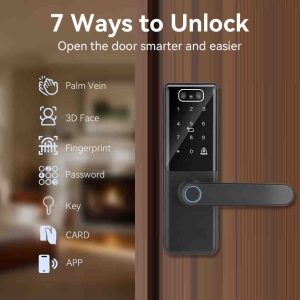
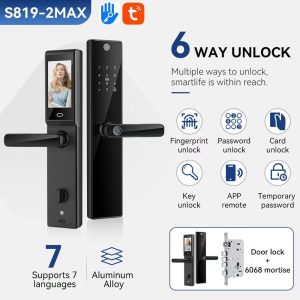
Palm vein, 3D face, fingerprint, password, key, card and app — seven options on one handle lock
The distinction matters because it explains why this approach behaves differently on a bad-hand day.
Under the Skin, Not on It
Near-infrared imaging maps the vein pattern inside the palm. Sweat, dust, oil, peeling skin and minor injuries sit on the surface and are largely irrelevant to that image, which is why the technology is marketed for sweaty, injured, peeling and dirty hands and it genuinely is.
No Contact Required
You hold your hand near the panel rather than pressing a finger onto a plate. Nothing to touch means nothing to leave smudges on, and in a shared hallway it also means the Entry point stays cleaner.
Distance and Placement
Recognition works at roughly 15 to 35 cm, about 5.9 to 13.8 inches, with the palm center facing the sensor. That is natural for an adult at a door; children may need showing once or twice.
Consistency Across Seasons
Because the reading does not depend on surface moisture, the same enrolment keeps working through summer heat and winter dryness. That reliability is the practical argument, more than any specification number.
What Else This Lock Offers
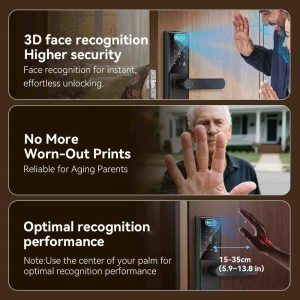
Reads vein patterns under the skin, so sweat, dust and worn fingerprints do not block entry
Palm vein is the headline. The rest of the package decides whether it fits a real household.
3D Face Recognition
A structured face scan allows hands-free entry at a normal standing distance. It is convenient when carrying bags or a child, and 3D imaging is specifically not fooled by a photograph the way older 2D systems were.
Fingerprint and Passcode
The handle carries a fingerprint reader for people who prefer it, and the keypad accepts a numeric code with anti-peeping entry, so digits typed around the real code conceal it from anyone standing behind you.
IC Card, App and Mechanical Key
A card suits a wallet or a school bag. The app handles remote unlocking and guest access. The mechanical key is the fallback for a flat battery or a network outage, and it should live outside the door rather than in a drawer the lock protects.
Built-In WiFi With the Tuya App
The lock connects directly to the home network, so there is no gateway to buy, power or troubleshoot. From the app you can issue temporary passwords with a validity Window, manage users, read the access log and receive unlock notifications.
Alarms That Report Rather Than Ignore
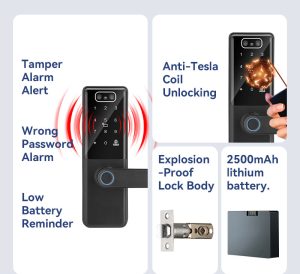
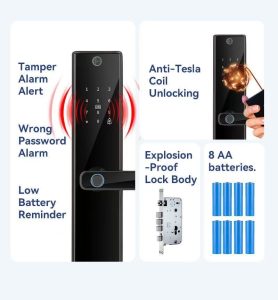
A tamper alarm sounds if the lock is forced or interfered with, a wrong-password alarm responds to repeated failed attempts, and a low battery reminder appears before the battery is actually flat. Those three cover the scenarios people worry about after buying.
2500 mAh and a Reinforced Body
The rechargeable 2500 mAh battery avoids disposable cells, and the lock body is built with an explosion-proof latch design. An anti-Tesla coil defends against electromagnetic unlock attempts, which is a real attack method rather than a marketing phrase.
Reversible Handle
The same unit fits left-handed and right-handed doors without a separate SKU, which removes one of the most common ordering mistakes.
Product Specifications
Attribute
Detail
Product type
7-in-1 biometric smart handle lock
Unlock methods
Palm vein, 3D face, fingerprint, password, IC card, app, mechanical key
A retrofit handle lock is decided by measurements, not by features. Five minutes with a tape measure prevents most returns.
Door Thickness, 35 to 55 mm
Measure the leaf at its edge. Thinner doors cannot seat the spindle properly and thicker ones leave the panel standing off the surface. There is no adjustment that resolves either case.
Door Hole, 38 to 54 mm
This is the existing bore through the door. Outside that range the handle and the internal linkage will not line up, and the fix is a different lock rather than a longer screw.
Backset, 60 to 70 mm
Backset is the distance from the door edge to the center of the spindle. It is the single most commonly mis-measured figure, and it decides whether the latch aligns with the frame.
The Edge Cutout Must Be Chiseled
The lock requires a chiseled lock case opening on the door edge. A door with a plain, non-chiseled edge is not compatible, and that is worth confirming in a photograph before ordering rather than after delivery.
Panel Clearance
The panel is about 63 mm wide and 193 mm tall. On doors with narrow stiles or an existing handle plate, check it fits without overlapping trim.
Where It Fits in Real Life
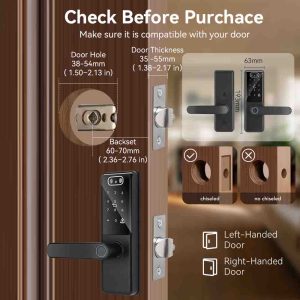
Confirm door thickness, hole size, backset and chiseled edge cutout before ordering
The households that benefit most are not the ones with the newest doors, they are the ones with the most varied hands.
Multi-Generational Homes
Grandparents use palm vein because their prints have faded; teenagers use the app; a child uses a card because the reader is at their height. One lock, four different access methods, no arguments about who gets a key.
Households Where Hands Get Dirty
Gardeners, cooks, tradespeople and anyone coming in from a worksite can open the door without cleaning up first. Sweaty hands after carrying shopping stop being a problem rather than a daily irritation.
Airbnb and Short-Term Rentals
Temporary passwords issued remotely remove the key handover entirely, and the access log answers arrival questions without messaging the guest. Self check-in becomes real rather than approximate.
Small Offices and Studios
Staff are added and removed in the app. A cleaner gets a code valid for a two-hour window, and nobody has to chase a departing employee for a key.
The First Week: Enrolment and Habits
Setup is quick, but a few minutes spent properly saves months of small frustrations.
Enrol Palms Properly
Register with the palm center facing the sensor at the recommended distance, and do it twice per hand if the app allows. Enrolling in the position you will actually use, standing at the door, produces better results than enrolling seated.
Set Up Two Methods Per Person
Give each person a primary method and a fallback: palm vein plus a card, or face plus a code. Redundancy stops one unreadable moment from becoming a lockout.
Test Before the Door Closes
After installation, test every method with the door open, then test again with it closed. The closed-door test is the one that reveals alignment problems, and it is much easier to fix before the household starts relying on the lock.
What It Does Not Do
Stating the boundaries is more useful than lengthening the feature list.
It Will Not Fit Every Door
Doors outside that thickness range, with a non-standard bore, an unusual backset or no chiseled edge cutout need another product.
Remote Features Need Power and WiFi
Palm, face, fingerprint, code, card and key all work locally. Remote unlocking and code issuing need a working network and a charged battery, so the local methods remain the everyday ones.
Recognition Is Positional
Palm vein needs the palm center aligned at the stated distance, and face recognition works best facing the panel squarely. Standing off to the side will disappoint.
It Replaces the Handle, Not the Door
The mortise body stays. This is a retrofit, which is why it is affordable and also why the compatibility check exists.
Who This Smart Lock Suits
Households with older parents whose fingerprints no longer read reliably.
Families with children who need a method that works at their height.
Anyone with sweaty, rough or frequently dirty hands from work or climate.
Landlords and Airbnb hosts who want remote check-in and expiring codes.
Small businesses that add and remove staff access regularly.
Care and Maintenance
Wipe the palm sensor and the face camera window with a soft dry cloth rather than a wet one, since a smeared optical surface is the usual cause of a sudden recognition complaint. Keep the keypad free of grease, avoid abrasive cleaners on the panel, and check the handle mounting every few months for looseness.
Recharge before the low battery reminder turns into a lockout, and keep the mechanical key outside the door rather than inside the house. If the front panel is the waterproof variant and the door faces driven rain, confirm the installation is sealed at the panel edge, because water ingress shortens the life of any outdoor lock. Store the app account details somewhere the whole household can find them, since a single phone should not be the only route to administration.
Is It Right for Your Door?
If your household has ever stood at the door pressing a finger three times while holding shopping, this solves that specific problem rather than adding another gadget. Palm vein reads what does not change, and the other six methods cover everyone who prefers something else.
The limits are the door dimensions, the chiseled edge requirement, and the fact that remote functions need a network while local access does not. Measure first, and the rest is a matter of enrolling hands and issuing codes.
For a home where keys have multiplied and nobody is sure who still has one, this removes a friction point that had become normal. Fit details, the waterproof panel option and the current variant are on the product page.
Frequently Asked Questions
These are the questions that decide most orders.
Does palm vein work with wet or dirty hands?
Yes. It images veins beneath the skin, so sweat, water, dust, oil, peeling skin and minor injuries do not affect recognition the way they affect a fingerprint sensor.
Will it fit my door?
It fits doors 35 to 55 mm thick with a 38 to 54 mm bore, a 60 to 70 mm backset and a chiseled lock case cutout on the door edge. Doors without that cutout are not compatible.
Do I need a gateway for app control?
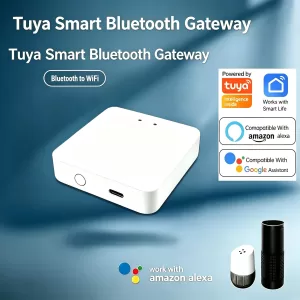
No. WiFi is built in, so the Tuya app connects to the lock directly without additional hardware.
What if the battery runs out?
A low battery reminder appears in advance, the battery is a rechargeable 2500 mAh unit, and the mechanical key opens the door as a backup.
Can children and elderly parents use it?
Yes. Palm vein suits faded fingerprints and small hands, IC cards work at any height, and passcodes remain a fallback.
If you are unsure about your door size or the edge cutout, send a photo with a tape measure in frame and we will confirm before you order.
A physical key is a single point of failure that most households never think about. It can be copied in a minute at a hardware shop, lost permanently on a beach, and handed to a cleaner, a dog sitter or a contractor with no way to take it back. The lock keeps working exactly as it did on the day it was installed, no matter how many copies exist.
A keyless handle lock changes the shape of that problem. Access becomes something you grant and revoke rather than something you hand over, and a record of every entry exists whether or not anyone remembers to mention it.
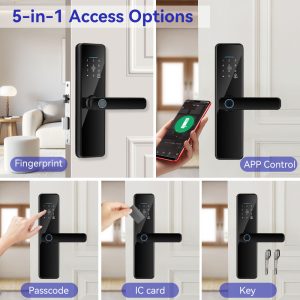
This 5-in-1 model covers the practical middle ground: fingerprint, passcode, IC card, app control and a mechanical key as backup, with built-in WiFi so no separate gateway is needed. It is a retrofit handle rather than a whole-door system, which makes it affordable, and also means the door has to be checked before ordering. Here is what it does well, and what a buyer should confirm first.
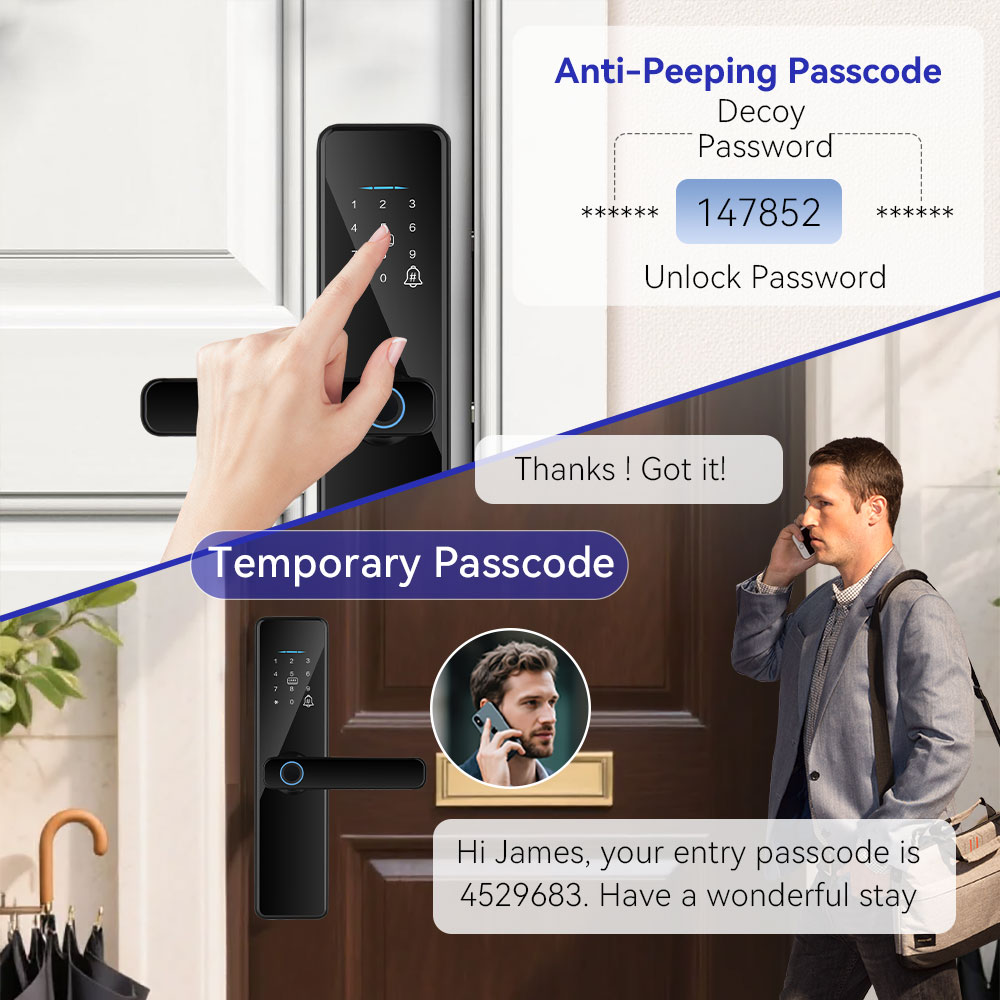
Anti-peeping password and one-time temporary code for guest access
Why the Key Is the Weak Point
Most home security conversations focus on the lock cylinder. The bigger exposure is usually the key itself.
Keys Get Copied and Never Returned
A spare key given to a cleaner, a neighbour or a former tenant is functionally a permanent credential. There is no audit trail, no expiry and no way to revoke it short of changing the cylinder, which almost nobody does.
Handover Is the Friction Point in Short Rentals
Meeting a guest at an inconvenient hour, hiding a key under a mat, or trusting a lockbox with a four-digit combination are all workarounds for the same limitation: a mechanical key cannot be issued remotely. Self check-in exists precisely to remove that dependency.
Nobody Knows Who Came In, or When
A traditional lock records nothing. When something is missing, the conversation becomes guesswork. An electronic lock records each unlock event, which turns a suspicion into a fact.
Lost Keys Force a Cylinder Change
The one moment a key problem becomes real money is the day a key goes missing. Replacing a cylinder and reissuing keys costs more than most people expect, and it usually happens at the worst possible time.
What This 5-in-1 Lock Does
5 unlock modes: fingerprint, App control, passcode, IC card and backup key
Five access methods share one handle, which is why the same device works for a household, a guest and a maintenance visit.
Fingerprint, the Everyday Method
A biometric reader on the handle recognises enrolled fingers in about the time it takes to press down. For family members this becomes the default: no key to carry, no code to remember, no phone to unlock first.
Passcode With Anti-Peeping Entry
The keypad accepts a correct code with random digits typed before and after it, so an observer cannot tell which digits actually matter. That detail matters in a hallway, a stairwell or any doorway Where someone can stand behind you.
Temporary and One-Time Codes
Codes can be created for a defined Window and then expire. This is the feature that makes the lock genuinely useful for rentals, deliveries, cleaners and contractors, because access ends without anyone having to collect anything.
IC Card for Households That Prefer It
Cards Work well for children, elderly family members and anyone who finds a keypad awkward. A card in a wallet does the same job as a fob, without the fingerprint enrolment that some older users dislike.
App Control Over Built-In WiFi
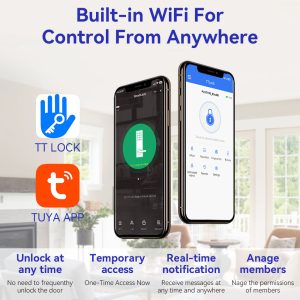
The lock connects directly to the home network, so there is no gateway to buy or power. From the Tuya or TT Lock app you can unlock remotely, issue and revoke codes, set validity periods and read the access history.
Mechanical Key as the Last Resort
A physical key still opens the lock, which matters on the day the battery dies, the WiFi drops or a phone is lost. Electronic convenience with a mechanical fallback is the sensible arrangement.
Anti-peeping virtual digits, temporary and one-time codes
Access management
Add and remove users, set validity periods, view unlock records
Notifications
Real-time unlock alerts in the app
Lock body size
About 270 mm by 65 mm
Door thickness
38 mm to 55 mm, about 1.5 to 2.17 inches
Compatible lock cases
6085, 5572, 4585 and single latch
Backup access
Mechanical key included
Typical use
Front doors, bedroom doors, rentals, small offices
Fit First: The Check Before You Order
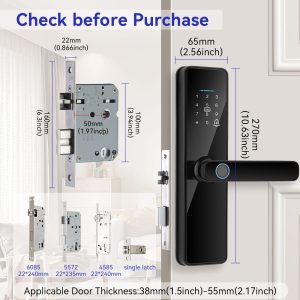
Check door thickness and lock case size before buying this smart handle lock
A retrofit lock is only as good as its compatibility, and this is the step buyers skip. It is worth five minutes with a tape measure.
Door Thickness, 38 to 55 mm
Measure the door leaf at the edge, not at the frame. Below 38 mm or above 55 mm the handle and spindle will not seat properly, and no amount of adjustment fixes a door that is simply outside the range.
Which Lock Case You Already Have
The lock replaces the handle and the electronics, not the mortise body inside the door. It is built around the 6085, 5572 and 4585 patterns and single latch doors, so the existing case determines whether it drops in or needs work.
Measure the Backset and the Face Plate
Backset is the distance from the door edge to the centre of the spindle, and the face plate dimensions decide whether the new body sits flush. Photograph the existing lock with a tape measure beside it; that is the fastest way to confirm fit before ordering.
Who Should Install It
Replacing a handle on a matching case is a straightforward job for a confident DIYer with a screwdriver. Replacing the mortise body, cutting a new face plate opening or working on a steel security door is a job for a locksmith, and it is worth saying so plainly.
Where It Fits in Real Life
Built-in WiFi, manage your smart lock anywhere via Tuya or TT Lock App
The same device serves quite different households, for different reasons.
Primary Home Front Door
Family members use fingerprints, guests get a temporary code, and nobody carries a key on a run. The mechanical key stays in a drawer for the day it is needed.
Airbnb and Short-Term Rentals
A code issued for the length of a stay, expiring at checkout, removes the key handover entirely. Self check-in becomes genuinely possible, and the access log answers questions about arrival times without contacting the guest.
Small Office or Studio
Staff get fingerprints or cards, a cleaner gets a code limited to a time window, and departing employees are removed from the app rather than asked to return a key.
Households With Children and Older Relatives
An IC card in a school bag or a purse works without a phone or a memorised code. That is often the deciding factor for multi-generational homes.
Shared Flats and Managed Properties
Where several people need access and the landlord is not nearby, remote code issuing avoids the round trip of collecting and delivering keys.
Living With It Week by Week
Once installed, the routine is mostly about managing people rather than operating a lock.
Issuing Access Takes Seconds
Enrolling a fingerprint at the door takes under a minute. A temporary code takes about the same, and it can be sent by message rather than explained over the phone.
Revoking Access Is the Real Benefit
Deleting a user or letting a code expire is the moment the lock earns its price. No key to reclaim, no cylinder to change, no awkward conversation.
Reading the Log Settles Arguments
The app shows which method opened the door and when. For a rental, that answers late-checkout questions; for a household, it answers who left the door unlocked.
What Happens When the Network Drops
Fingerprint, passcode, card and key all work locally, without WiFi. Remote unlocking and code issuing need connectivity, so the local methods remain the everyday ones and the app is the management layer.
What It Does Not Do
Honest limits are more useful than a longer feature list.
It Is a Handle Lock, Not a Full Door System
It replaces the handle and adds electronic access; the mortise body stays. Buyers expecting a complete lock replacement, or a door with no existing cutout, need a different product.
Fingerprints Need a Reasonable Finger
Very dry skin, worn prints from manual work, or a bandaged finger will read inconsistently. Those users are better served by a card or a code, which is why both are included.
Remote Features Need Power and WiFi
The lock still needs a working battery and a network for app functions. Treat the mechanical key as part of the system rather than an afterthought, and keep it somewhere you can reach from outside.
Who This Smart Lock Suits
Landlords and Airbnb hosts who want remote check-in and expiring guest codes.
Families who would rather not carry keys or hand spares to every visitor.
Households with older relatives or children who do better with a card than a keypad.
Small businesses that need to add and remove staff access cleanly.
Anyone replacing a handle whose door already matches 6085, 5572, 4585 or a single latch.
Care and Maintenance
Keep the fingerprint sensor clean and dry, and wipe it with a soft cloth rather than a wet one; a smeared reader is the most common cause of a “fingerprint stopped working” complaint. Clean the keypad lightly, avoid abrasive cleaners on the finish, and check the handle for looseness every few months, tightening the mounting screws if the body starts to shift.
Watch the battery indication in the app and replace cells before they run flat rather than after. Keep the mechanical key outside the home, not inside a drawer that the lock protects, and store the app account credentials somewhere the household can find them. If the door is exposed to heavy rain, confirm the installation is sealed properly at the face plate, since water ingress rather than electronics is what usually shortens the life of an outdoor lock.
Is It Right for Your Door?
If the reason you are looking at a smart lock is keys, guests and not knowing who came in, this covers all three in one handle. Five access methods mean nobody in the household has to adapt to a single way of entering.
The limits are worth repeating: it retrofits onto specific lock cases and a 38 to 55 mm door, it is not a complete door replacement, and the remote features depend on WiFi while local access does not. Measure first, and the rest is straightforward.
For a rental that needs self check-in, or a home that has been carrying too many spare keys, the change is mostly about removing a friction point that had become normal. Fit guidance, the compatible lock case list and the current variant are all on the product page.
Frequently Asked Questions
These are the questions that decide whether an order goes ahead.
Do I need a separate gateway for WiFi?
No. The lock has built-in WiFi and connects directly to the home network, so remote control works through Tuya or TT Lock without extra hardware.
Will it fit my existing door?
It fits doors 38 to 55 mm thick with a 6085, 5572, 4585 or single latch lock case. Measure the door edge thickness and photograph the existing face plate before ordering.
Can I give a guest a code that expires?
Yes. Temporary and one-time codes can be created with a validity window, so access ends at checkout or at the end of a scheduled visit without anyone collecting a key.
What if the battery dies or the WiFi is down?
Fingerprint, passcode, card and the mechanical key all work without a network. Keep the backup key somewhere reachable from outside the door.
How many fingerprints can I add?
Capacity varies with the app version and is shown during setup. For a normal household, one or two prints per person plus a card each is the practical arrangement.
If you are unsure which lock case your door uses, send a photo of the existing handle and face plate and we will confirm before you order.
If one cat is getting fat and the other is staying thin, the Feeder is almost never the problem — the feeding arrangement is. Free feeding lets whichever cat guards the bowl eat more, and a standard timed feeder does not fix that, because it still cannot tell which cat is eating.
Why the bowl arrangement matters more than the feeder
Free feeding rewards the pushy cat. Dry food left out all day goes to whoever defends it.
A single timed feeder is still a single bowl. The fast cat finishes its portion and eats the other’s share.
Portions on the bag are maintenance averages, not weight-loss targets. They assume an average, neutered, indoor cat — not your two cats.
Four routes, in order of how well they actually work
Approach
How it works
Trade-off
Feed in separate rooms
Two meals, two closed doors, 20–30 min each
Most reliable, needs two people or a routine
Microchip or RFID selective feeder
Lid opens only for the registered cat
Real selective feeding; collars go missing, needs a settling-in period
Timed feeder with two bowls
Drops both portions at once
Simple, but does not stop food stealing
Slow feeder bowl
Shape slows eating speed
Helps gulping, not portion theft
Important safety note on getting a cat to lose weight
Do not simply halve the food. Cats that lose weight too quickly are at real risk of hepatic lipidosis, a serious liver condition. Get a target daily calorie figure and a safe rate of loss from a vet before changing the amount, then weigh weekly and score body condition rather than judging by eye.
Getting the portions right
Work from calories, not cups. Wet food is bulky but low in calories per gram, which is why it is usually the first lever for an overweight cat.
Split the daily amount into more, smaller meals — cats that beg are usually cats that get one or two big meals.
Keep the thin cat’s food out of reach rather than increasing it; an underweight cat may have a dental or thyroid issue worth checking.
Recheck after four weeks. Adjust by small amounts, not big ones.
Frequently Asked Questions
Will an automatic feeder stop one cat from eating the other’s food?
Not on its own. A standard feeder dispenses into an open bowl. You need either physical separation, or a feeder that only opens for a specific microchip or collar tag. Why Cameras Miss Faces but Doorbells Don’t
Is wet food or dry food better for weight control?
Wet food is generally better for an overweight cat because it delivers fewer calories per gram and adds water. It also spoils faster in a feeder, so Check how long the bowl can safely sit out. 4-Inch Tuya Smart Control Panel: What It Replaces
How fast should an overweight cat lose weight?
Slowly, and under veterinary guidance — rapid loss is genuinely dangerous for cats. Your vet should set the target rate based on current weight and body condition score. Smart Door Lock Buying Guide: Fingerprint vs Keypad
Do microchip feeders work for all cats?
They work well for most cats, but there is an adjustment period, some cats are wary of the lid mechanism, and collar-mounted tags can be lost. Keep the old routine available for the first week.
How many meals per day should cats get?
Many cats do better on three to four small meals than on one or two large ones, and it reduces begging. Match the total to the calorie target rather than the number of meals.
Can I use one feeder for two cats?
Yes, using a dual-bowl unit — but understand that it manages timing, not access. If one cat steals food, a dual bowl will not stop it.
What if a cat has a medical diet?
This is where selective feeders earn their cost, because a prescription diet must not be eaten by the other cat. Confirm the lid seals reliably before relying on it.
How do I track progress?
Weigh on the same kitchen or baby scale weekly, record it, and use a 9-point body condition score alongside the number. The scale alone can mislead when muscle mass changes.
Window cleaning fails for a reason that has nothing to do with effort. You spray, you wipe, and then the water has to go somewhere. It runs down the pane, pools on the sill, drips onto the frame, and leaves a drying edge that turns into a streak within minutes. So you go back with a dry cloth, and the cloth leaves lint, and the whole thing starts again.
The missing step is removal. Not wiping harder, not using a better cloth, but taking the dirty water off the glass instead of pushing it around. That is what a window vacuum does, and it is the reason professional cleaners carry one.
This cordless model combines the three stages in one tool: a spray bottle with a microfibre pad to loosen and wipe, a squeegee blade to collect, and suction to pull the water into a 150 ml tank. It runs on a 2200 mAh battery, so there is no cord trailing through a wet floor. Here is how it works, where it surprises people, and where a Small tank sets the practical limit.
Window cleaning is easier with this cordless Electric window squeegee vacuum
Why Windows Are the Chore Nobody Finishes
Most people do not skip window cleaning because they are lazy. They skip it because the process has too many steps that can go wrong.
The Water Has to Go Somewhere
Spray and wipe leaves a film of water on the glass. Gravity takes it down to the frame, where it collects dust and forms a brown line, or onto the sill, where it needs a cloth. Neither of those is the part anyone signed up for.
Cloths Leave What They Cannot Absorb
A microfibre cloth holds a surprising amount, but once saturated it starts redistributing water rather than removing it. That is why the second pass often looks worse than the first, and why wiping in a circular motion produces the swirl patterns people blame on the cleaner.
Reach Is the Other Problem
Upper panes, balcony glass and car windows all Sit at awkward heights. Stretching with a cloth means less control at exactly the point where control matters, and a ladder adds a safety consideration that most households reasonably avoid.
The Car Is Its Own Case
Car glass is worse than house glass because it is raked at an angle, so every drop slides rather than sitting. Cleaning a windscreen with a cloth and a spray bottle is a twenty-minute job that usually ends with visible smears at eye level.
What This Cordless Window Cleaner Does
Three functions, one handle. Each one addresses a specific point where the manual method fails.
Spray, Then Wipe
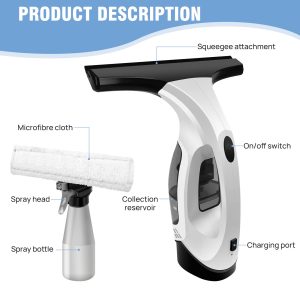
Wipe the glass surface first with the included spray bottle and microfibre cloth pad
The kit includes a spray bottle with a microfibre pad attached, so you wet the glass and wipe the loosened dirt in one motion without switching tools. The pad does the scrubbing that removes the film; the spray does the dissolving.
Squeegee Blade for Collection
A wide rubber blade pulls the remaining water into a single edge instead of spreading it. That is the difference between a surface that dries clear and one that dries with a dozen drying lines.
Suction That Removes Rather Than Relocates
The vacuum picks up the water the blade collects and stores it in the tank. Strong suction matters more than it sounds: without it, the blade just pushes a puddle to the bottom of the pane, and the last ten centimetres are always the messiest.
2200 mAh, No Cord
Multi-function electric window cleaner with strong suction, 2200mAh battery and 150ml dirty water tank
A cordless body means you can work on a balcony, around a car, or up a pane without unplugging and re-plugging. The 2200 mAh battery is sized for a normal cleaning session rather than a whole building, and charging is by a standard port on the body.
150 ml Dirty Water Tank
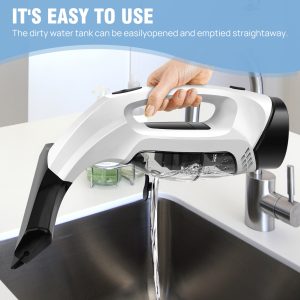
The collection reservoir is 150 ml, which is enough for a set of windows or a car’s worth of glass. It opens and empties in one motion over a sink, with no disassembly and no need to touch the contents.
Indoor and Outdoor Use
Works perfectly on car windows, mirrors, shower screens and home glass surfaces
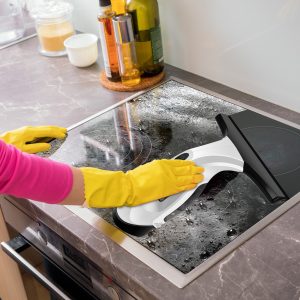
The same tool handles interior panes, exterior panes from inside a balcony, shower screens, mirrors, and flat glass surfaces like a ceramic hob. One device replaces a spray bottle, a cloth, a squeegee and a towel.
Spray, wipe with microfibre pad, then vacuum and squeegee
Battery
2200 mAh, cordless operation
Charging
Built-in charging port on the body
Dirty water tank
150 ml collection reservoir
Tank emptying
Opens and drains directly, no tools required
Cleaning head
Rubber squeegee blade with vacuum intake
Included accessories
Spray bottle, spray head, microfibre cloth pad
Controls
Single on and off switch on the handle
Application
Indoor and outdoor glass, mirrors, shower screens, car windows, flat hob glass
Handling
Single-hand grip, no cord to manage
Water contact
Tank and blade handle dirty water; the motor body stays dry
Where It Works Beyond Windows
The window is the obvious case. These are the ones people discover afterwards.
Shower Screens and Mirrors
Shower glass collects the same mineral film as windows, and bathroom mirrors collect toothpaste spray. Both are flat, both are vertical, and both dry with visible marks when left to Air. A vacuum pass leaves them clear without a towel.
Car Windows and Windscreens
The rake of a windscreen makes cloth cleaning awkward. A squeegee with suction lets you pull water down and away in overlapping passes, including the corners that a cloth never quite reaches. It also handles the inside of the glass, where condensation film builds up.
Ceramic and Induction Hob Glass
It’s easy to use, quickly open and empty the dirty water tank after cleaning
Flat black glass shows every smear. After cleaning, a squeegee pass removes the residue and the water together, which is faster than buffing with a cloth and leaves no lint behind.
Balcony and Partition Glass
Balcony doors, glass partitions and sliding panels are tall, awkward and often cleaned from an angle. Cordless operation matters here because there is rarely an outlet nearby and a cable across a wet floor is the last thing anyone needs.
How to Get a Streak-Free Finish
Versatile glass cleaner works on smooth ceramic cooktop surfaces
The tool does the work, but the sequence determines the result. Four habits make the difference.
Spray Less Than You Think
A Light, even mist is enough. Overspraying creates more water than the tank can take in one pass and forces you to go back over the pane, which is exactly the inefficiency the tool is meant to remove.
Wipe With the Pad Before Vacuuming
The microfibre pad loosens and lifts the dirt; the vacuum removes the water. Skipping the wipe means the blade drags dirt along the glass and leaves a fine line of it at the end of the stroke.
Overlap Each Pass, Blade Slightly Angled
Work top to bottom in overlapping strips, keeping the blade edge contacting the glass and the nozzle behind it. A slight angle lets the water collect at the edge rather than escaping around the sides.
Empty the Tank Before It Fills
Once the reservoir approaches full, suction drops and water starts to trail. Emptying it between windows takes a few seconds and prevents the one failure that looks like a product fault but is really just a full tank.
Three Mistakes That Cause the Streaks
Clean home sliding windows effortlessly with this lightweight cordless window cleaner
Most complaints about glass cleaning come down to technique rather than product. Three habits account for the majority of it.
Cleaning in Direct Sunlight
Sun heats the glass and dries the cleaning solution before the blade reaches it, which leaves the dissolved dirt sitting on the surface as a haze. Work on shaded glass, or on an overcast day, or clean early before the sun reaches the pane.
Circular Motion With a Cloth
Circular wiping redistributes water and creates the swirl pattern that shows up at a low angle. Straight, overlapping passes in one direction move the dirt toward the edge instead of around the pane, and the vacuum finishes the removal.
Using Too Much Solution
More liquid does not clean better; it just takes longer to remove and exceeds what the tank can hold in one pass. A light mist and a second wipe with the damp pad is usually enough for anything short of building dust.
Who This Window Cleaner Suits
Product parts introduction: squeegee attachment, collection reservoir, spray bottle and microfibre cloth
Households with large or balcony windows that are cleaned rarely because the process is tedious.
Car owners who want clear glass without a spray-and-scrub routine.
Renters and flat dwellers with shower screens and mirrors that show every mark.
Anyone cleaning glass at height who would rather reach with one hand than climb.
People with grip or shoulder limits for whom a wet cloth and a towel is genuinely tiring.
Care and Maintenance
After each session, empty the tank, rinse it, and let it dry before replacing it. Wipe the squeegee blade with a damp cloth and check that no grit is trapped under the edge, since a single grain will scratch glass with every pass. The microfibre pad should be washed by hand or on a gentle cycle without fabric softener, which coats the fibres and reduces their ability to absorb.
Keep the motor body dry. The tank and blade are designed to handle dirty water; the handle and charging port are not, so do not rinse the whole unit under a tap or leave it standing in a puddle. Charge it with the port dry and the unit at room temperature, and store it upright so any residual water drains rather than sitting against the seals. If suction weakens, check the tank seal and the intake for lint before assuming the battery is at fault.
Is It the Right Tool for You?
If the reason your windows stay dirty is the drips, the towels and the second pass, this removes all three. Spray, wipe, vacuum, done, with the dirty water ending up in a tank instead of on your sill.
The honest limits: a 150 ml tank means larger jobs need emptying partway through, so a full house of windows is a session with a couple of breaks rather than one continuous sweep. It cleans glass and flat hard surfaces, not deep sills, frames or textured finishes. And it is a wet-use tool, so the motor body still needs to be kept out of the water it is collecting.
For a home with glass that gets noticed, or a car that never looks clean for long, the time saved per session is the whole argument. Battery details, tank capacity and the current accessory set are on the product page.
Frequently Asked Questions
These are the questions buyers ask before their first order.
Does it need to be plugged in while working?
No. It runs on an internal 2200 mAh battery and charges through a port on the body, so it works anywhere without a cord. Plan a charging session between larger cleaning days.
Will it work on car windows?
Yes, including windscreens and side glass. Work in overlapping passes from the top down, and empty the tank before it fills so suction stays consistent on the last strokes.
How much water does the tank hold?
150 ml. That covers a set of windows or a car, but a large job may require emptying it once or twice, which takes only a few seconds.
Can I use it on a hot hob?
Only once the surface has cooled. Cleaning a hot ceramic hob with water is both ineffective and unsafe, so let it cool first and then clean as you would any flat glass surface.
What happens if suction drops?
Check three things in order: whether the tank is full, whether the tank seal is seated properly, and whether lint or grit is blocking the intake. Those account for almost every case of weak suction.
If you are unsure whether it suits the glass surfaces in your home, send us a photo or a description and we will tell you before you order.
Two Smart switches can look identical on a shelf and behave completely differently once a client replaces the lamps. The difference is not the radio or the touch panel — it is how the output stage handles the load, and specifically how it handles LED loads, which draw badly non-sinusoidal current at a fraction of the wattage the switch was designed around.
The DS-121JL publishes its LED limit separately from its incandescent limit, and that is the number a buyer should actually plan against. This article explains the rating, why the two figures differ so much, and how to lay out circuits so a four-gang plate does not end up flickering in a finished building.
The rating, stated plainly
The detail page gives: Voltage AC 220-240 V / 50 Hz, max load 10-400 W per gang INC and 5-200 W per gang LED, with Wi-Fi + BLE wireless and CE / RoHS marking. The 118 × 72 × 39 mm vertical format and 1-4 gang options are shared with the rest of the 118-type platform.
DS-121JL — 220-240 V input with separate INC and LED load ratings per gang.
Neutral required / single live wire with bypass capacitor
Terminals
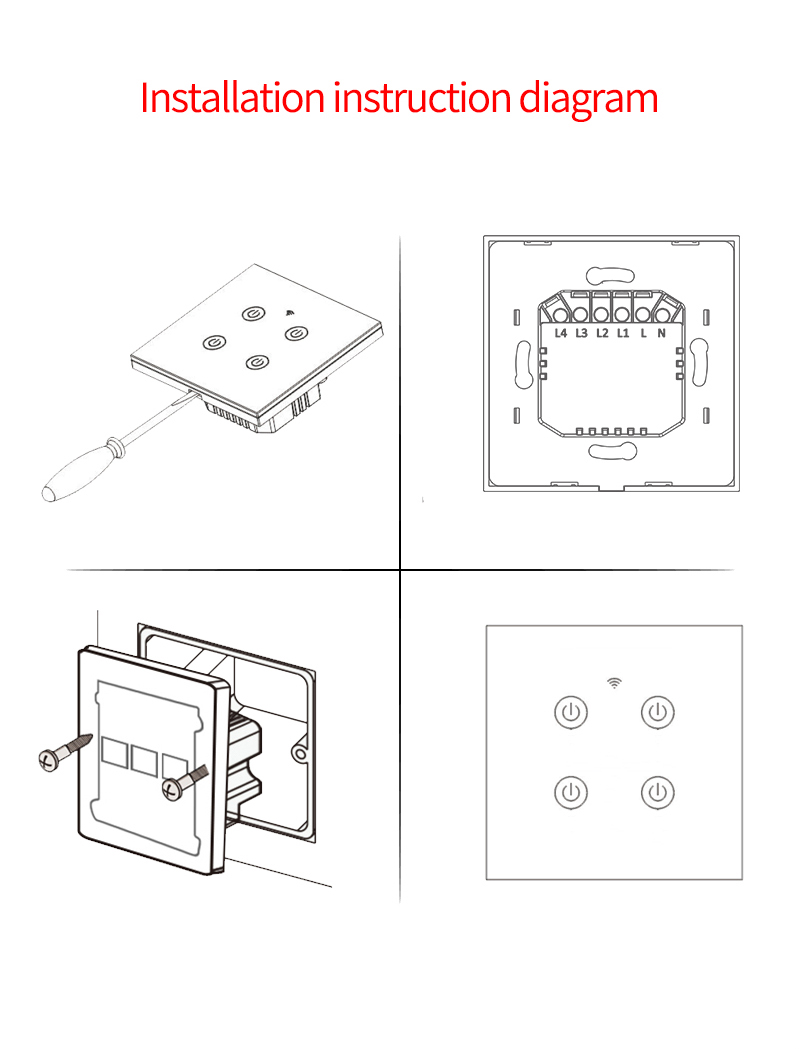
L1, L2, L3, L4, L, N
Colours
White / Black / Champagne gold
Certification
CE, RoHS
Why the LED figure is roughly half the incandescent figure
Incandescent and halogen lamps are close to resistive: current follows voltage, and a 400 W lamp draws a predictable current at 230 V. LED lamps are not resistive. They rectify the mains, draw current in short pulses near the voltage peaks, and rely on a driver or an integrated capacitor to smooth the result. The consequences for a switching device are:
Peak current is much higher than the average suggests. A 100 W LED group can present peak currents a 400 W resistive rating was never sized for.
Harmonics and reactive current add heat in the output stage and the neutral, which is why the manufacturer publishes a lower ceiling rather than a conversion factor.
Low loads are their own problem. Below the stated 5 W per gang, leakage in a Smart switch standby circuit can be enough to make lamps glow faintly when off.
So the LED number is not a conservative marketing reduction. It is the practical rating for the load type, and it should be used as the design limit whenever LED is involved.
Rating block as printed on the detail page: 220-240 V / 50 Hz, 10-400 W INC, 5-200 W LED.
Circuit planning: five rules that hold up on site
1. Budget LED circuits at 200 W per gang, not 400 W
If a four-gang plate runs 200 W of LED per gang, the plate is at its LED limit. Mixed circuits — some LED, some halogen — must be rated by the LED rule, because the LED part of the load is what drives the peak current.
2. Split large lighting groups across gangs
A 480 W LED bank on one gang exceeds the limit; split across three gangs it does not. Because the four-gang unit has four independent outputs, the fix is usually a wiring decision at design stage rather than a different product.
3. Above 200 W per circuit, switch a contactor
Retail floors, warehouse bays and exterior lighting banks routinely exceed 200 W of LED per circuit. Use the smart switch to drive a contactor coil and let the contactor carry the load. The switch then handles a coil rather than a lamp bank and the rating question disappears.
4. Keep lamp types consistent within a group
Mixing an integrated LED downlight and a driver-based retrofit on the same switched circuit makes flicker diagnosis almost impossible. Standardise lamps per circuit and record the model in the handover file — the single most effective measure for reducing warranty claims.
5. Watch the low end as carefully as the high end
Below 5 W per gang, a lamp may not draw enough to keep the electronics stable, particularly in single-live-wire mode. One 5 W lamp on a gang is a specification to test, not to assume.
Distribute LED load across gangs — four independent outputs, each rated 5-200 W LED.
Single live wire or neutral, on a 220-240 V site
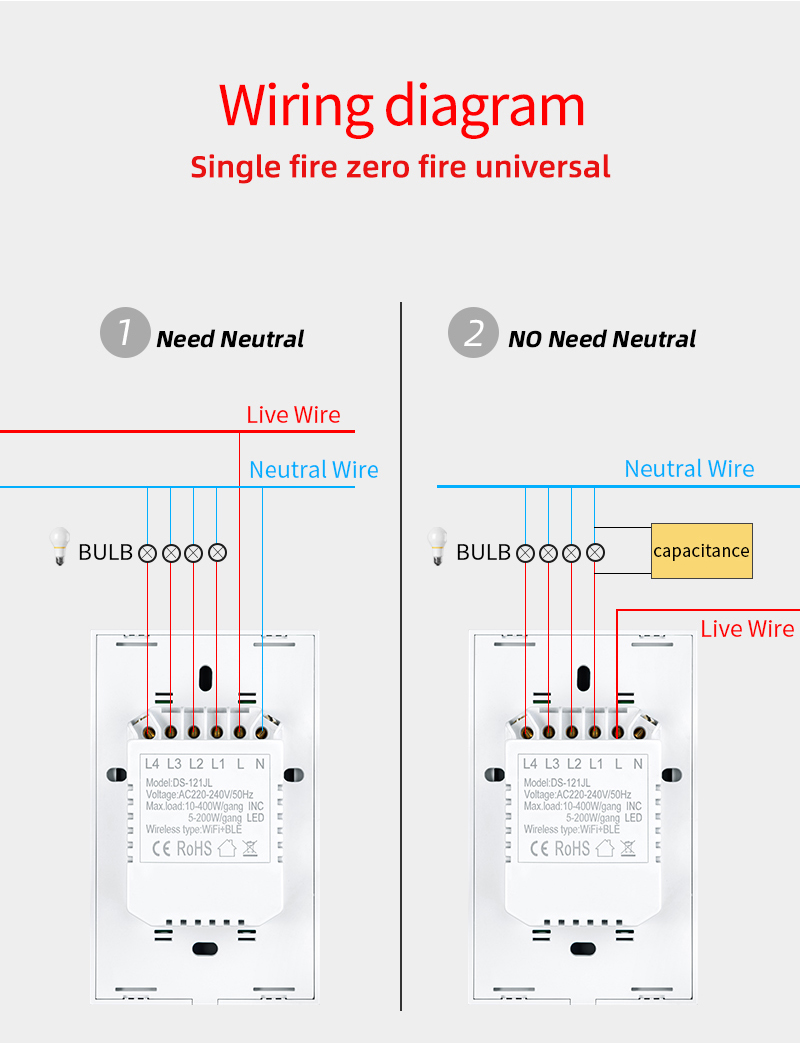
The JL platform is documented as single fire zero fire universal: it can be wired with a neutral, or without one using a bypass capacitor across the load. On 220-240 V markets the single-live-wire route is common in older housing where the neutral is looped at the ceiling.
Where LED lamps are involved, the single-live-wire mode deserves extra care. The standby current needed to keep the switch alive flows through the lamp, and a low-wattage LED driver may interpret that trickle as a signal rather than a nuisance — visible as a faint glow or a slow flash at night. If the site is LED throughout, neutral mode is the safer specification wherever a neutral exists.
Both wiring modes on one SKU — neutral connection, or single live wire with capacitor.
Markets this SKU is built for
The 220-240 V input with a 118-type vertical plate is the combination used across much of the Middle East, South-East Asia, South America and parts of Africa, where the 118 opening is standard but the supply is European-style. Specifying a 120 V-rated product into those projects is a common and expensive mistake; the JL variant is the correct part number there.
118 × 72 × 39 mm — the vertical format used across 220-240 V markets with 118 openings.
Applications
Hospitality refurbishment in 220 V markets
Guest rooms typically have four lighting groups — entrance, bedside, desk and bathroom — and almost always on LED. Four gangs at 200 W LED each is comfortably above a typical room load, with margin for future lamp changes.
Residential LED retrofit
Replacing halogen downlights with LED drops the load by a wide margin, which is exactly when users discover that their old switch was fine and their new one flickers. Rating the circuit by the LED figure at design stage avoids that conversation.
Finish options — white, black and champagne gold across the 118-type range.
Restaurants and retail frontage
Track lighting and display lighting are almost entirely LED and often exceed 200 W per circuit. Split the circuits, or drive a contactor from the switch and keep the smart control at the wall.
Glass touch panel and housing — the finish buyers verify at sample approval.
OEM / ODM and documentation
Private label runs on the standard 118-type glass housing: laser-etched logo, custom retail box, multilingual manual and neutral packaging for online sellers. Alongside the goods, ask for these documents — they are what an electrical contractor will want on site:
CE and RoHS declarations for the 220-240 V variant
The two wiring diagrams (neutral / single live wire) in the destination language
Bypass capacitor specification and recommended quantity
Lamp compatibility guidance for the LED range
Certification and rating page supplied with the quotation pack.
Ask us before you commit the circuit
Send us the lamp schedule — wattage per circuit, lamp type, driver or integrated, and whether a neutral is present at each drop. We will tell you whether the DS-121JL stays within rating for each circuit or whether the load should be split or contactor-switched, and we will quote against the gang mix the project actually needs.
Request DS-121JL quotation, LED compatibility sheet and a sample → include your destination market and per-circuit lamp wattage, and we will confirm the suitable part number in the same reply.
Is Smart Switch Led Load Compatibility worth buying?
Based on the breakdown in this article, Smart Switch Led Load Compatibility offers a solid mix of features and value. If your main goal matches the key benefits described above, it is a practical choice for everyday use.
How do I choose the right smart switch led load compatibility for my needs?
Start with your core use case, then compare battery life, compatibility, and build quality as covered above. Choosing the right smart switch led load compatibility comes down to matching specs with how you actually use it.
Does smart switch led load compatibility require a companion app?
Most devices of this type pair with a free companion app for setup and firmware updates. A few advanced features may sit behind a paid plan, so check the official specs page before buying.
📌 This article is part of our Complete Smart Hub — more guides and buying tips inside.
Vertical 118-type Wall plates are the workhorse of commercial lighting in North America and in a number of markets that adopt the same opening. The format exists because it gives you a tall, narrow canvas — enough real estate for four Switch keys plus an indicator, on an opening already cut into millions of walls.
The DS-121BW is a 118-type Touch switch with Wi-Fi and BLE, offered in 1- to 4-gang configurations, with a wide-range 100-240 V input and a 600 W per gang rating. This article is about the part of the decision that datasheets do not cover: how many zones you can sensibly put on one plate, and where a four-gang vertical unit beats four single switches.
Product overview
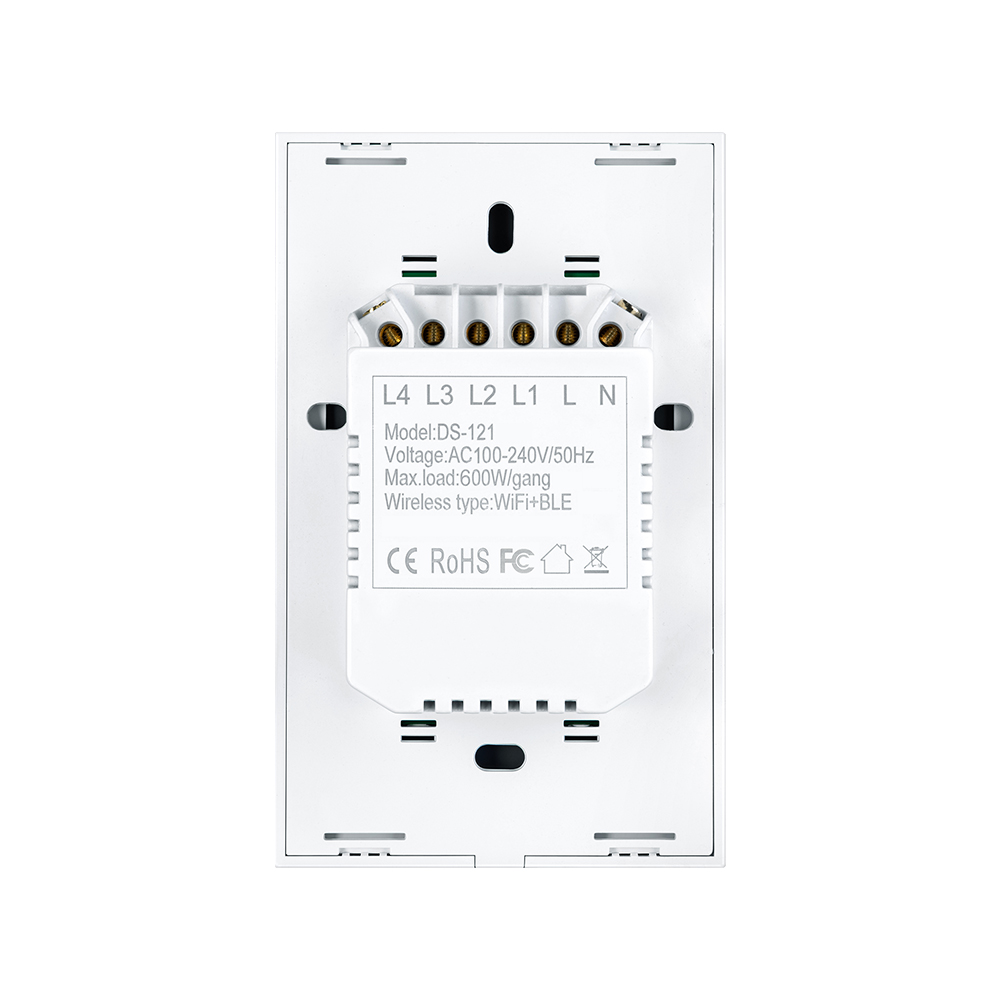
The faceplate measures 118 × 72 mm with a body depth of 39 mm. Four capacitive touch keys sit under a tempered Glass front, each switching an independent circuit. The rear terminal block carries L4, L3, L2, L1, L and N — four switched outputs plus a permanent live and a neutral, which is what makes a true four-circuit unit possible on a single plate rather than four separate devices sharing one feed.
DS-121BW — 118 × 72 mm vertical format, one to four gangs, glass touch front.
A four-gang 118-type unit replaces four single switches. That is not only a device-cost calculation — it is a labour and wall-space calculation, and on commercial fit-outs labour is usually the larger number.
One box, one cable pull, four zones
Four separate switches require four boxes and, in new work, four cable runs from the ceiling. A single four-gang plate concentrates the switching points at one location and pulls one multi-core cable to the ceiling junction. On a restaurant floor plate or a classroom block, that difference compounds across dozens of positions.
Scene logic becomes possible
Four circuits on one controller means the app can drive combinations rather than individual keys: all-on for cleaning, perimeter-only for security lighting, task-only for close-down. With four independent devices this has to be stitched together at the automation layer; here it is native.
Wall space on narrow piers
Retail and hospitality interiors frequently have narrow structural piers between glazing where a bank of horizontal switches will not fit. A vertical 118-type plate occupies the pier and keeps the design language clean.
Rear terminals: four switched outputs (L1–L4) plus permanent live and neutral.
Wide-range input and what it means in practice
The 100-240 V, 50/60 Hz input means the same part number can be stocked for North American 120 V circuits and for 220-240 V markets without a second SKU. For a distributor serving both, that halves the SKU count on the shelf and removes a common picking error in mixed orders. Confirm the destination market requirement during quotation — certification scope, not the electrical range, is usually what decides whether one part number can serve two regions.
Dimension drawing — 118 × 72 mm faceplate, 39 mm body depth.
Applications
Open-plan office zoning
Four lighting groups per plate — for example perimeter, task, circulation and meeting — maps onto how open floors are actually lit today. Scheduling in the app handles morning and evening transitions without touching the wiring.
Restaurants, cafés and bars
Front-of-house lighting changes several times a day. Scene control from one plate lets staff switch between service, close-down and cleaning modes on a single tap instead of hunting for four separate keys behind a banquette.
Four zones per plate — perimeter, task, circulation and meeting lighting.
Schools and training rooms
Classroom lighting is usually split between general, board and projector circuits. A four-gang plate puts all of them at the door, with the projector circuit available for a schedule override.
Residential multi-gang replacement
In apartments with tall 118-type plates at the entrance, a single four-gang unit replaces the original bank of rockers without altering the opening — the fastest possible upgrade path in occupied buildings.
Rear view — terminal block orientation to check against existing cable routing.
Load planning rules that prevent callbacks
600 W per gang is per output, not per plate. A four-gang unit fully loaded is 2,400 W of switching on a single 39 mm body. Distribute heavy circuits across gangs rather than stacking them.
Resistive loads are the easy case. Tungsten and halogen loads draw what their rating says. Motor loads, drivers and anything with high inrush need a contactor.
Keep a spare gang on the plan. Four gangs fill up fast once signage, exterior and feature lighting are added. Specify the four-gang version even when three are needed today.
Neutral is required. The BW platform is neutral-referenced. Confirm N at every drop during survey.
Commissioning and control
Pairing runs over BLE locally, then the device joins the site 2.4 GHz Wi-Fi. Alexa and Google Assistant integration comes after account linking, and multi-user sharing covers facilities and cleaning staff. On a phased fit-out, local BLE commissioning lets rooms be completed before network handover — which is normally the critical path on a commercial programme.
Voice and app control across the full gang range.
OEM / ODM for private label
The 118-type glass housing takes laser-etched logos and custom retail packaging without new tooling. For distributors launching a private label, the practical package is: branded glass front, custom box, multilingual manual, neutral pack for e-commerce, firmware configured to your app ecosystem. Private mould shapes are quoted separately and make sense only above a volume threshold — the standard housing is almost always the faster first order.
Glass faceplate and PC housing — the build detail buyers inspect at sample stage.
Datasheet confirmation
Before a tender response is submitted, request the gang-specific datasheet for the exact SKU you are quoting. Ratings, terminal count and depth are consistent across the range, but certification scope differs by market and must match the destination, not the platform.
Rating table as printed on the detail page: 100-240 V AC, 50/60 Hz, 600 W per gang.
Get a quote
Tell us the gang split you need per position, the number of switch points, the destination market and the certification set required. We will return SKU-level pricing, the datasheet for each gang count, and a sample. Orders that combine the 118-type range with the 86 mm EU range can be consolidated into one shipment.
Request DS-121BW quotation and sample → include your zone schedule (how many 2-, 3- and 4-gang positions) and we will quote against it directly.
Based on the breakdown in this article, 118 Type Smart Switch offers a solid mix of features and value. If your main goal matches the key benefits described above, it is a practical choice for everyday use.
How do I choose the right 118 type smart switch for my needs?
Start with your core use case, then compare battery life, compatibility, and build quality as covered above. Choosing the right 118 type smart switch comes down to matching specs with how you actually use it.
Does 118 type smart switch require a companion app?
Most devices of this type pair with a free companion app for setup and firmware updates. A few advanced features may sit behind a paid plan, so check the official specs page before buying.
📌 This article is part of our Complete Switch Hub — more guides and buying tips inside.
Ask any installer in Europe what stops a Smart switch retrofit and you will get the same answer: there is no neutral in the switch drop. In most of the continent’s older housing stock the switch box carries a switched live and nothing else — the neutral is looped at the ceiling rose or the junction box, not at the wall. A neutral-referenced smart switch simply cannot be fitted there without pulling new cable.
The DS-101JL is the answer to that specific objection: a 1- to 4-gang 86 mm Touch switch that can be wired either with a neutral or, using a bypass capacitor across the load, on a single live wire. This article explains the two wiring modes, the limits of the single-live-wire approach, and how to qualify a site before ordering.
Two wiring modes on one device
The rear terminal block is marked L4, L3, L2, L1, L, N. In neutral mode, L is the permanent live and N is connected to the neutral conductor. In single-live-wire mode, N is left unconnected and the device draws its standby current through the load, with a capacitor fitted across the lamp to provide a return path.
Wiring diagram — the same device supports a neutral connection or a single-live-wire feed.
The detail page states the two configurations explicitly: Need Neutral and No Need Neutral + capacitance. That is the honest way to present it. A single-live-wire smart switch is not a magic neutral substitute; it is a circuit that keeps a small standby current flowing through the lamp, and every consequence of that follows from the physics.
The bypass capacitor across the load provides the return path in single-live-wire mode.
The five things that decide whether single-live-wire will work
1. The load must be a lighting load, and it must be present
The standby current has to flow through something. A single-live-wire switch with no lamp connected — or with the lamp removed — has no return path and will not power up. This is not a fault; it is the design. If a circuit needs to be isolated at the switch for maintenance, that is an argument for the neutral mode.
2. Low-wattage LED lamps are the main failure mode
Below a certain load, the standby current is not enough to keep the electronics alive and the lamp may flicker or glow faintly when “off”. The bypass capacitor raises the available current, which is why it is supplied with the device rather than being an optional accessory. On a circuit with one 5 W LED lamp, test before rolling out to a hundred rooms.
3. Dimmable and driver-based lamps behave differently
Lamps with an electronic driver — most GU10 retrofits, integrated LED downlights — can interact badly with the leakage path, showing a faint glow at night. In practice the fix is either a different lamp, a second capacitor, or switching that circuit to neutral mode. Budget for a lamp substitution on problem circuits rather than assuming the switch is at fault.
4. Never use single-live-wire mode on a socket circuit
The device is a lighting controller. Socket outlets, appliances with a mains switch, and anything that draws standby power on its own should not be switched this way. Keep the scope to lighting and the failure rate stays low.
5. Four gangs on one live feed aggregate the leakage
A four-gang single-live-wire unit draws standby current through the sum of its loads. On a lighting group where one gang feeds a single small lamp and three feed nothing, behaviour becomes unpredictable. Where gang count is high and loads are small, specify neutral mode.
Rear terminal block — L4 / L3 / L2 / L1, permanent live L, neutral N (unused in single-live-wire mode).
Site survey: the four questions to ask before quoting
Is there a neutral at the switch drop? If yes, use neutral mode and stop worrying about lamp compatibility.
What is the lamp type and wattage per gang? Filament lamps are forgiving; low-wattage LED retrofits are not.
Is the switch box deep enough? 35 mm panel thickness, roughly 49 mm of rear depth including terminals — check against the box.
Who is the installer? Single-live-wire work involves mains voltage with the circuit live during testing. Specify a licensed electrician in the tender documents and put the wiring diagram in the manual.
Installation sequence — isolate the circuit, wire per diagram, fix the panel, restore power.
Where the single-live-wire capability pays for itself
Pre-1980s housing and heritage buildings
Where chasing walls is either expensive or prohibited, a switch that works on the existing two-wire drop converts an impossible upgrade into a same-day installation. This is the primary market for the JL variant.
Rental and social housing portfolios
Owners rarely permit new cabling. A device that fits the existing wiring and can be removed again at the end of a lease is the only version of the product a property manager will sign off.
Small hotels converting to app control
Room-by-room upgrade without closing floors. Where a room does have a neutral, use neutral mode; where it does not, the same SKU covers it. Keeping one part number across a mixed building simplifies spares.
Residential retrofit — no new cabling, no wall chasing.
Control, app and voice
The switch runs on the Smart Life / Tuya stack over 2.4 GHz Wi-Fi with BLE for pairing. Local BLE commissioning means a room can be paired before the building network is live — a practical advantage on phased fit-outs. Alexa and Google Assistant are supported once the account is linked, and device sharing lets facilities staff control rooms without holding the owner credentials.
Voice control and app scheduling across the gang range.
OEM / ODM
Private-label programmes run on the standard 86 mm glass housing without new tooling: laser-etched logo on the glass, custom retail box, multilingual manual, neutral packaging for marketplace sellers, and firmware-level brand configuration. Because the single-live-wire capability is a documented wiring option rather than a hardware variant, a distributor can carry one SKU and address both neutral and non-neutral sites — which is usually the difference between a viable stock holding and an unviable one.
Compliance and documentation to request
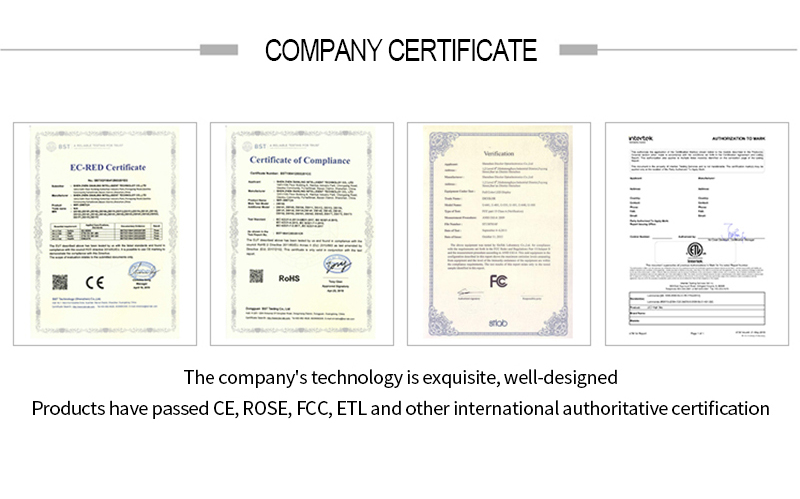
Ask for the CE and RoHS declarations, the ETL and FCC reports if you sell outside the EU, the wiring diagram in the destination language, and the capacitor specification. The last item is frequently missing from competitor packs and is exactly what an electrician needs when a lamp glows in the dark.
Certification set — CE, RoHS, FCC and ETL reports available with quotation.Finish and build detail — verify panel colour and terminal layout against the purchase order.
Before you order
Send us the site profile: how many drops have a neutral, the lamp type and wattage per circuit, gang count per room and the destination country. We will confirm whether the JL variant is the right part number for each circuit, supply the sample and capacitor, and quote on the gang mix you Actually need rather than a flat blend. Mixed orders combining the 86 mm EU range with the 118 mm US-format range ship in a single consolidated container.
Request DS-101JL pricing, the wiring diagram and a test sample → tell us the number of non-neutral drops in the project and we will advise on capacitor quantities in the same reply.
Is Smart Switch Without Neutral Wire worth buying?
Based on the breakdown in this article, Smart Switch Without Neutral Wire offers a solid mix of features and value. If your main goal matches the key benefits described above, it is a practical choice for everyday use.
How do I choose the right smart switch without neutral wire for my needs?
Start with your core use case, then compare battery life, compatibility, and build quality as covered above. Choosing the right smart switch without neutral wire comes down to matching specs with how you actually use it.
Does smart switch without neutral wire require a companion app?
Most devices of this type pair with a free companion app for setup and firmware updates. A few advanced features may sit behind a paid plan, so check the official specs page before buying.
📌 This article is part of our Complete Smart Hub — more guides and buying tips inside.
In Europe, the 86 × 86 mm round-corner box is not a niche format — it is the default back box in apartments, hotels and offices built or renovated over the last three decades. That single fact drives most of the sourcing decisions we see from EU distributors: any Smart switch that cannot drop into an existing 86 mm box without chasing walls has a very limited addressable market.
The DS-101BW is built around that constraint. It is a tempered-glass-front, 1- to 4-gang capacitive Touch switch with Wi-Fi and BLE on board, sized to the EU 86 mm format and slim enough to sit close to the wall. This article covers what it Actually is, what it is not, and how to spec it so that a container load does not become a returns problem.
What the DS-101BW actually is
The unit is a wall-mounted lighting controller, not a plug-in module. Power and load terminals sit on the rear, switching is done through capacitive touch keys under a glass faceplate, and the radio link is a 2.4 GHz Wi-Fi + BLE combination. BLE is what makes first-time commissioning tolerable — pairing happens locally over Bluetooth, then the device joins the customer’s 2.4 GHz network.
DS-101BW — EU 86 mm format, tempered glass faceplate, capacitive touch keys.
Panel and body dimensions
The faceplate is 86 × 86 mm with a 35 mm overall profile and roughly 49 mm of rear depth including the terminal block. That rear figure is the one that decides whether an install works: shallow European dry-lining boxes and older concrete boxes are frequently under 45 mm of usable depth once cables are folded back. Measure before quoting, or specify a deeper box for new-build.
Side profile: 35 mm body depth, rear section measured for shallow EU boxes.
Gang options and finish range
One to four gangs are available on the same 86 mm faceplate, so a project can standardise on one SKU family and cover single-pole bathroom lighting through to four-zone living areas. Finishes run white, black and champagne gold — the champagne variant matters more than it sounds, because hotel interior packages increasingly specify warm metallics and will reject a project on a pure-white-only range.
Finish options across the 86 mm family — white, black and champagne gold.
Note on ratings: the electrical figures above are the shared DS-101 platform values published in our DS-101 JL English datasheet and detail pages. Where a tender requires a stamped declaration per SKU, confirm the final rating on the datasheet issued with your quotation — do not copy the platform table into a tender response without that confirmation.
Why a glass front, and where it fails
Glass is chosen for two reasons that have nothing to do with aesthetics. First, it does not yellow or scuff the way lacquered plastics do after a few years of cleaning chemicals — relevant in hotels where rooms are wiped daily. Second, a sealed glass faceplate with no mechanical travel has no gap for dust or steam ingress at the key, which is why glass touch panels dominate bathroom and kitchen specifications.
What glass does not fix is the mounting surface. A glass panel is unforgiving of a box that is set 2 mm out of plane or a wall that is not flat: the panel will show a shadow line, and on a four-gang unit that line is 86 mm long. On retrofit projects, insist on a box alignment check during the site survey rather than discovering it at handover.
Four-gang variant — four independent zones on a single 86 mm faceplate.
Wiring layout and load planning
The rear terminal block is laid out as L4, L3, L2, L1, L, N. Each L terminal drives one lighting circuit; L is the permanent live feed and N is the neutral. Two practical points come up on almost every project:
Neutral is required. This is a neutral-referenced design — there is no single-live-wire workaround on the BW platform. If a site has switch drops with live only, that is a different product decision, and it should be resolved at survey stage, not on site.
600 W per gang is a switching limit, not a suggestion. Four gangs at 600 W is 2,400 W on one 86 mm faceplate. The heat has to go somewhere. For high-wattage circuits — water heaters, large resistive loads, big commercial lighting banks — use a contactor driven by the switch rather than the switch itself.
Rear terminals: L4 / L3 / L2 / L1 plus permanent live L and neutral N.
Where this SKU earns its place
Hotel and serviced apartment refurbishment
Room-by-room replacement is the classic use case. The existing 86 mm boxes stay, the wiring stays, and the only change is the device. Four-gang units cover entrance, bedside and desk lighting groups; scenes and schedules are pushed from the app rather than rewired. Because commissioning uses BLE locally, a technician can pair a room without the hotel Wi-Fi credentials being available yet — which in practice removes the single biggest scheduling conflict on a fit-out programme.
Guest-room lighting groups controlled from a single 86 mm glass panel.
Residential upgrade and rental stock
In rented flats the appeal is reversibility: a glass touch panel replaces the original rocker without touching the wiring, so a landlord can install it and, if required, put the original switch back at the end of a tenancy. The 1- and 2-gang versions are the volume movers here.
Clinics, offices and small retail
Where a facility wants scheduled lighting — reception lighting on at 07:30, signage off at 22:00 — timer and schedule functions in the app do the job without a building management system. The 4-gang unit maps cleanly onto a four-zone open-plan floor plate.
Commercial fit-out: scheduled zone control without a BMS.
Commissioning and app control
Devices are commissioned through the Smart Life / Tuya ecosystem. The sequence is the same one that has become standard across the category: hold the key to enter pairing mode, connect over BLE, enter the 2.4 GHz network credentials, assign the device to a room. Alexa and Google Assistant are supported once the account is linked. Multi-user sharing matters for the hotel scenario — housekeeping and maintenance need access without sharing the owner’s login.
OEM / ODM programme
For distributors and private-label brands, the 86 mm glass platform is available with customisation at the points that actually differentiate a product on a shelf:
Laser-etched logo on the glass faceplate
Custom colour box and multilingual manual (EN / DE / FR / ES available on request)
Neutral packaging for marketplace sellers, retail packaging for distribution
Firmware-level brand configuration within the app ecosystem
Tooling for private-mould variants is quoted separately and depends on volume; the standard 86 mm glass housing can be branded without new tooling, which is usually the fastest route to market for a first container.
Procurement checklist
Confirm neutral availability at every switch drop before committing to the BW platform.
Measure rear box depth — target 50 mm usable; flag anything below 45 mm.
Fix the gang mix per room type rather than ordering a flat blend of 1–4 gang.
Decide the finish split by project package; champagne gold is a project-driven SKU, not a stock item.
Confirm certification documentation required by the destination market (CE / RoHS for EU, FCC / ETL for North American tenders).
Request a sample unit and test it on the target network with the target app version before volume release.
Product detail — verify finish, gang marking and terminal layout against the PO.
Next step
If you are specifying 86 mm glass touch switches for an EU renovation, a hotel roll-out or a private-label launch, send us the room-type schedule, the gang mix, the finish split and your target certification set. We will come back with a quotation, the SKU-level datasheet for each gang count, and a sample lead time. Mixed containers with the 118 mm US-format range can be consolidated in a single shipment to reduce freight cost per unit.
Request a quotation, datasheet and sample for DS-101BW → include your project country, estimated annual volume and required certification, and we will respond with availability and pricing.
Based on the breakdown in this article, 86mm Glass Smart Wall Switch offers a solid mix of features and value. If your main goal matches the key benefits described above, it is a practical choice for everyday use.
How do I choose the right 86mm glass smart wall switch for my needs?
Start with your core use case, then compare battery life, compatibility, and build quality as covered above. Choosing the right 86mm glass smart wall switch comes down to matching specs with how you actually use it.
Does 86mm glass smart wall switch require a companion app?
Most devices of this type pair with a free companion app for setup and firmware updates. A few advanced features may sit behind a paid plan, so check the official specs page before buying.
📌 This article is part of our Complete Smart Hub — more guides and buying tips inside.
Tuya WiFi Smart Door Lock | Premium Keyless Access for Residences, Apartments & Short-Term Rentals
Redefine perimeter security with refined, Intelligent access control. Our Tuya-native Smart door lock transcends the limitations of traditional mechanical locking systems, delivering seamless, auditable and remotely managed keyless entry for discerning homeowners, property operators and hospitality hosts. Engineered for reliability, privacy and Smart home interoperability, this lock consolidates multiple secure unlocking modalities into one streamlined hardware solution, eliminating the friction of key distribution, handover and rekeying.
For private households, vacation villas, serviced apartments, Airbnb portfolios and commercial storage spaces, access management is no longer constrained by physical keys. Authorisations can be provisioned, scheduled or revoked remotely via the Smart Life App, granting granular control over who enters your property and precisely when access is permitted. Powered by dual WiFi and Bluetooth communication, it operates reliably online for remote management while retaining local unlocking capability under unstable or offline network conditions.
Multi-Modal Secure Access, Tailored for Every Scenario
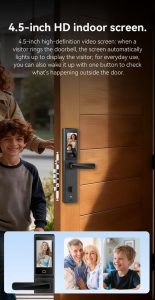
Flexibility does not come at the cost of security. This smart lock integrates six independent unlocking pathways, carefully calibrated to cover daily use, visitor access, offline operation and emergency backup, ensuring you will never be locked out unexpectedly.
Semiconductor Biometric Fingerprint Recognition
Equipped with industrial-grade live semiconductor fingerprint sensor, the system achieves rapid recognition within 0.3 seconds. The sensor is engineered to reject counterfeit silicone fingerprint molds, mitigating spoofing risks substantially. It supports storage of over 100 unique fingerprint profiles, making it equally suitable for large families and multi-tenant apartment deployments. Daily entry becomes effortless: simply touch the sensor, no keys, phones or passcodes required — ideal for users carrying groceries, supervising children or pets.
Anti-Peep Virtual Passcode Entry
The capacitive keypad supports anti-peep scrambled password technology. Users may input random dummy digits before and after the valid credential; the lock will isolate the core password and trigger unlocking. This prevents credential exposure from shoulder surfing in public areas. Administrators can configure three tiers of passcodes: permanent codes for household members, scheduled recurring codes for cleaners and maintenance staff, and time-bound one-time passcodes for couriers, contractors and ad-hoc guests. Temporary credentials expire automatically upon the predefined window, removing manual revocation workload.
RFID IC Card & Key Fob Access
Compatible with standard M1 RFID credentials, this channel offers a low-learning-curve entry method for elderly residents, young children and users who prefer non-biometric, non-phone operation. Property managers can batch provision cards for tenants and on-site staff. Any lost or stolen fob can be instantly disabled within the Smart Life App to block unauthorised entry, a critical feature for multi-unit accommodation management.
Smart Life App Remote & Bluetooth Unlock
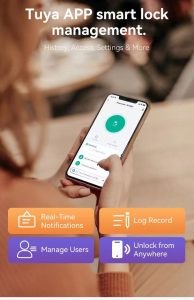
Once connected to WiFi, authorised users can remotely trigger unlock via the Tuya Smart Life App for trusted visitors while away from the premises. When internet connectivity fails, local Bluetooth unlock remains functional within proximity. All access events are timestamped and synchronised to the cloud audit trail. Pre-generated offline dynamic passwords can be issued in advance, allowing valid entry even when the site has no stable network — a vital capability for remote villas and locations with poor internet infrastructure.
Time-Limited Dynamic Offline Passwords
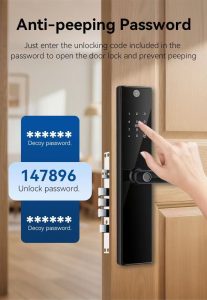
For permanently offline environments, time-bound dynamic passwords are generated within the App. Each credential is single-use or time-restricted and cannot be reused after expiry. This mode is widely adopted for renovation sites, remote cabins and secondary buildings where permanent WiFi installation is impractical.
Mechanical Emergency Key Override
A concealed mechanical key slot is retained as a failsafe backup. In the event of full battery depletion or rare electronic fault, the supplied emergency key enables manual opening. This redundant design removes the risk of lockout caused by power loss, delivering peace of mind for long-term deployment.
Layered Security & Intelligent Alert Ecosystem
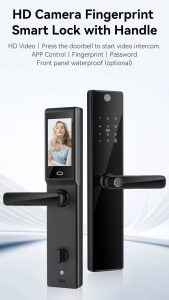
Security is not an add-on feature — it is the foundational architecture of this smart lock.
Anti-Tamper Intrusion Alarm: Violent prying or forced disassembly triggers a local audible siren and pushes instant alert notifications to your mobile device, deterring break-in attempts and notifying administrators in real time.
Brute-Force Lockout Protection: Consecutive failed fingerprint or passcode attempts will temporarily freeze the keypad interface, blocking automated password guessing attacks.
Low Battery Early Warning: The system prompts via on-keypad indicators and App push notifications when battery capacity drops below threshold. A Type‑C external power port provides emergency power supply if batteries are fully drained.
Door Ajar Detection & Reminder: Continuously monitors door closure status. If the door remains open beyond your preset grace period, the system sends automated alerts to prevent accidental unsecure states.
Comprehensive Access Audit Logs: Every unlock event is recorded with timestamp, unlock method and user identity. Logs are exportable from the App for compliance checks, property auditing and tenant lifecycle management.
Smart Home Orchestration & Voice Assistant Integration
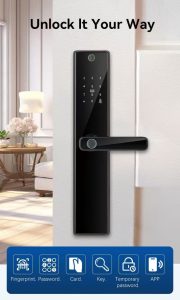
This Tuya ecosystem lock natively integrates with Alexa and Google Assistant. After account linking, users can query lock status via voice commands. Beyond voice control, it supports Tuya scene automation, enabling custom smart home workflows triggered by lock events. Popular automation scenarios include: unlocking the door to activate hallway lighting, triggering climate equipment upon entry, and locking the door to power down non-essential smart sockets and lighting circuits. It works standalone over WiFi without a mandatory gateway, while also supporting gateway joining for more stable local-area smart linkage for larger smart home setups.
Universal Fit, Streamlined Installation & Global Certification
Engineered for broad compatibility, this lock fits most standard wooden doors, metal security doors and composite interior doors. It supports door thickness ranging from 35mm to 60mm. The adjustable latch assembly accommodates left-hand and right-hand swing orientations, eliminating the need for destructive door modification in most installations. The package includes complete mounting hardware and a full English user manual. A qualified installer can finish fitting within 30 minutes. For wholesale partners, branded installation tutorials and technical documentation are available to support your end customers.
Units carry CE and FCC certification, complying with international electrical safety and electromagnetic compatibility standards. Robust circuit design reduces electronic failure rates, making it suitable for mass rollout in rental portfolios and retail distribution.
Ideal Deployment Scenarios
🏡 Luxury Private Residences & Family Homes: Convenient keyless daily access, remote temporary entry for guests and delivery services.
🏨 Short-Term Rental & Airbnb Hosts: Send time-bound passcodes prior to check-in, eliminate on-site key handover, auto-revoke access after check-out and simplify housekeeping scheduling.
🏢 Serviced Apartments & Property Management: Centralised bulk lock management, instant access revocation upon tenant move-out and exportable audit trails for property compliance.
🏪 Offices, Warehouses & Storage Rooms: Time-restricted staff access, entry logging and controlled perimeter security for commercial premises.
👵 Age-Friendly Living: Simple RFID card and passcode operation, designed for users who find biometrics or mobile apps cumbersome.
Package Inventory
Front exterior lock panel
Back interior lock panel
Adjustable lock body / latch set
2 × Mechanical emergency keys
2 × RFID IC cards
Full set of mounting screws and accessories
English user manual
Why Select Our Tuya Smart Door Lock?
Many competing smart locks rely solely on Bluetooth connectivity or require a dedicated gateway for remote functionality. Our dual WiFi+Bluetooth architecture balances cloud-based remote administration and offline operational resilience. Combined with high-precision semiconductor fingerprint recognition, anti-peep credential protection, multi-layer alarm systems and native smart home interoperability, this lock delivers enterprise-grade access control at a consumer-friendly price point.
Whether you are a homeowner upgrading domestic security, a host scaling a rental portfolio, or a distributor sourcing reliable smart hardware for resale, this Tuya Smart lock offers a stable, market-proven solution that aligns with modern smart living and professional property management requirements.
Contact us for bulk pricing, custom OEM branding and technical support for your smart lock project.
Based on the breakdown in this article, Tuya Wifi Bluetooth offers a solid mix of features and value. If your main goal matches the key benefits described above, it is a practical choice for everyday use.
How do I choose the right tuya wifi bluetooth for my needs?
Start with your core use case, then compare battery life, compatibility, and build quality as covered above. Choosing the right tuya wifi bluetooth comes down to matching specs with how you actually use it.
Does tuya wifi bluetooth require a companion app?
Most devices of this type pair with a free companion app for setup and firmware updates. A few advanced features may sit behind a paid plan, so check the official specs page before buying.
Water damage is expensive out of proportion to its cause. A washing machine hose that fails while nobody is home runs for hours; a slow drip under a sink rots a cabinet for months before anyone notices. A leak sensor costs a fraction of either, and the whole question is where it stands.
Under the kitchen sink. The most common failure point in the house: supply hoses, a trap, a dishwasher connection. One sensor flat on the cabinet floor.
Behind or beneath the washing machine and dishwasher. Appliance hoses are the classic burst. Put the sensor at the lowest point behind the machine, not beside it.
Under the water heater or boiler. Slow leaks here run unnoticed for months. Include the pressure relief valve’s discharge area.
At the toilet base. A failing wax ring or a loose supply line shows up as water on the floor behind the bowl.
In the basement, cellar or sump pit. The lowest point in the building is where water arrives first — a Zigbee level sensor in a pit or tank reports rising water before it becomes a flood.
In the loft or under the roof. Rain ingress and condensate from heating pipework. Also the place nobody checks.
Probe or contact sensors trigger when water bridges two contacts on the floor — the default choice for sinks, appliances and basements. Level sensors measure depth and suit a tank, a pit or a water butt, where “it is rising” matters more than “it is wet”. Rain sensors are the outdoor equivalent: the WiFi/Zigbee rain sensor and the IPX4 rain detection sensor close a skylight, retract an awning or simply tell you it started raining.
Two further types solve adjacent problems. The vibration and tilt sensor reports movement or a change of angle — a gate, a hatch, a washing machine that has started shaking itself across the floor. And for an outdoor position where a cable is impossible, the solar rainwater and leak sensor runs off its own panel.
Winter: the case for installing before December
Frozen pipes are the seasonal argument. A pipe in an unheated room, a loft, a garage or against an external wall can split, and it does not leak while frozen — it leaks when it thaws, which is often when nobody is there. Two precautions go with the sensors: keep the heating at a low setpoint rather than off when the house is empty, and put a sensor under any pipe run that passes through an unheated space. That combination is also why our guide to thermostat plugs for heaters is relevant here — a cheap scheduled heater in an unheated room is cheaper than the repair.
Making the alert useful
A sensor that beeps in an empty house does nothing. These are Zigbee devices, so they need a gateway to reach you and to run automations locally — see our guide to smart home hubs for why local execution matters when the internet is out. Then set the obvious automation: leak detected, send a push to every adult in the household, not just the one who installed it.
Be realistic about shut-off. A sensor cannot close a valve unless there is a motorised valve on the main; without one, the value of the sensor is speed of notification, which is still most of the value.
Installation details that decide whether it works
Place it at the lowest point of the area, flat on the floor — water does not travel uphill to meet a sensor.
Keep contacts off bare metal. A sensor resting on a metal tray or a foil-faced board can false-trigger.
Do not mount it where it will be soaked by normal use — outside the shower tray, inside the washing machine’s drip line, but not under the sink’s cleaning spray.
Test it with a wet cloth twice a year, and note that battery-powered sensors should be checked at the same time.
A plan that takes one afternoon
Install the gateway first and pair everything at a table, not in a cupboard — pairing is far quicker with the devices in front of you. Then walk the house once with a list of every place water enters or leaves: sink, appliances, toilet, boiler, tank, and the lowest floor. Place a sensor at each, name it in the app after its location rather than “sensor 3”, and set one automation that notifies everyone. Finish by wetting a cloth and testing each one; a sensor that has never been tested is an assumption, not a precaution.
Frequently Asked Questions
How many do I need?
Two for the essentials, six for full coverage. Start with the kitchen sink and the washing machine, then add the water heater and the lowest floor.
Do they work without WiFi?
The local alarm sounds. Remote notification needs the gateway and your network; automations stored on the gateway keep running without internet.
WiFi or Zigbee?
Zigbee for battery sensors — the battery lasts far longer and the mesh covers a basement better than a single WiFi radio.
Can one detect a leak inside a wall?
Not until it reaches the floor. For concealed pipes, place sensors at the lowest accessible point below the run, and Watch for a boiler losing pressure.