Posted on — Leave a comment

The Door That Answers: Face, Palm and a Camera at the Front Door

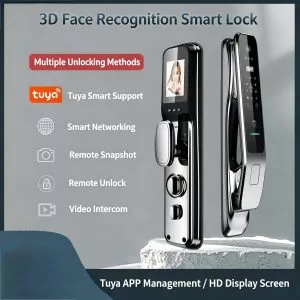
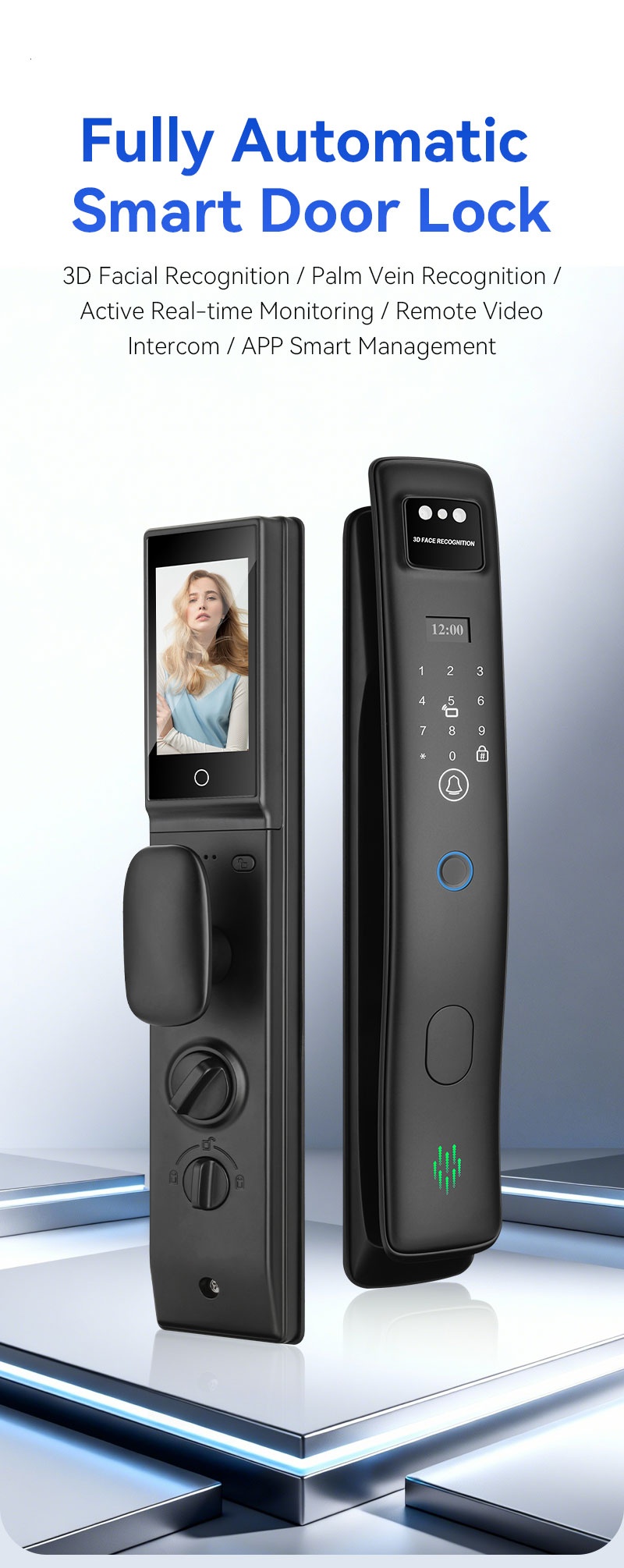
Fully automatic smart door lock with camera screen, 3D face and palm vein recognition, remote video intercom
Most front doors are passive. They open if you have the right object, and otherwise they stay shut, offering no information about who is standing on the other side. That is fine until you are carrying two bags of shopping, or a delivery arrives while you are at work, or someone knocks at an hour when you would rather not open the door at all.
A door that recognises you and can show you who is outside changes that relationship. It is no longer a barrier you operate; it is an Entry point you manage, from the doorstep or from another city.
This lock combines three things that are usually sold separately: 3D face recognition that opens with your hands full, Palm vein recognition that works when fingerprints do not, and a camera with remote video intercom so you can see and speak to a visitor before deciding anything. It is fully automatic, so the bolt extends on its own once the door closes. Here is what it does, what it needs, and which doors it will not fit.
Fully automatic smart door lock with camera screen, 3D face and palm vein recognition, remote video intercom
Automatic locking, door camera and indoor screen, remote video intercom and app management

What Actually Happens at a Front Door
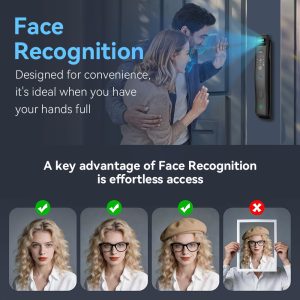
3D face recognition smart door lock, hands-free unlock, works with glasses and hats, rejects printed photos
Hands-free entry when your hands are full; a printed photo cannot fool the 3D camera
The friction is small and constant, which is why people stop noticing it.

The Fumble With Keys and Bags

Arriving home with shopping, a stroller or a sleeping child means putting everything down to find a key. Every solution that requires a hand, a pocket or a specific object adds a step at the worst possible moment.

The Delivery You Missed

A courier knocks, nobody answers, and a card goes through the letterbox. Without a camera, the choice is between leaving packages outside all day and arranging to be home, neither of which is convenient.

The Conversation Through a Closed Door

Speaking to a stranger through a door with no way to see them is a small but genuine discomfort, and it happens more often than most people admit, especially for anyone living alone.

The Door Left Unlocked

A manual lock depends on someone remembering to lock it. The failure is not malicious, it is ordinary inattention at the end of a long day.

Five Things This Lock Does Differently
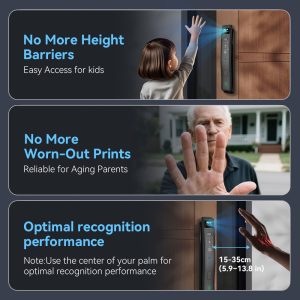
Smart lock palm vein recognition, no height barrier for kids, reliable for aging parents, 15–35cm sensing distance
Children reach it easily, worn fingerprints do not matter, and the palm is held 15–35 cm away
Each feature maps to one of those moments rather than adding a specification for its own sake.

3D Face Recognition

The camera builds a three-dimensional map of the face, so the door opens while your hands are occupied. It continues to work with spectacles, a cap or a beret, and a change of makeup or hairstyle does not require re-enrolling. Crucially, a printed photo or an image on a phone screen does not pass, because a flat image has no depth to compare.

Palm Vein Recognition

Near-infrared imaging reads the vein pattern beneath the skin. Sweat, dust, oil, peeling skin and small injuries sit on the surface and barely affect the result, which is exactly Where fingerprint readers struggle. Hold the palm center about 15 to 35 cm from the sensor and the door opens without contact.

A Camera and Remote Video Intercom

The outside panel carries a camera, and the app supports real-time monitoring and two-way conversation. When someone rings or stands at the door, you can look, speak and then unlock remotely, or decide not to. That single capability changes how deliveries, visitors and unexpected callers are handled.

A Fully Automatic Bolt

There is no handle to turn. The motor retracts the bolt to let you in and extends it again once the door closes. Locking stops depending on memory, which is the quiet benefit most people notice after a week.

App Management and Temporary Codes

Faces, palms, fingerprints, cards and codes are all administered from the app. Guests get a code with a validity Window, cleaners get one limited to a two-hour slot, and departing staff are removed rather than chased for a key. The access log records which method opened the door and when.

Product Specifications

Attribute
Detail
Product type
Fully automatic mortise Smart lock
Unlock methods
Palm vein, 3D face, fingerprint, password, IC card, app, mechanical key
Face recognition
3D structured-light scan, works with glasses, hats and makeup changes
Palm vein range
About 15 to 35 cm, palm center facing the sensor
Camera functions
Active real-time monitoring, remote video intercom
App management
Remote unlock, user management, temporary passwords, access log
Front panel size
About 420 mm long by 70 mm wide
Mortise types
6068 and 7068
6068 mortise sizes
24 × 240 mm, 30 × 240 mm, 30/40 × 388 mm
7068 mortise sizes
24 × 240 mm, 30 × 240 mm
Backset
60 mm, about 2.36 inches
Face plate width
68 mm or 69 mm options
Mortise thickness
About 24 mm
Locking action
Automatic bolt extension, no handle required

Why Palm Vein, Not Just Fingerprint

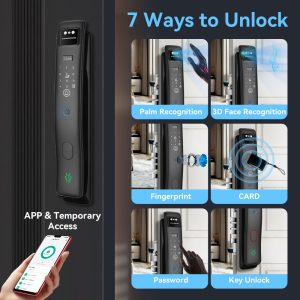
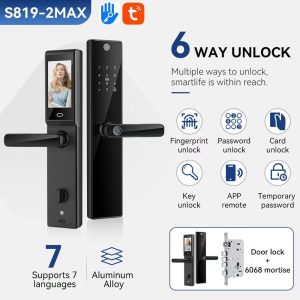
Seven unlock ways smart lock, palm vein, 3D face, fingerprint, card, password, key and app temporary access
Palm, 3D face, fingerprint, card, password, key and app access on one panel
Most locks stop at fingerprints. The addition is not a gimmick; it covers the population that fingerprint locks quietly exclude.

Worn Prints and Age

Decades of manual work, cooking or gardening smooth out ridge detail, and older skin loses definition. A sensor that needs clear ridges will ask for a second and third attempt, and the user eventually carries a key again.

Wet, Oily and Dirty Hands

Shopping bags leave hands damp, cooking leaves them oily, and a garden or a worksite leaves them dusty. Surface-based readers suffer; vein-pattern readers do not, because the pattern is under the skin.

Children and Height

A palm sensor does not require standing on tiptoe or pressing a small finger precisely onto a plate. A child can hold a hand up at the sensor and be recognised, which matters if the alternative is a key they lose.

Contactless and Hygienic

Nothing is touched, so nothing is left behind. In a shared entrance or a rental property, that is a small but real improvement over a shared fingerprint plate.

Face Recognition: What It Handles
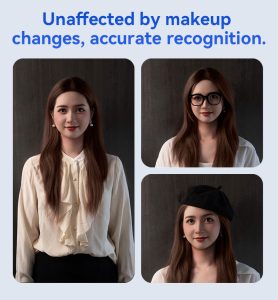
3D face recognition unaffected by makeup changes, accurate recognition with glasses and hat
New makeup, glasses or a hat do not require re-enrolling your face
The practical questions are always the same: does it work with my glasses, and can someone fool it with a picture.

Glasses, Hats and Makeup

Recognition continues with spectacles, a cap or a beret, and it is not thrown off by a change of makeup or hairstyle. That matters because a lock that needs re-enrolment after every haircut is a lock nobody trusts.

Photos Do Not Pass

A printed photograph or a phone screen held up to the camera is flat, and a 3D scan has nothing to match it against. Anti-spoofing is the difference between a convenience feature and a security hole.

Hands-Free Moments

The genuine value appears on the day you arrive with both arms full. Standing in front of the panel for a moment is a great deal easier than putting everything down on wet ground to search a pocket.

Fit: Mortise, Backset and Panel
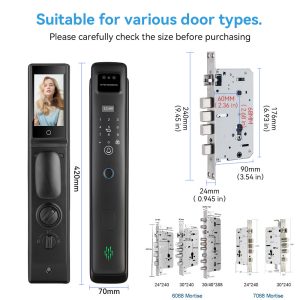
Smart lock dimension drawing, 420x70mm panel, 6068 and 7068 mortise, 60mm backset, 24mm mortise thickness
Check panel size, mortise type and 60 mm backset against your door before ordering
A fully automatic lock replaces the mortise body, not just the handle. Compatibility is decided by measurements, and this is where most ordering mistakes happen.

Mortise Type, 6068 or 7068

The existing body inside the door must match one of those patterns. Sizes include 24 × 240 mm, 30 × 240 mm and 30/40 × 388 mm for 6068, and 24 × 240 mm or 30 × 240 mm for 7068.

Backset of 60 mm

Measure from the door edge to the centre of the spindle. A 60 mm backset is required, and it is the figure people most often guess rather than measure.

Panel Clearance, 420 by 70 mm

The front panel is tall. On doors with narrow stiles, decorative panels or an existing viewer, check that the footprint fits without overlapping trim before ordering.

Automatic Locking Changes the Habit

Because the bolt extends by itself, the door must be properly closed, not left ajar. It is worth testing alignment on the first day, since a misaligned frame that worked with a manual latch can cause repeated motor strain.

Who Should Install It

This is a mortise replacement with electronics, a camera and a screen. Professional installation is the sensible route, particularly on steel doors or where the existing cutout needs modification.

Where It Makes a Difference
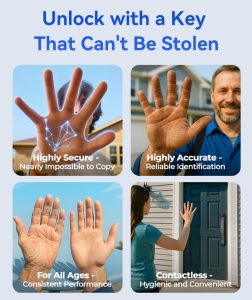
Fully Automatic Smart Door Lock with 3D Face & Palm Vein Recognition, Camera Video Intercom, Tuya App, 7 Unlock Ways, 6068/7068 Mortise

The same hardware serves quite different households for quite different reasons.

Family Homes With Several Generations

Parents use face recognition with full hands, grandparents use palm vein because their prints have faded, and children use a card or a palm. One lock, and nobody has to adopt someone else’s preferred method.

Rental Properties and Self Check-In

A temporary code issued remotely handles arrival, the access log answers timing questions, and the camera shows who actually turned up. That combination is what makes self check-in credible rather than optimistic.

Households That Receive Deliveries

Seeing and speaking to a courier from the app turns a missed delivery into a conversation. It also means a package can be accepted into a hallway rather than left on a step.

Anyone Living Alone

Being able to look at the doorway before answering is a genuine comfort, and it costs nothing to use the intercom instead of opening the door to an unknown caller.

Small Offices and Studios

Staff access is added and removed in the app, and the log provides a record of arrivals without a separate attendance system.

What It Does Not Do

Boundaries are more useful than an extra bullet point.

Remote Functions Need Power and a Network

Palm, face, fingerprint, code, card and key all work locally. Remote unlocking, intercom and code issuing need the lock online, so the local methods remain the everyday ones.

The Camera Watches the Doorway, Not the House

It is an entry-point camera. It does not replace a broader security setup, and it will not cover a garden, a driveway or a back entrance.

It Will Not Fit Every Mortise

Doors with a different mortise pattern, a backset other than 60 mm, or insufficient panel clearance need another product. No feature compensates for a body that does not match.

The Mechanical Key Still Matters

A flat battery, a network outage or a lost phone are all ordinary events. Keep the key somewhere reachable from outside, not in a drawer that the lock is protecting.

Who This Smart Lock Suits

  • Multi-generational households where fingerprints, faces and cards all get used.
  • Landlords and Airbnb hosts wanting self check-in plus a camera at the door.
  • People who receive frequent deliveries and are not always home.
  • Older users or manual workers whose fingerprints read poorly.
  • Anyone who wants to see a caller before unlocking the door.

Care and Maintenance

Wipe the camera window, the face sensor and the palm sensor with a soft dry cloth rather than a wet one, since a smeared optical surface is the usual cause of a sudden recognition complaint. Keep the keypad free of grease, avoid abrasive cleaners on the panel, and check the bolt alignment every few months, particularly in humid seasons when doors swell.
Watch the battery indication in the app and change or charge before it becomes urgent. If the panel is exposed to driven rain, confirm the installation is sealed at the panel edge. Store the app account details where the whole household can find them, because a single phone should not be the only route to administration, and keep the mechanical key outside the door.

Is It Right for Your Door?

If the appeal is opening a door with full hands, seeing who is outside before answering, and never wondering whether the door got locked, this covers all three in one panel. Palm vein adds the group that fingerprint locks leave out, which in most families is at least one person.
The limits are real: a specific mortise and backset, a tall panel that needs clearance, remote features that depend on connectivity, and installation that is best done professionally. Measure first and the rest follows.
For a front door that has been asked to do more than it was designed for, the change is less about technology than about removing three small daily frictions. Fit guidance, the mortise options and the current variant are on the product page.

Frequently Asked Questions

These are the questions that most often decide an order.

Can a photo fool the face recognition?

No. The camera captures a three-dimensional face map, so a printed photo or a phone screen does not match.

Will it fit my door?

It requires a 6068 or 7068 mortise, a 60 mm backset, and clearance for a 420 by 70 mm panel. Measure the existing body and backset before ordering.

Does it lock itself?

Yes. The bolt extends automatically once the door is closed, so there is no handle to turn and no step to remember.

Can I see and talk to visitors?

Yes, through the app, using the outside camera with remote video intercom. You can also unlock remotely if you decide to let them in.

What if the battery runs out?

The app shows battery status in advance, and the mechanical key provides backup entry. Keep that key outside the door.
If you are unsure which mortise your door uses, send photos of the existing lock body with a tape measure in frame and we will confirm before you order.

Related Articles

You Might Also Like

Posted on — Leave a comment

Keyless Entry Smart Lock: Five Ways In, and a Passcode That Cannot Be Watched

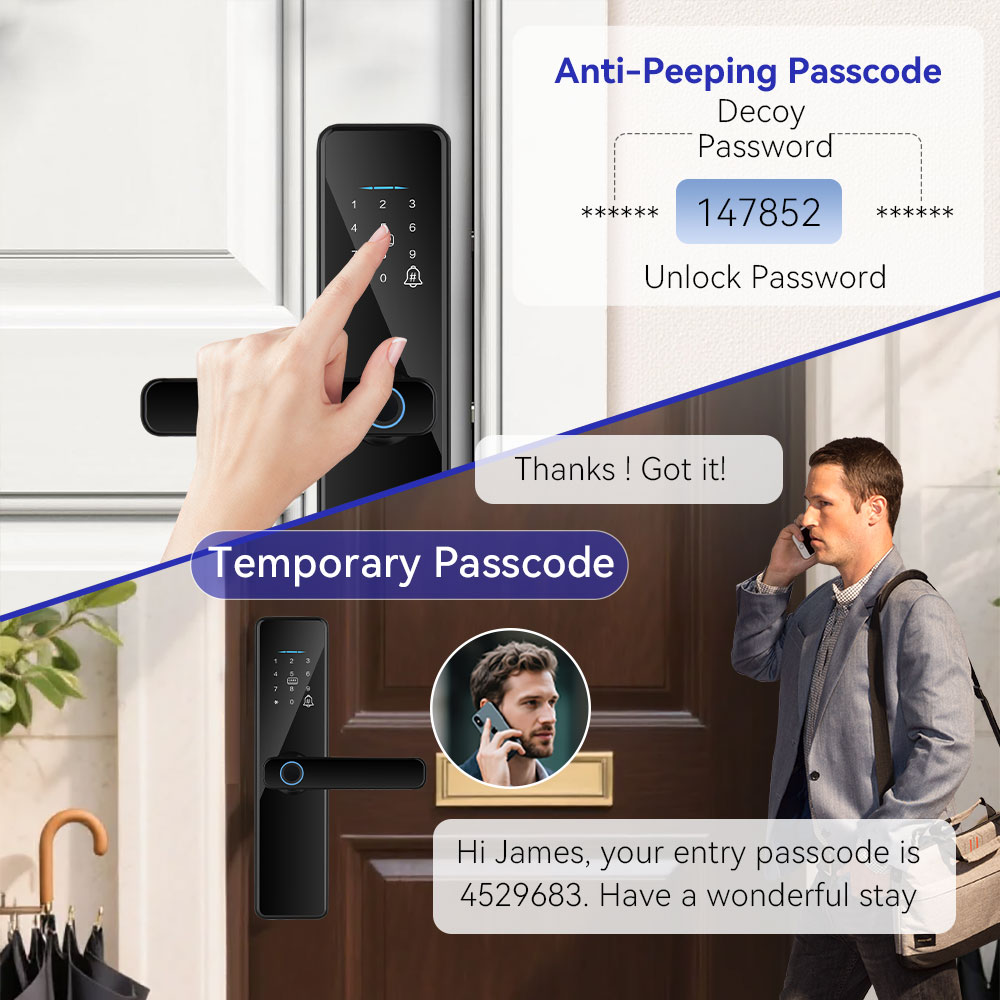
Smart door lock anti-peeping passcode and temporary passcode unlock function demo
A physical key is a single point of failure that most households never think about. It can be copied in a minute at a hardware shop, lost permanently on a beach, and handed to a cleaner, a dog sitter or a contractor with no way to take it back. The lock keeps working exactly as it did on the day it was installed, no matter how many copies exist.
A keyless handle lock changes the shape of that problem. Access becomes something you grant and revoke rather than something you hand over, and a record of every entry exists whether or not anyone remembers to mention it.
This 5-in-1 model covers the practical middle ground: fingerprint, passcode, IC card, app control and a mechanical key as backup, with built-in WiFi so no separate gateway is needed. It is a retrofit handle rather than a whole-door system, which makes it affordable, and also means the door has to be checked before ordering. Here is what it does well, and what a buyer should confirm first.
Smart door lock anti-peeping passcode and temporary passcode unlock function demo
Anti-peeping password and one-time temporary code for guest access

Why the Key Is the Weak Point

Most home security conversations focus on the lock cylinder. The bigger exposure is usually the key itself.

Keys Get Copied and Never Returned

A spare key given to a cleaner, a neighbour or a former tenant is functionally a permanent credential. There is no audit trail, no expiry and no way to revoke it short of changing the cylinder, which almost nobody does.

Handover Is the Friction Point in Short Rentals

Meeting a guest at an inconvenient hour, hiding a key under a mat, or trusting a lockbox with a four-digit combination are all workarounds for the same limitation: a mechanical key cannot be issued remotely. Self check-in exists precisely to remove that dependency.

Nobody Knows Who Came In, or When

A traditional lock records nothing. When something is missing, the conversation becomes guesswork. An electronic lock records each unlock event, which turns a suspicion into a fact.

Lost Keys Force a Cylinder Change

The one moment a key problem becomes real money is the day a key goes missing. Replacing a cylinder and reissuing keys costs more than most people expect, and it usually happens at the worst possible time.

What This 5-in-1 Lock Does

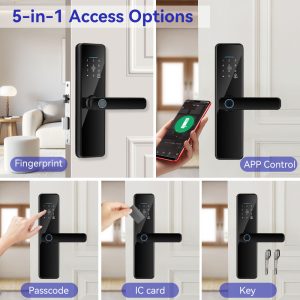
5-in-1 access options smart lock: fingerprint, app, passcode, ic card, mechanical key
5 unlock modes: fingerprint, App control, passcode, IC card and backup key
Five access methods share one handle, which is why the same device works for a household, a guest and a maintenance visit.

Fingerprint, the Everyday Method

A biometric reader on the handle recognises enrolled fingers in about the time it takes to press down. For family members this becomes the default: no key to carry, no code to remember, no phone to unlock first.

Passcode With Anti-Peeping Entry

The keypad accepts a correct code with random digits typed before and after it, so an observer cannot tell which digits actually matter. That detail matters in a hallway, a stairwell or any doorway Where someone can stand behind you.

Temporary and One-Time Codes

Codes can be created for a defined Window and then expire. This is the feature that makes the lock genuinely useful for rentals, deliveries, cleaners and contractors, because access ends without anyone having to collect anything.

IC Card for Households That Prefer It

Cards Work well for children, elderly family members and anyone who finds a keypad awkward. A card in a wallet does the same job as a fob, without the fingerprint enrolment that some older users dislike.

App Control Over Built-In WiFi

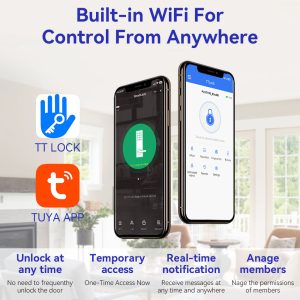
The lock connects directly to the home network, so there is no gateway to buy or power. From the Tuya or TT Lock app you can unlock remotely, issue and revoke codes, set validity periods and read the access history.

Mechanical Key as the Last Resort

A physical key still opens the lock, which matters on the day the battery dies, the WiFi drops or a phone is lost. Electronic convenience with a mechanical fallback is the sensible arrangement.

Product Specifications

Attribute
Detail
Product type
Retrofit Smart handle door lock
Unlock methods
Fingerprint, passcode, IC card, app, mechanical key
Connectivity
Built-in WiFi, no gateway required
Compatible apps
Tuya Smart and TT Lock
Passcode features
Anti-peeping virtual digits, temporary and one-time codes
Access management
Add and remove users, set validity periods, view unlock records
Notifications
Real-time unlock alerts in the app
Lock body size
About 270 mm by 65 mm
Door thickness
38 mm to 55 mm, about 1.5 to 2.17 inches
Compatible lock cases
6085, 5572, 4585 and single latch
Backup access
Mechanical key included
Typical use
Front doors, bedroom doors, rentals, small offices

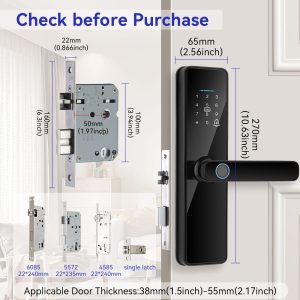
Fit First: The Check Before You Order

Smart door lock dimension guide, check before purchase, applicable door thickness and lock body size
Check door thickness and lock case size before buying this smart handle lock
A retrofit lock is only as good as its compatibility, and this is the step buyers skip. It is worth five minutes with a tape measure.

Door Thickness, 38 to 55 mm

Measure the door leaf at the edge, not at the frame. Below 38 mm or above 55 mm the handle and spindle will not seat properly, and no amount of adjustment fixes a door that is simply outside the range.

Which Lock Case You Already Have

The lock replaces the handle and the electronics, not the mortise body inside the door. It is built around the 6085, 5572 and 4585 patterns and single latch doors, so the existing case determines whether it drops in or needs work.

Measure the Backset and the Face Plate

Backset is the distance from the door edge to the centre of the spindle, and the face plate dimensions decide whether the new body sits flush. Photograph the existing lock with a tape measure beside it; that is the fastest way to confirm fit before ordering.
Who Should Install It
Replacing a handle on a matching case is a straightforward job for a confident DIYer with a screwdriver. Replacing the mortise body, cutting a new face plate opening or working on a steel security door is a job for a locksmith, and it is worth saying so plainly.

Where It Fits in Real Life

Built-in WiFi smart lock Tuya TT Lock app remote control, temporary access, real-time notification
Built-in WiFi, manage your smart lock anywhere via Tuya or TT Lock App
The same device serves quite different households, for different reasons.

Primary Home Front Door

Family members use fingerprints, guests get a temporary code, and nobody carries a key on a run. The mechanical key stays in a drawer for the day it is needed.

Airbnb and Short-Term Rentals

A code issued for the length of a stay, expiring at checkout, removes the key handover entirely. Self check-in becomes genuinely possible, and the access log answers questions about arrival times without contacting the guest.

Small Office or Studio

Staff get fingerprints or cards, a cleaner gets a code limited to a time window, and departing employees are removed from the app rather than asked to return a key.

Households With Children and Older Relatives

An IC card in a school bag or a purse works without a phone or a memorised code. That is often the deciding factor for multi-generational homes.

Shared Flats and Managed Properties

Where several people need access and the landlord is not nearby, remote code issuing avoids the round trip of collecting and delivering keys.

Living With It Week by Week

Once installed, the routine is mostly about managing people rather than operating a lock.

Issuing Access Takes Seconds

Enrolling a fingerprint at the door takes under a minute. A temporary code takes about the same, and it can be sent by message rather than explained over the phone.

Revoking Access Is the Real Benefit

Deleting a user or letting a code expire is the moment the lock earns its price. No key to reclaim, no cylinder to change, no awkward conversation.

Reading the Log Settles Arguments

The app shows which method opened the door and when. For a rental, that answers late-checkout questions; for a household, it answers who left the door unlocked.

What Happens When the Network Drops

Fingerprint, passcode, card and key all work locally, without WiFi. Remote unlocking and code issuing need connectivity, so the local methods remain the everyday ones and the app is the management layer.

What It Does Not Do

Honest limits are more useful than a longer feature list.

It Is a Handle Lock, Not a Full Door System

It replaces the handle and adds electronic access; the mortise body stays. Buyers expecting a complete lock replacement, or a door with no existing cutout, need a different product.

Fingerprints Need a Reasonable Finger

Very dry skin, worn prints from manual work, or a bandaged finger will read inconsistently. Those users are better served by a card or a code, which is why both are included.

Remote Features Need Power and WiFi

The lock still needs a working battery and a network for app functions. Treat the mechanical key as part of the system rather than an afterthought, and keep it somewhere you can reach from outside.

Who This Smart Lock Suits

  • Landlords and Airbnb hosts who want remote check-in and expiring guest codes.
  • Families who would rather not carry keys or hand spares to every visitor.
  • Households with older relatives or children who do better with a card than a keypad.
  • Small businesses that need to add and remove staff access cleanly.
  • Anyone replacing a handle whose door already matches 6085, 5572, 4585 or a single latch.

Care and Maintenance

Keep the fingerprint sensor clean and dry, and wipe it with a soft cloth rather than a wet one; a smeared reader is the most common cause of a “fingerprint stopped working” complaint. Clean the keypad lightly, avoid abrasive cleaners on the finish, and check the handle for looseness every few months, tightening the mounting screws if the body starts to shift.
Watch the battery indication in the app and replace cells before they run flat rather than after. Keep the mechanical key outside the home, not inside a drawer that the lock protects, and store the app account credentials somewhere the household can find them. If the door is exposed to heavy rain, confirm the installation is sealed properly at the face plate, since water ingress rather than electronics is what usually shortens the life of an outdoor lock.

Is It Right for Your Door?

If the reason you are looking at a smart lock is keys, guests and not knowing who came in, this covers all three in one handle. Five access methods mean nobody in the household has to adapt to a single way of entering.
The limits are worth repeating: it retrofits onto specific lock cases and a 38 to 55 mm door, it is not a complete door replacement, and the remote features depend on WiFi while local access does not. Measure first, and the rest is straightforward.
For a rental that needs self check-in, or a home that has been carrying too many spare keys, the change is mostly about removing a friction point that had become normal. Fit guidance, the compatible lock case list and the current variant are all on the product page.

Frequently Asked Questions

These are the questions that decide whether an order goes ahead.

Do I need a separate gateway for WiFi?

No. The lock has built-in WiFi and connects directly to the home network, so remote control works through Tuya or TT Lock without extra hardware.

Will it fit my existing door?

It fits doors 38 to 55 mm thick with a 6085, 5572, 4585 or single latch lock case. Measure the door edge thickness and photograph the existing face plate before ordering.

Can I give a guest a code that expires?

Yes. Temporary and one-time codes can be created with a validity window, so access ends at checkout or at the end of a scheduled visit without anyone collecting a key.

What if the battery dies or the WiFi is down?

Fingerprint, passcode, card and the mechanical key all work without a network. Keep the backup key somewhere reachable from outside the door.

How many fingerprints can I add?

Capacity varies with the app version and is shown during setup. For a normal household, one or two prints per person plus a card each is the practical arrangement.
If you are unsure which lock case your door uses, send a photo of the existing handle and face plate and we will confirm before you order.

Related Articles

You Might Also Like
Posted on — Leave a comment

Smart Door Lock: How to Choose the Right One

A Smart door lock replaces the key with a credential — a fingerprint, a face, a PIN, a phone or a card — while keeping a physical key or a mechanical thumb-turn as the backup. Electrically it is a lock body, a reader, a motor that throws the bolt, and a battery pack; mechanically it must still meet the same strength standard as the lock you are replacing.

That second half is where most buying mistakes happen. A lock with an excellent fingerprint sensor and a weak latch is still a weak lock. Read the mechanical grade first, then the credential list, then the electronics.

The four credentials, and who each is for

Credential How it works Strengths Watch out for
Fingerprint Capacitive or optical sensor reads the ridge pattern Fast, nothing to carry, cheap to add Dry, wet or worn fingerprints fail; enrol from several angles
3D face recognition Structured-light or ToF depth mapping Truly hands-free — groceries in both hands; depth data resists photo spoofing Height range matters for children and wheelchair users; needs some ambient light
Palm vein Near-infrared reads the subcutaneous vein pattern Highest anti-spoofing; contactless; works with gloves off Fewest models; users must learn the gesture distance
PIN / password Touch keypad Works for guests and cleaners; easy to revoke Wear marks reveal the code — use models with a scrambled/random prefix
App / Bluetooth / card Phone, fob or NFC card Remote unlocking, temporary codes, audit trail Phone flat or Bluetooth off = lockout; always keep the backup

Buying rule: any lock you install on a main entrance should have at least two independent ways in — one biometric and one non-biometric (PIN or mechanical key). Fingerprint sensors fail on cold, dry hands, and that is exactly when you are standing outside at 11 pm.

Grade the mechanics before the electronics

Standard Grade Typical use
ANSI/BHMA A156.13 (US, deadbolts) Grade 1 / 2 / 3 Grade 1 commercial, Grade 2 residential (the sensible Home choice), Grade 3 light duty
EN 12209 / EN 15685 (Europe) Classification codes for durability, fire, corrosion, security Ask the supplier for the full 8-digit code, not just “CE”
BS 3621 (UK) Insurance-approved for mortice locks Many insurers require it; check your policy before replacing

Cycle testing is the number that separates a real lock from a gadget: Grade 1 is tested to hundreds of thousands of operations, Grade 3 to a fraction of that. If a listing does not state a grade or a cycle count, assume it is untested.

Fit: the measurements that decide whether it will fit your door

  1. Door thickness — most residential locks fit 35–55 mm. Measure the door, not the frame.
  2. Backset — the distance from the door edge to the centre of the bore hole. 60 mm and 70 mm are the common sizes.
  3. Bore hole diameter — usually 54 mm for the main hole, 25 mm for the latch.
  4. Latch / mortise type — a tubular latch is a retrofit; a mortise lock body needs a pocket cut into the door. Check which one your door already has, because converting between them is carpentry.
  5. Handing — whether the lock is for a left- or right-handed door. Many modern locks are reversible, but confirm.
  6. Door material — solid wood, composite and metal doors behave differently with RF; a metal door can block the Wi-Fi or Bluetooth signal to the outside unit.

Power, and the failure mode that locks people out

  • Battery life — typically 6–12 months on 4–8 AA cells for a fingerprint lock, shorter for locks with Video intercom or always-on Wi-Fi.
  • Low-battery warning — the lock should warn you in the app and audibly, at least two weeks before it dies. If it does not, set a calendar reminder.
  • Emergency power — a USB-C or Micro-USB contact on the outside lets you jump-start the lock from a power bank. This single feature resolves most “locked out” cases.
  • Mechanical key override — keep one key outside the house (with a neighbour, not under the mat).
  • Cold weather — alkalines lose capacity below freezing; lithium cells are worth it for exposed doors.

Connectivity: Bluetooth, Wi-Fi or Zigbee

Link Range Remote unlock from anywhere? Battery impact
Bluetooth A few metres No, unless paired with a gateway Lowest
Wi-Fi (Tuya / Smart Life) Router coverage Yes Highest — shortens battery life noticeably
Zigbee Mesh via hub Yes, through the hub Low, and the mesh is reliable

For a front door, Bluetooth plus a nearby Zigbee or Wi-Fi gateway is the balanced choice: the lock itself sips power, and the gateway handles remote access and automations (“unlock → turn on the hallway light”).

Security practices that matter more than features

  • Never rely on the app alone. Keep the mechanical key accessible outside the property.
  • Use temporary codes for guests and delete them afterwards — do not share your master code.
  • Turn off auto-unlock if the lock supports proximity unlocking; it is the most commonly abused convenience feature.
  • Check the audit log — a lock that records entries is genuinely useful for rentals and small offices.
  • Update firmware, and change the default admin PIN before the first night.
  • Do not install a Smart lock on a fire escape route without checking local rules; some jurisdictions restrict electronic locks on exit doors.

Frequently Asked Questions

What happens if the battery dies?

You can normally power the lock temporarily from a power bank through the emergency USB contact on the outside, then use your fingerprint or PIN and replace the cells. Every lock should also have a mechanical key override — if the one you are considering does not, do not buy it.

Can a smart lock be hacked?

The realistic risks are weak PINs, unpatched firmware and Bluetooth relay attacks, not Hollywood remote hacking. Mitigations are boring but effective: a long non-obvious admin code, firmware updates, no proximity auto-unlock, and a lock from a vendor that publishes its security updates.

Do I need Wi-Fi for a smart lock?

Not for everyday use — Bluetooth locks work fully offline for fingerprints and PINs. You need Wi-Fi or a hub only for remote unlocking, notifications and integration with the rest of the home.

Will it work on my existing door?

Usually yes if your door already has a standard tubular latch or mortise pocket. Check door thickness, backset (60/70 mm) and bore-hole diameter against the lock’s specification; glass doors and very thin metal doors generally need a different fitting.

Can I keep my existing keys?

Almost never — the cylinder changes with the lock. Some models can be keyed to match an existing cylinder; ask before ordering if you want one key for the whole house.

What should a wholesale or project buyer check?

Mechanical grade and cycle-test certificate for the destination market (ANSI in the US, EN in Europe, BS 3621 where insurers require it), credential mix per region, door-thickness and backset range, battery type and emergency power, app platform (Tuya or private), certifications (CE / FCC / RoHS, plus local requirements), and minimum order quantities — typically 500 pieces for standard models.

Related products

Related guides

Related Articles

You Might Also Like