Posted on — Leave a comment

Using a Smart Plug as a Heater Thermostat: What Works, and the Two Things to Check First

The cheapest way to make an electric heater Smart is not to replace it. It is to put something between it and the wall. A thermostat plug has its own temperature sensor and switches the outlet according to a target temperature and a schedule, which is exactly what the dial on the heater was supposed to do and usually does badly.

Two checks come first, and they decide whether the idea works at all in your house.

Check one: the load

Read the rating plate on the heater, then read the rating on the plug. A European 16 A thermostat socket handles roughly 3500 W; the US version is rated for a 15 A household circuit, so a 1500 W space heater is comfortable and a second One on the same circuit is not. If the heater’s plate says more than the plug’s rating, stop — this is the one specification where rounding up is not allowed.

Also check what the plug is plugged into. Never chain a heater through an extension lead or a multi-way strip; the combination of a continuous high load and a coiled cable is how these things go wrong. Wall outlet, directly.

Check two: what the heater does when power returns

This is the check people skip, and it is why some setups “do not work”. A thermostat plug controls the heater by cutting and restoring mains power. That only works if the heater comes back on by itself — a mechanical dial or a rocker Switch that stays in the on position will; a heater with an electronic soft-touch power button that wakes up in standby will not, and you will find a cold room and a standby light every morning.

Test it before you buy anything: switch the heater on, pull the plug, wait ten seconds, plug it back in. If it resumes heating, you are fine. If it sits in standby waiting for someone to press a button, you Need either a heater with a mechanical switch or a different approach.

What you actually gain

  • A real thermostat. The bimetal dials on portable heaters drift by several degrees. A plug reading the room temperature holds closer, and you set the target in the app instead of guessing where “3” is.
  • A schedule that matches your life. Warm the room for the hour before you get up and the hour before you get Home, off overnight. This is where the saving comes from — not from any magic inside the plug.
  • Hysteresis done properly. Good thermostat control switches off slightly above target and back on slightly below, instead of chattering around the set point. If your plug’s app has a temperature-difference or hysteresis setting, leave it at one to two degrees.
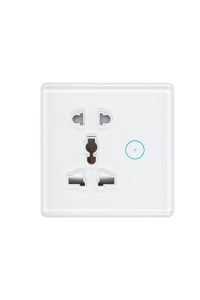
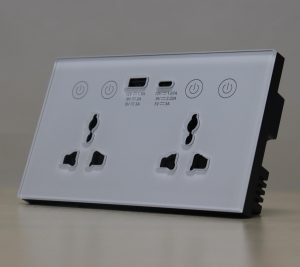
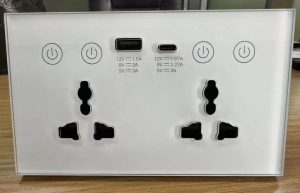
  • Energy figures you can look at. If you want to know what the heater costs per week, a socket with metering such as the 16 A socket with energy monitoring reports it directly. Our guide to energy monitoring on smart plugs covers how to read those numbers.

Place the sensor where it means something. A plug measuring temperature at floor level next to a heater will report a warm room while you sit cold two metres away; that is the most common reason people conclude the plug is inaccurate.

Thermostat plug versus a proper thermostat

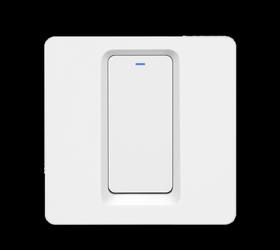
A plug controls one heater at the socket. If you want to control a boiler or a whole heating circuit from the wall, that is a switch or a thermostat wired into the system, not a plug — the trade-offs are set out in our comparison of smart thermostats versus smart switches for heating. And if the room’s switch box is what you are replacing, check whether there is a neutral Wire before ordering, which our no-neutral guide covers.

For a permanent installation rather than a plug-in one, the US standard smart socket or a matching 86 × 86 socket from the same series as your switches keeps the wall looking like one unit. If you are building automations around it, the MPH-S1 socket gateway acts as both an outlet and a hub for the sensors feeding it, and a separate temperature and humidity sensor lets you measure the far side of the room instead of the floor.

Where it should not be used

Three situations where a thermostat plug is the wrong answer. Any heater with a motorised or electronic control panel that loses its settings on power loss — a plug cycling it will wipe the setting every time. Anything safety-related that must never be switched off remotely, such as a heater in a room where pipes could freeze. And loads near or above the plug’s rating, where the correct fix is a properly rated contactor and a thermostat, not a smarter plug.

Frequently Asked Questions

Will a thermostat plug actually cut my heating bill?

It cuts the hours the heater runs while nobody is there, which is usually the largest avoidable part of the bill. It does not make a heater more efficient — a 2000 W heater still draws 2000 W when it is on.

Can I use it with an oil-filled radiator?

Yes, and they suit it well: they have mechanical switches that survive power cuts, and their slow thermal response pairs well with a hysteresis setting.

What about an extension lead?

No. High continuous loads should go straight into a wall outlet. If you must, use a properly rated single-outlet lead, uncoiled, and never daisy-chained.

Does it still work if the WiFi drops?

The schedule stored on the device keeps running; app control and remote changes do not. Set the schedule to survive a router reboot rather than depending on an automation in the cloud.

Related Articles

You Might Also Like

Posted on — Leave a comment

Water Heater Switches: Why a 20 A / 40 A Smart Switch Is Not the Same as a Light Switch

water heater switches - Water Heater Switches: Why a 20 A / 40 A Smart Switch Is Not the Same as a Light Switch
Water Heater Switches: Why a 20 A / 40 A Smart Switch Is Not the Same as a Light Switch

A water heater is the One load in a home that runs at full power for an hour at a time, day after day. That is a different job from switching a 60 W lamp, and it is why “just use a Smart Switch” is bad advice on a heater circuit. Here is what to look for, and how the EU and US plates differ.

The rating is the whole point

Lighting Switches are typically rated 600 W per gang. A storage heater wants 20 A / 4000 W and an instant heater wants 40 A / 8000 W, held continuously, not for a few seconds. A switch that is not built for that will run hot at the relay and eventually weld shut — which is the failure mode you really do not want on a water heater.

EU or US plate

EU models are 86 × 86 mm for European, British and GB boxes and carry CE / ROHS. US models are 118 × 72 mm for US, Australian, Italian, Canadian, Brazilian, Vietnamese and Thai boxes and carry FCC. Match the box; everything else — app, schedules, voice — is identical on both. Wiring the DS-126 Series: Single-Fire, Zero-Fire and the Capacitor Question

Which protocol

  • WiFi — simplest commissioning, straight to the router via Tuya / Smart Life.
  • Zigbee — needs a gateway, but gives mesh coverage and low standby draw; good for whole-building projects.
  • HomeKit — pairs directly with Apple Home, no bridge app.
  • Pure Touch — no network at all, for sites Where the heater must stay off the network.

Touch or push button

Glass touch plates look right in living spaces; push-button plates are better Where hands are wet or Where a physical click is expected. Both are made on the same high-power boards.

What the app adds

The point of putting a heater on a Smart switch is the timer: heat for 30, 60, 90 or 120 minutes instead of leaving the element on all day, plus power statistics so you can see what it actually costs. Most models here also have a child lock.

FAQ

Do I need 20 A or 40 A?
20 A / 4000 W covers a Standard storage heater. Choose 40 A / 8000 W for instant heaters and other heavy resistive loads.
Is a neutral required?
Most heater switches here are zero-fire; check the model line before ordering.
Can it report energy use?
Several models in the range include power statistics in the app.

Ready to specify it? Full specifications, gang options, colors and quantity pricing are on the Smart Water Heater Switch — EU 86 × 86 mm & US 118 × 72 mm, WiFi / ZigBee / HomeKit / Pure Touch product page — OEM logo, manual and packaging are available from the first order.

Related Articles

You Might Also Like
Frequently Asked Questions

Is Water Heater Switches worth buying?

Based on the breakdown in this article, Water Heater Switches offers a solid mix of features and value. If your main goal matches the key benefits described above, it is a practical choice for everyday use.

How do I choose the right water heater switches for my needs?

Start with your core use case, then compare battery life, compatibility, and build quality as covered above. Choosing the right water heater switches comes down to matching specs with how you actually use it.

Does water heater switches require a companion app?

Most devices of this type pair with a free companion app for setup and firmware updates. A few advanced features may sit behind a paid plan, so check the official specs page before buying.

Posted on — Leave a comment

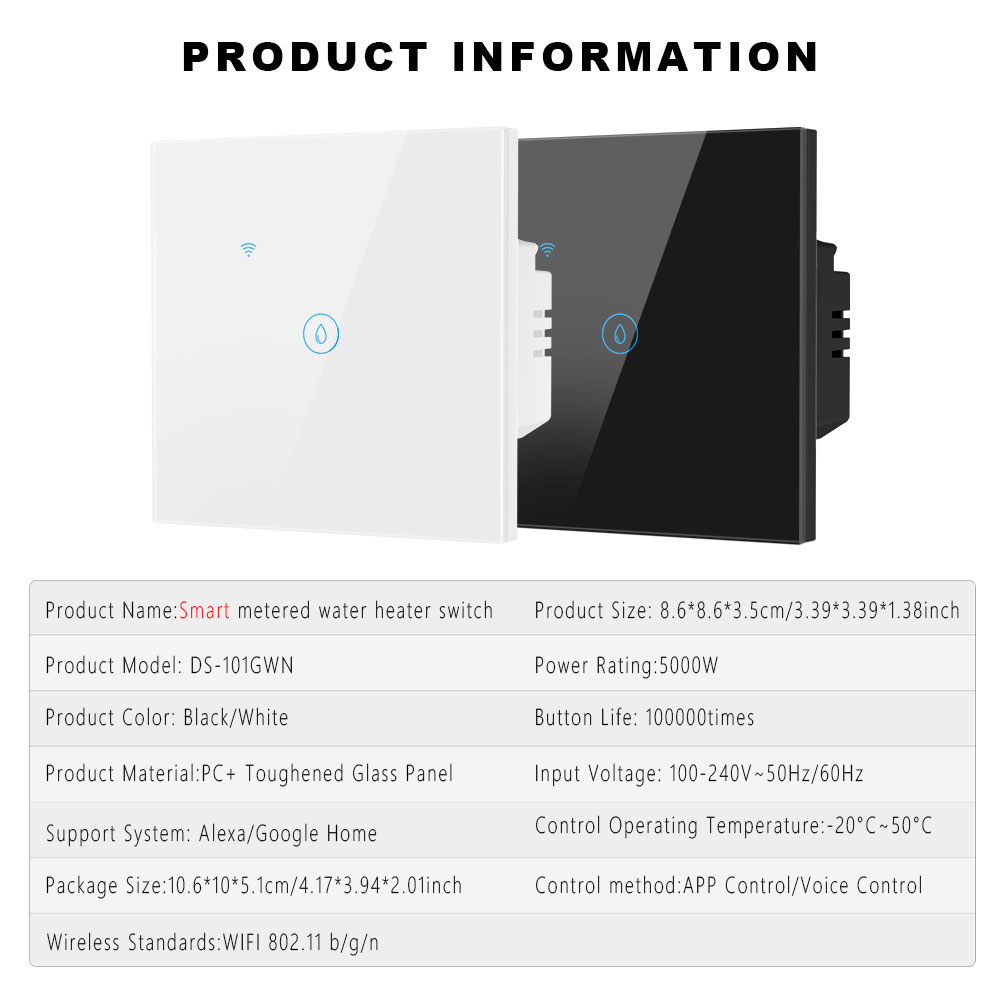
DS-101GWN Smart Water Heater Switch: WiFi Energy Monitoring, Overload Protection and Voice Control

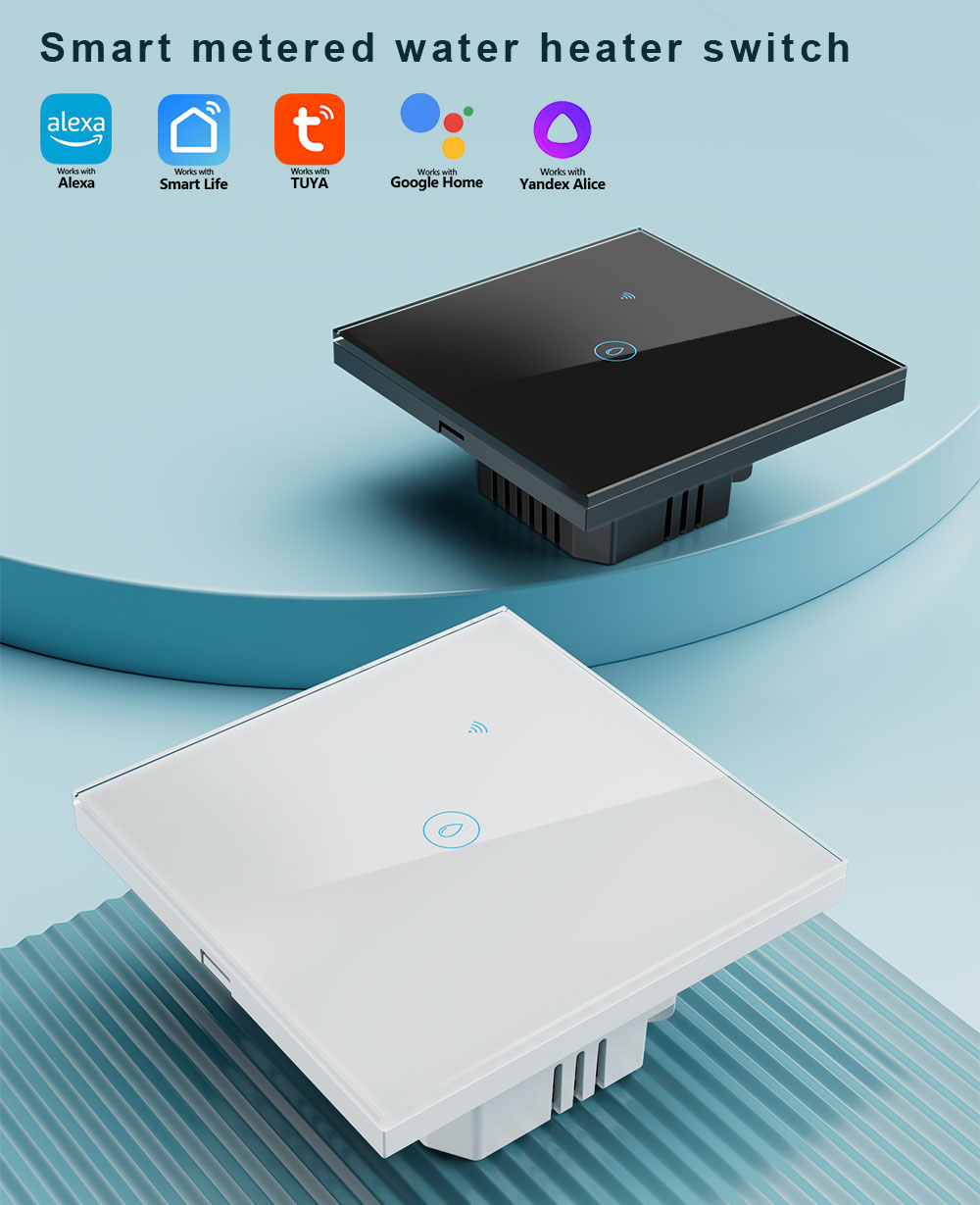
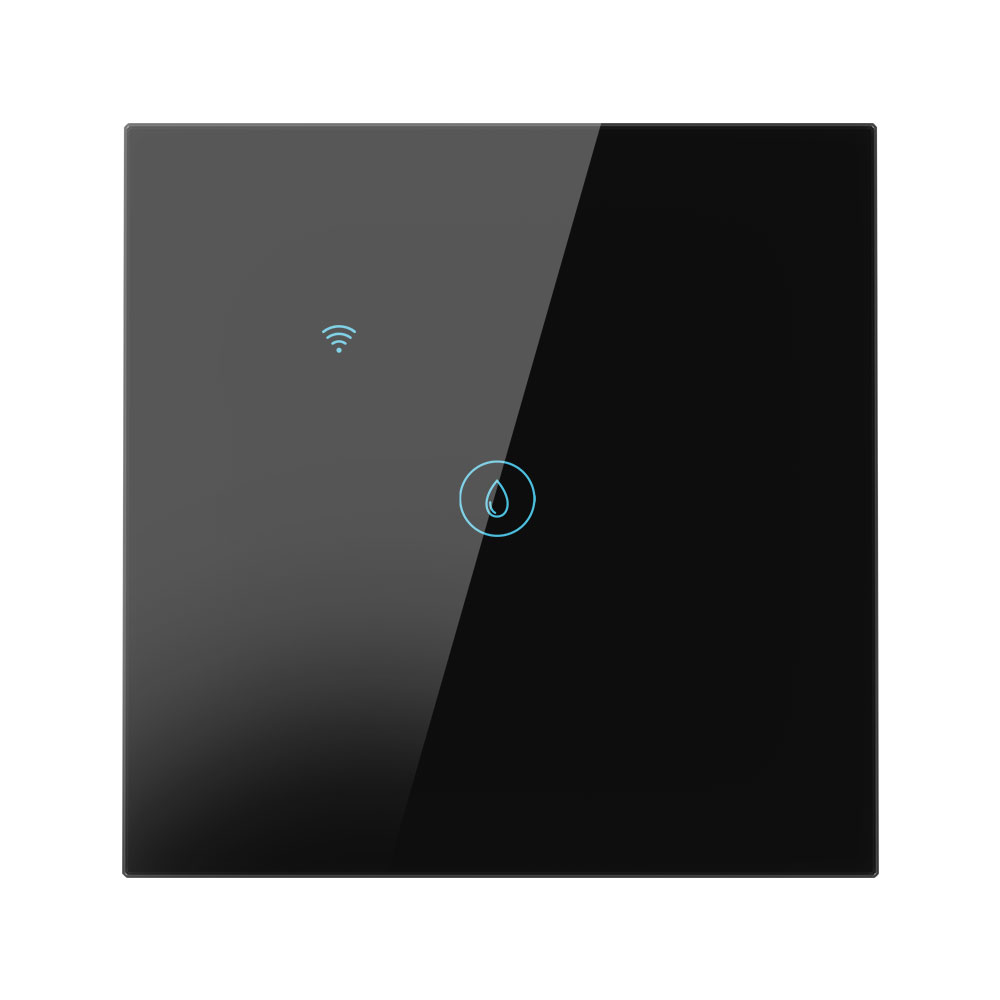
Electric water heaters are among the heaviest loads in any home, hotel room or rental apartment. Leaving them powered around the clock wastes energy, and switching them on and off by hand every day is not realistic. The DS-101GWN Smart metered water heater switch closes that gap: a 5000W high-power smart switch in a Standard 86 mm wall plate, with real-time electricity statistics, overload protection, timers, away mode and voice control.

This guide covers what the DS-101GWN does, the specifications your procurement team needs, how it is wired, and how it fits hotel, apartment and modern-home projects.

Why Water Heaters Need a Dedicated Smart Switch

A standard lighting switch is not built for a resistive load that can run for hours. Water heater retrofits usually fail for three reasons:

  • Current and power rating. A 3000-5000W heater needs switching hardware rated well above a typical lighting circuit.
  • Heat build-up. Long duty cycles demand larger contact area and proper heat dissipation.
  • No feedback. Without metering, neither the property owner nor the installer knows how much energy the heater really consumes.

The DS-101GWN is designed specifically for this load class, using the same 86 mm form factor as the rest of our smart switch range, so it retrofits into existing wall boxes without rework.

DS-101GWN smart metered water heater switch specifications

Key Features of the DS-101GWN

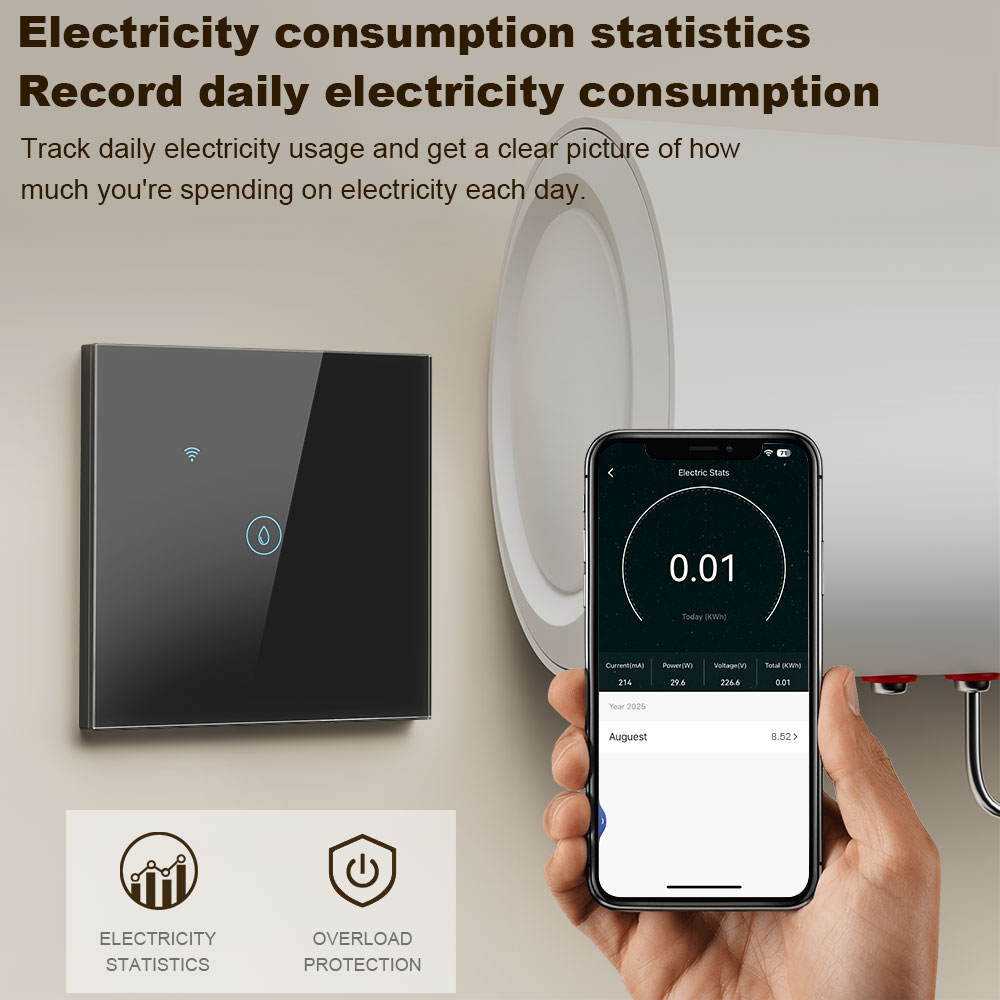
1. Real-Time Electricity Statistics

Voltage, current, power and accumulated energy consumption are measured inside the switch and displayed in the app. Property managers can see which rooms consume the most, and guests or tenants can be billed against actual usage instead of a flat fee.

DS-101GWN energy monitoring in the mobile app

2. Overload Protection

When the connected load exceeds the safe threshold, the switch cuts the circuit instead of letting the relay and Wiring overheat. This is the single most requested feature from hotel and apartment operators, because a failed water heater circuit can take a whole floor offline.

3. Voice Control with Alexa and Google Home

The DS-101GWN pairs with Amazon Alexa and Google Home, so the heater can be switched by voice in hands-free applications, while the physical Touch panel keeps working normally for users who prefer it.

DS-101GWN compatible with Alexa and Google Home

4. Countdown Timer and Weekly Schedules

Set a 30-minute boost before a shower, or schedule the heater to run only during off-peak hours. Schedules run on the device itself, so heating still follows the routine even if the Wi-Fi network drops.

5. Away Mode

Away mode cuts the circuit automatically when the property is vacant, which is useful for serviced apartments, holiday rentals and second homes Where heaters would otherwise stay on for weeks.

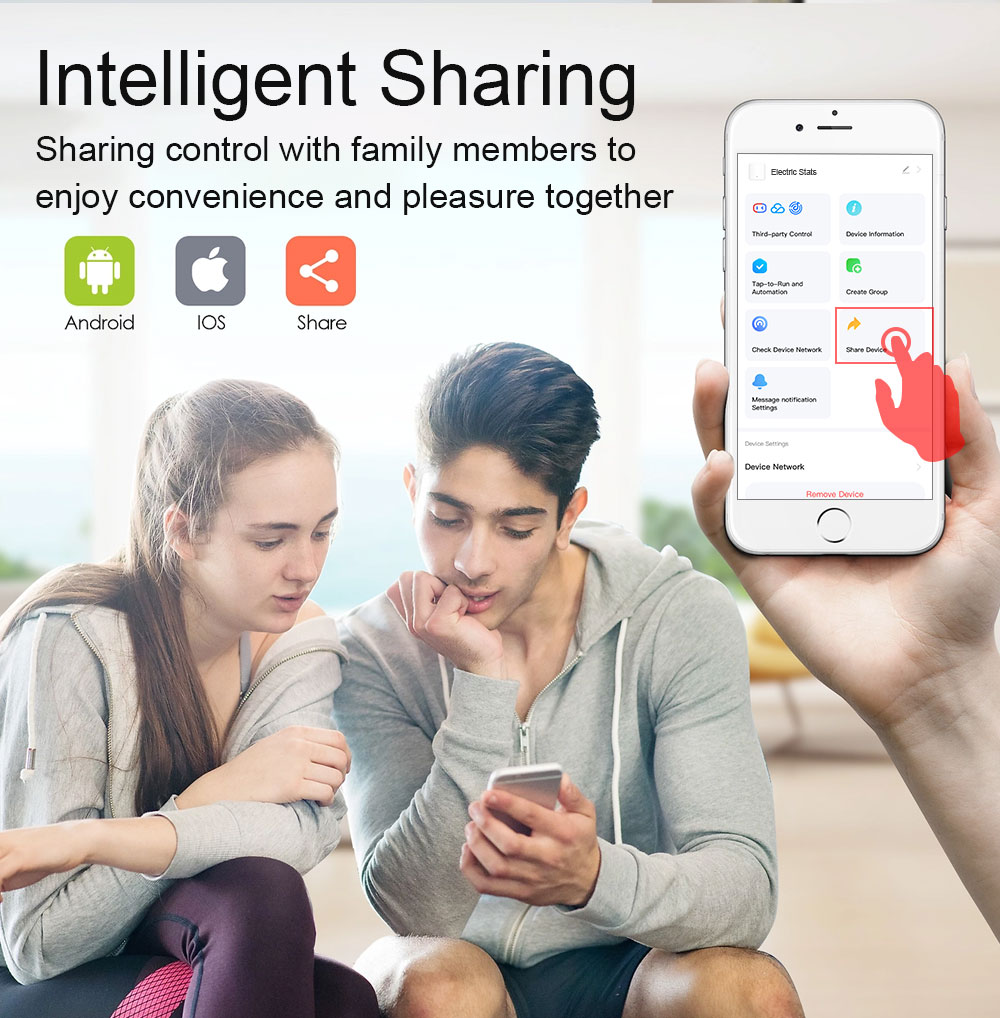
6. Family Sharing and Multi-User Control

Several accounts can control the same switch, with permission levels for owners, managers and family members. That makes the unit suitable for households as well as small property teams.

DS-101GWN family sharing and multi-user control

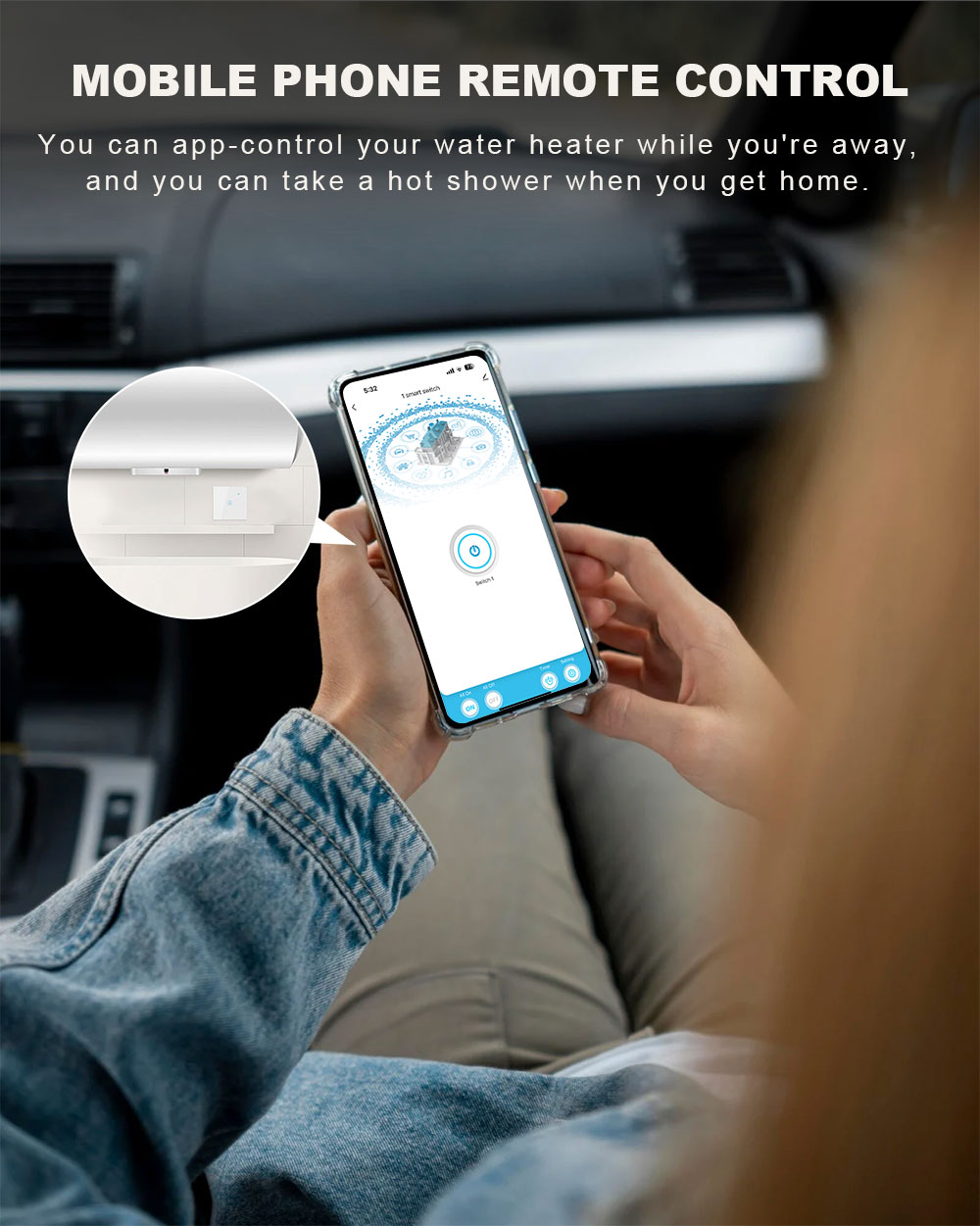
7. Remote Control from Anywhere

Once paired with the app, the heater can be switched on before arrival and turned off after leaving – a practical feature for landlords and short-stay operators who need to protect their energy budget.

DS-101GWN remote control of the water heater from the app

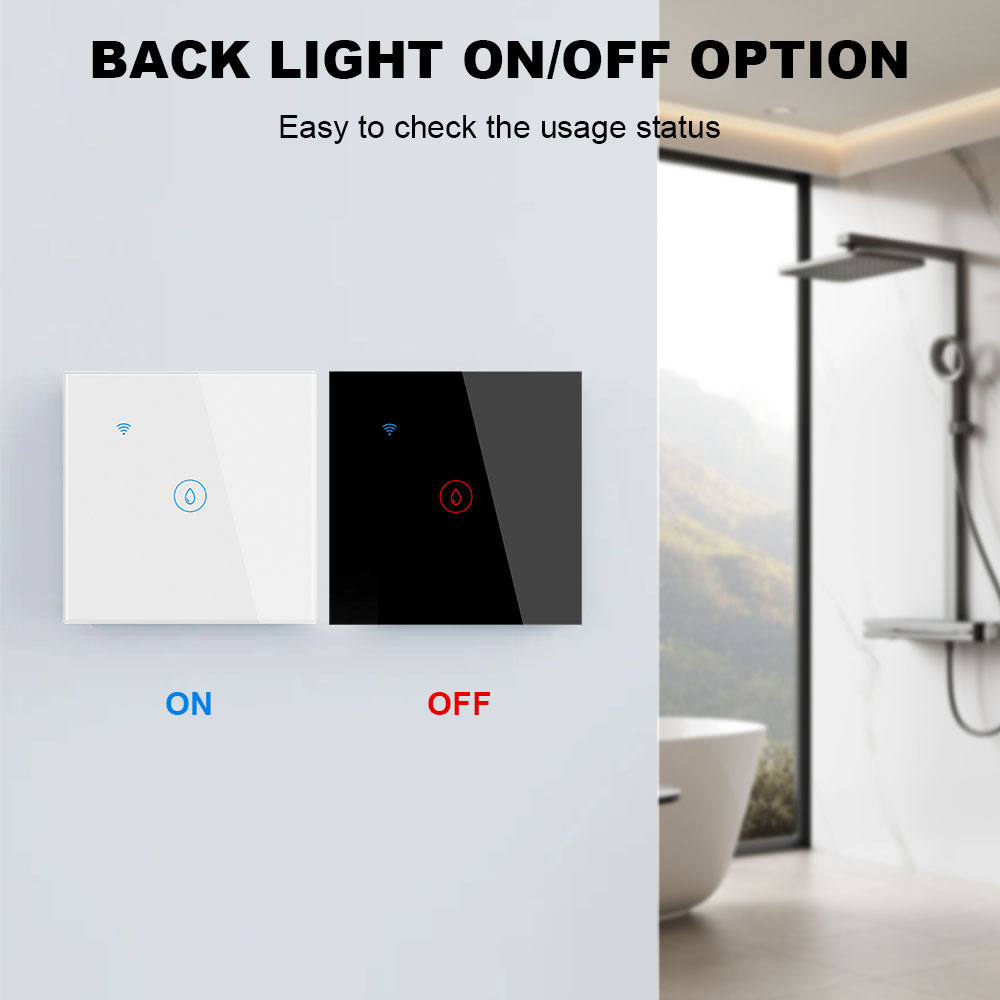
8. Black Glass Touch Panel with Backlight

The tempered glass front is available in black or white, with a backlit touch panel that stays readable in dark corridors and hotel bathrooms. The panel carries a 100,000-press button life rating.

DS-101GWN backlit touch panelDS-101GWN black glass panel WiFi switch

DS-101GWN Specifications

Product name Smart metered water heater switch
Model DS-101GWN
Colour options Black / White
Material PC + toughened glass panel
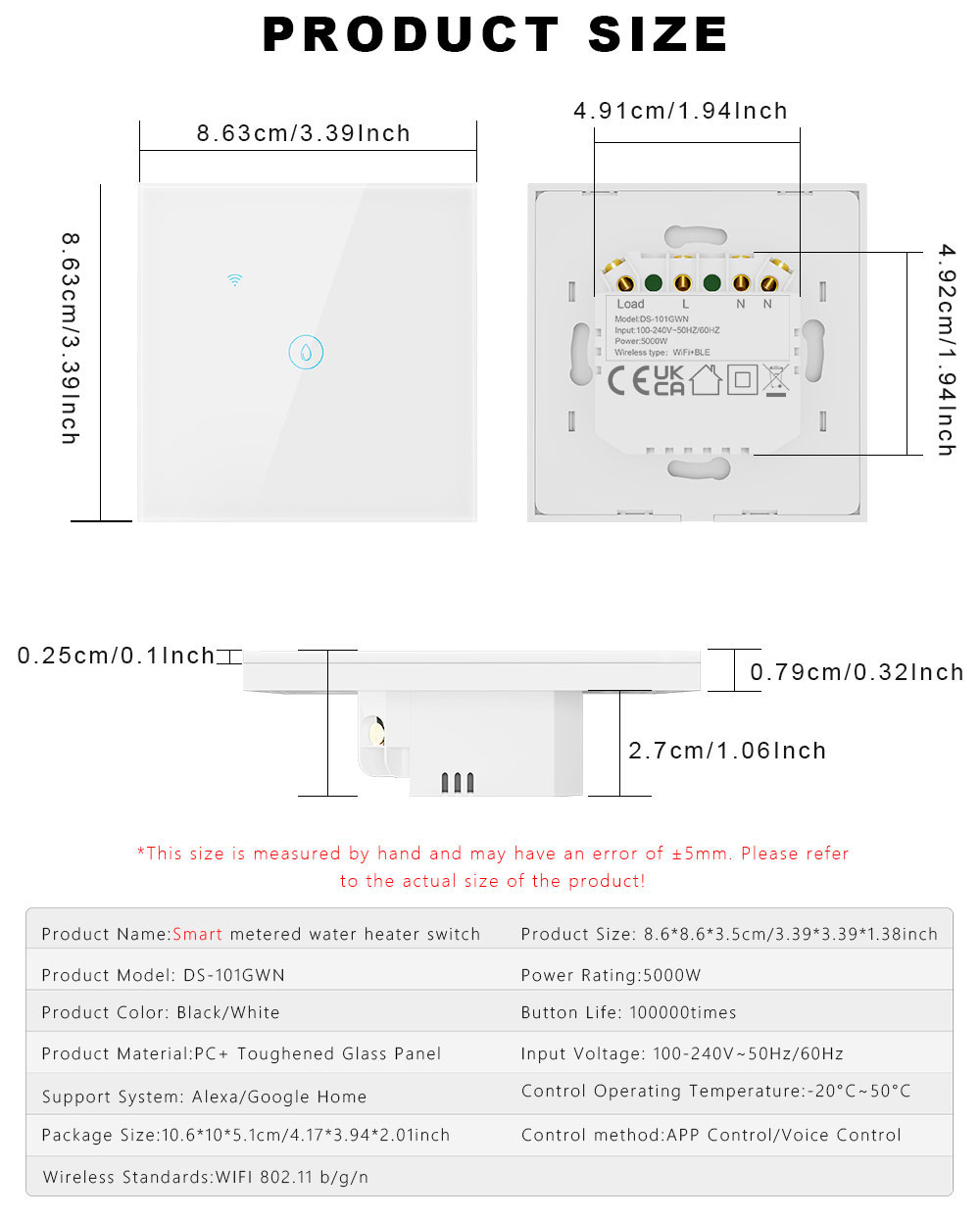
Product size 86 x 86 x 35 mm (3.39 x 3.39 x 1.38 in)
Input voltage 100-240V~ 50Hz/60Hz
Power rating 5000W
Wireless standard WiFi 802.11 b/g/n (Wi-Fi + BLE)
Control method Touch panel / App / Voice
Compatible systems Amazon Alexa, Google Home
Button life 100,000 presses
Operating temperature -20C to 50C
Package size 106 x 100 x 51 mm (4.17 x 3.94 x 2.01 in)
Markings CE, UKCA

Dimensions, Wiring and Installation

The switch uses the international 86 mm wall box standard. Terminals are marked L, N and N (load L / N / N), and the wall plate is 8.6 cm square with a 2.5 mm glass front and a mounting bracket projecting 0.79 cm from the wall. Hand-measured dimensions may vary by +/-5 mm.

DS-101GWN dimensions and wiring specifications

Installation follows the standard sequence used across the range: isolate the circuit, verify the wiring against the diagram, fix the unit into the wall box, fit the panel and restore power. For a step-by-step walkthrough of the same platform, see our guide on how to install a WiFi touch smart switch.

Typical Applications

Certification, Packaging and Quality Control

Units carry CE and UKCA markings and are produced with PC flame-retardant housings and tempered glass panels. Each batch is function-tested before packing, and OEM packaging with your own brand, manual and barcode is available.

OEM, ODM and Wholesale Support

We supply the DS-101GWN to distributors, importers and project contractors, with support for custom logos, colour selection, packaging design and private-label firmware. Because we are a factory-direct OEM and ODM smart switch and socket manufacturer, MOQ and lead time can be quoted against your project schedule. Request the datasheet and price list for your market before finalising a tender.

FAQ

Does the DS-101GWN require a neutral wire?
Yes – the device uses L and N supply terminals, so a neutral conductor must be present in the wall box.

What is the maximum load?
The switch is rated at 5000W with an input range of 100-240V~, which covers the large majority of domestic and hospitality water heaters. Confirm the actual heater rating before installation.

Can it work without the app?
Yes. The touch panel and the schedules stored on the device continue to work; the app is needed only for remote control, metering history and firmware updates.

Which app and voice assistants are supported?
The switch works with Amazon Alexa and Google Home, and with the standard Tuya-based smart life ecosystem.

Do you support custom branding?
Yes. Logo printing, custom packaging, manual localisation and firmware branding are available for volume orders.

Related Reading

Related Articles

You Might Also Like
Frequently Asked Questions

Is 101gwn Smart Water worth buying?

Based on the breakdown in this article, 101gwn Smart Water offers a solid mix of features and value. If your main goal matches the key benefits described above, it is a practical choice for everyday use.

How do I choose the right 101gwn smart water for my needs?

Start with your core use case, then compare battery life, compatibility, and build quality as covered above. Choosing the right 101gwn smart water comes down to matching specs with how you actually use it.

Does 101gwn smart water require a companion app?

Most devices of this type pair with a free companion app for setup and firmware updates. A few advanced features may sit behind a paid plan, so check the official specs page before buying.

Posted on — Leave a comment
DS-101GWN Smart Water Heater Switch: WiFi Energy Monitoring, Overload Protection and Voice Control
ds-101gwn-smart-switch-specifications

Electric water heaters are among the heaviest loads in any home, hotel room or rental apartment. Leaving them powered around the clock wastes energy, and switching them on and off by hand every day is not realistic. The DS-101GWN Smart metered water heater switch closes that gap: a 5000W high-power smart switch in a Standard 86 mm wall plate, with real-time electricity statistics, overload protection, timers, away mode and voice control.

This guide covers what the DS-101GWN does, the specifications your procurement team needs, how it is wired, and how it fits hotel, apartment and modern-home projects. Reolink vs Tuya Security Camera

Why Water Heaters Need a Dedicated Smart Switch

A standard lighting switch is not built for a resistive load that can run for hours. Water heater retrofits usually fail for three reasons:

  • Current and power rating. A 3000–5000W heater needs switching hardware rated well above a typical lighting circuit.
  • Heat build-up. Long duty cycles demand larger contact area and proper heat dissipation.
  • No feedback. Without metering, neither the property owner nor the installer knows how much energy the heater really consumes.

The DS-101GWN is designed specifically for this load class, using the same 86 mm form factor as the rest of our smart switch range, so it retrofits into existing wall boxes without rework.

DS-101GWN smart metered water heater switch specifications

Key Features of the DS-101GWN

1. Real-Time Electricity Statistics

Voltage, current, power and accumulated energy consumption are measured inside the switch and displayed in the app. Property managers can see which rooms consume the most, and guests or tenants can be billed against actual usage instead of a flat fee.

DS-101GWN energy monitoring in the mobile app

2. Overload Protection

When the connected load exceeds the safe threshold, the switch cuts the circuit instead of letting the relay and Wiring overheat. This is the single most requested feature from hotel and apartment operators, because a failed water heater circuit can take a whole floor offline.

3. Voice Control with Alexa and Google Home

The DS-101GWN pairs with Amazon Alexa and Google Home, so the heater can be switched by voice in hands-free applications, while the physical Touch panel keeps working normally for users who prefer it.

DS-101GWN compatible with Alexa and Google Home

4. Countdown Timer and Weekly Schedules

Set a 30-minute boost before a shower, or schedule the heater to run only during off-peak hours. Schedules run on the device itself, so heating still follows the routine even if the Wi-Fi network drops.

5. Away Mode

Away mode cuts the circuit automatically when the property is vacant, which is useful for serviced apartments, holiday rentals and second homes Where heaters would otherwise stay on for weeks.

6. Family Sharing and Multi-User Control

Several accounts can control the same switch, with permission levels for owners, managers and family members. That makes the unit suitable for households as well as small property teams.

DS-101GWN family sharing and multi-user control

7. Remote Control from Anywhere

Once paired with the app, the heater can be switched on before arrival and turned off after leaving — a practical feature for landlords and short-stay operators who need to protect their energy budget.

DS-101GWN remote control of the water heater from the app

8. Black Glass Touch Panel with Backlight

The tempered glass front is available in black or white, with a backlit touch panel that stays readable in dark corridors and hotel bathrooms. The panel carries a 100,000-press button life rating.

DS-101GWN backlit touch panel
DS-101GWN black glass panel WiFi switch

DS-101GWN Specifications
Product name Smart metered water heater switch
Model DS-101GWN
Colour options Black / White
Material PC + toughened glass panel
Product size 86 × 86 × 35 mm (3.39 × 3.39 × 1.38 in)
Input voltage 100–240V~ 50Hz/60Hz
Power rating 5000W
Wireless standard WiFi 802.11 b/g/n (Wi-Fi + BLE)
Control method Touch panel / App / Voice
Compatible systems Amazon Alexa, Google Home
Button life 100,000 presses
Operating temperature -20°C to 50°C
Package size 106 × 100 × 51 mm (4.17 × 3.94 × 2.01 in)
Markings CE, UKCA
Dimensions, Wiring and Installation

The switch uses the international 86 mm wall box standard. Terminals are marked L, N and N (load L / N / N), and the wall plate is 8.6 cm square with a 2.5 mm glass front and a mounting bracket projecting 0.79 cm from the wall. Hand-measured dimensions may vary by ±5 mm.

DS-101GWN dimensions and wiring specifications

Installation follows the standard sequence used across the range: isolate the circuit, verify the wiring against the diagram, fix the unit into the wall box, fit the panel and restore power. For a step-by-step walkthrough of the same platform, see our guide on how to install a WiFi touch smart switch.

Typical Applications
Certification, Packaging and Quality Control

Units carry CE and UKCA markings and are produced with PC flame-retardant housings and tempered glass panels. Each batch is function-tested before packing, and OEM packaging with your own brand, manual and barcode is available.

OEM, ODM and Wholesale Support

We supply the DS-101GWN to distributors, importers and project contractors, with support for custom logos, colour selection, packaging design and private-label firmware. Because we are a factory-direct OEM and ODM smart switch and socket manufacturer, MOQ and lead time can be quoted against your project schedule. Request the datasheet and price list for your market before finalising a tender.

FAQ

Does the DS-101GWN require a neutral wire?
Yes — the device uses L and N supply terminals, so a neutral conductor must be present in the wall box.

What is the maximum load?
The switch is rated at 5000W with an input range of 100–240V~, which covers the large majority of domestic and hospitality water heaters. Confirm the actual heater rating before installation.

Can it work without the app?
Yes. The touch panel and the schedules stored on the device continue to work; the app is needed only for remote control, metering history and firmware updates.

Which app and voice assistants are supported?
The switch works with Amazon Alexa and Google Home, and with the standard Tuya-based smart life ecosystem.

Do you support custom branding?
Yes. Logo printing, custom packaging, manual localisation and firmware branding are available for volume orders.

Related Reading

Related Articles

You Might Also Like
Frequently Asked Questions

Is 101gwn Smart Water worth buying?

Based on the breakdown in this article, 101gwn Smart Water offers a solid mix of features and value. If your main goal matches the key benefits described above, it is a practical choice for everyday use.

How do I choose the right 101gwn smart water for my needs?

Start with your core use case, then compare battery life, compatibility, and build quality as covered above. Choosing the right 101gwn smart water comes down to matching specs with how you actually use it.

Does 101gwn smart water require a companion app?

Most devices of this type pair with a free companion app for setup and firmware updates. A few advanced features may sit behind a paid plan, so check the official specs page before buying.

Posted on — Leave a comment

Smart Switch for Water Heater and AC

A water heater, an air conditioner and a bedside lamp do not ask the same thing from a switch, and the number that separates them is the current rating. Get that number wrong and the switch either trips, runs hot, or quietly dies in a few months — so this is the one specification worth reading before you buy.

Start from the appliance, not the switch

Every Smart switch, socket or controller carries a maximum current, usually printed as 10 A, 16 A or 20 A. Convert your appliance first: Reolink vs Tuya Security Camera

  • Amps ≈ watts ÷ volts. A 2,000 W heater on 230 V draws about 8.7 A. The same heater on 120 V draws about 16.7 A.
  • Motors are different. An air conditioner, a pump or a fan has a compressor or motor with a startup surge that can be several times the running current. The switch must be rated for that surge, not just the running figure.
  • Continuous loads need headroom. Anything that runs for hours — a water heater, a floor heating mat, a towel rail — should sit at roughly 80% of the switch rating or less.

So a 16 A switch at 230 V is comfortable to about 3,600 W of resistive load, and noticeably less than that for a motor load.

What each appliance actually needs

Water heaters and boilers

Heating elements are resistive and predictable: check the element rating on the nameplate and size the switch above it. What most people actually want here is not just on/off but temperature control — a controller with a probe that switches by measured temperature rather than by clock, so the tank reaches the Set point and stops. That is a different product from a plain switch and it usually saves more energy than any schedule.

Air conditioners

An AC unit is the hardest case in a house: inductive load, large startup surge, and it often runs for hours. Two safe approaches:

  • A switch rated well above the unit’s running current, specified for motor or inductive loads.
  • Infrared control instead of switching power — a universal IR controller sends the same commands as the remote Without touching the wiring at all. This is the low-risk answer and the one most installers prefer for split units.

Floor heating

Heating mats and cables are resistive but continuous, and they are usually paired with a thermostat rather than a switch: a 16 A floor-heating thermostat with a floor probe and a boiler relay covers both electric mats and gas boilers. A plain switch here is the wrong product — the comfort gain comes from temperature control and scheduling together.

Fans, pumps and curtains

Ceiling fans and curtain motors are smaller loads but still inductive, and fan speed control is not the same as dimming a lamp. Look for a panel with a dedicated fan or curtain channel rather than repurposing a light dimmer.

Wall switch, socket, or controller?

  • Wall switch (10-16 A): replaces the plate and controls a fixed circuit — best for heaters on their own circuit and for room lighting.
  • Smart socket (16 A): controls the appliance plugged into it and measures what it consumes. Best when the appliance is already on a plug, and the metering is genuinely useful for a heater.
  • Temperature controller: switches by measured temperature. Best for water heaters, floor heating, heat mats, incubators and aquariums.
  • IR controller: no power switching at all. Best for air conditioners and TVs.

Safety checklist before you order

  • Read the appliance nameplate for watts and current, and note whether it is a motor load.
  • Choose a rating with headroom — a 16 A device for a 10 A continuous load, not a 10 A device for a 9 A load.
  • Check the switch is specified for the load type: resistive, inductive or motor.
  • Never put a heater or an AC unit on a plug-in Smart plug rated below the appliance, and never daisy-chain extension leads through one.
  • Confirm the circuit itself is protected correctly; a smart device is not a substitute for a correctly-sized breaker and RCD.
  • When in doubt, or where local regulations require it, have an electrician fit it — high-current work is not the place to improvise.

XingLiao switches, sockets and controllers for high loads

Frequently Asked Questions

What does 16A mean on a smart switch?

It is the maximum current the relay can switch continuously — about 3,600 W at 230 V or roughly 1,900 W at 120 V for a resistive load. Motor loads need more headroom than the running figure suggests.

Can I put an air conditioner on a smart switch?

Sometimes, with a switch rated well above the unit’s running current and specified for motor loads. The safer alternative for split units is an infrared controller that sends the remote’s commands without switching the power at all.

Do I need a thermostat or just a switch for floor heating?

A thermostat. Floor heating needs temperature feedback from a floor probe, and the comfort and energy savings come from controlling to temperature, not from switching mains on a timer.

Why does my smart switch get warm?

Some warmth is normal under load, but a switch that is hot to the touch is undersized or poorly terminated. Check the load against the rating and have the connections inspected.

Can I use a smart plug for a heater?

Only if the plug’s rating exceeds the heater’s draw — a 2,000 W heater on 230 V needs a plug rated comfortably above 8.7 A. Many small smart plugs are 10 A and should not run heaters continuously.

Is energy monitoring useful on high-load devices?

Very. Heating and cooling are usually the largest loads in a home, and a metering socket turns “I think the heater is expensive” into a number you can act on.

Related guides

Browse all smart switches and sockets · Tell us the appliance and its rating and we will match the right switch

Related Articles

You Might Also Like