A second lens on a Securitycamera is easy to dismiss as a spec-sheet trick. In practice it solves a specific problem that a single lens cannot: you cannot simultaneously watch a whole room and read a detail in it. Wide enough to see everything means too wide to identify anything.
The fixed lens holds a constant view of the whole scene while the PTZ lens pans, tilts and zooms to follow movement. The value is that you never lose the overview: a single-lens PTZ Camera that swings away to follow somebody leaves you blind to whatever happens behind it. With two lenses, the overview keeps recording whatever the tracking lens is doing.
2. One wide lens plus one telephoto lens
Both lenses point at the same scene at different focal lengths. You get a wide context shot and a tight detail shot of the same moment — the difference between “a person approached the door” and “here is a readable face and the parcel they carried”.
Where a dual-lens camera earns its cost
Driveways and forecourts — the overview catches the vehicle, the detail lens catches the plate or the driver.
Shop floors and small warehouses — one camera covers the aisle and the till without a second install.
Large gardens — the fixed lens watches the gate, the PTZ follows whoever comes through it.
Where it does not: a small room, a corridor, or anywhere a single wide lens already covers everything you care about. If the space is smaller than about 25 square metres and has one entrance, one lens is enough and cheaper.
What to check on the spec sheet
Which lens does the tracking? On PTZ designs, confirm the moving lens is the one with optical zoom.
Night behaviour of both lenses. Two lenses need two sets of IR LEDs; a model that lights only one leaves the other blind after dark.
Storage load. Two streams use roughly twice the card space. Size the card accordingly.
Resolution honesty. A “6 MP” figure often describes the combined or the higher lens. Check per-lens resolution.
Installation notes
Dual-lens units are physically larger and heavier than a Mini camera, and the outdoor PTZ versions need a solid fixing — a soffit, a wall with proper plugs, not a fence panel that moves in the wind. Mount high enough to be out of reach but Low enough that the detail lens has a usable angle on faces; roughly 2.5 to 3.5 metres works outdoors.
Does a dual-lens camera record two videos at once?
Yes — both streams are recorded, and the app lets you view them together or separately.
Is auto-tracking useful or annoying?
Useful outdoors with pets and passing cars if sensitivity is tuned; annoying in a busy scene where it chases everything. Most models let you set tracking zones.
Can I turn one lens off?
Usually you can disable a view in the app, which is a way to halve storage use if you only need one angle.
Does it work at night?
Yes, provided both lenses have infrared or full-colour night support — check this per model rather than assuming.
Do I need a subscription for auto-tracking?
No, tracking runs on the camera itself. Cloud storage is a separate, optional service.
Based on the breakdown in this article, Dual Lens Security offers a solid mix of features and value. If your main goal matches the key benefits described above, it is a practical choice for everyday use.
How do I choose the right dual lens security for my needs?
Start with your core use case, then compare battery life, compatibility, and build quality as covered above. Choosing the right dual lens Security comes down to matching specs with how you actually use it.
Does dual lens security require a companion app?
Most devices of this type pair with a free companion app for setup and firmware updates. A few advanced features may sit behind a paid plan, so check the official specs page before buying.
📌 This article is part of our Complete What Hub — more guides and buying tips inside.
KT-A36 Dual-Lens Security Camera Review: One Camera, Two Views, Zero Blind Spots
When was the last time you wished you had eyes in two places at once? The KT-A36 dual-lens security camera answers that question in a single device. Combining a fixed bullet lens and a PTZ dome lens in one unit, the KT-A36 turns one camera into two — covering two areas simultaneously without buying, wiring, or maintaining a second system.
In this review, we walk through the features that make the KT-A36 a Smart pick for homes, shops, warehouses, and yards, and how its dual-view design solves the most common blind-spot problem in single-camera setups.
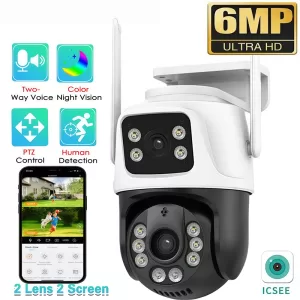
6MP dual-lens gun-ball security camera featuring 3MP×2 resolution, PTZ pan 355°/tilt 90°, full-color & 30m IR night vision, human auto-tracking, two-way audio, IP66 waterproof. Compatible with ICSEE app.
Why “One Camera, Two Views” Matters
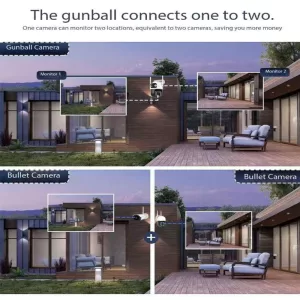
Most outdoor surveillance forces a trade-off. A fixed lens gives you a stable wide-angle view but can’t zoom in on details. A PTZ camera can pan, tilt, and zoom — but once it turns away, the area behind it is no longer visible. The KT-A36 ends that compromise with a gun-ball dual-lens design: a fixed bullet camera on top watching your main scene, and a PTZ dome camera on the bottom that can rotate freely to track what’s happening.
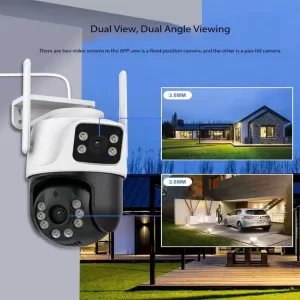
The result is a real-time dual-screen, dual-angle monitoring experience in the ICSEE app — one live view for the fixed overview, another for the PTZ close-up, side by side.
Gun-ball design connects one camera to two perspectives — wide bullet lens for the yard, PTZ dome for the entrance. One device does the work of two.
Dual-Lens System: Fixed Bullet + PTZ Dome
The KT-A36 pairs two distinct cameras in one housing:
Fixed bullet lens (3.6 mm wide-angle) — a stable overview of your yard, driveway, or storefront. Always on, always watching.
PTZ dome lens (Pan 355° / Tilt 90°) — pans left and right almost a full circle, tilts up and down 90°, and zooms in for detail. Use it to follow people, vehicles, or anything that moves.
Because the two lenses work independently, the fixed overview never goes dark while the PTZ lens is tracking. You get two perspectives, zero blind spots — from a single device.
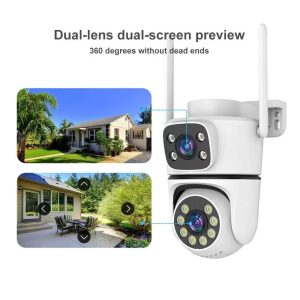
Dual-lens camera delivers two views simultaneously — wide-area coverage from the fixed bullet lens and detailed tracking from the PTZ dome lens.
3MP × 2 Resolution — Sharp Where It Matters
Each lens captures at 3MP, giving you sharp 1080p-class detail on both feeds. The combined dual-view system delivers up to 6MP of monitoring coverage, so license plates, faces, and package labels remain readable at typical home and shop distances.
Full-Color Night Vision + 30 m IR
Daytime clarity is the easy part. What sets the KT-A36 apart is its dual night-vision mode:
Full-color night vision keeps the scene in vivid color after dark, so you can see clothing colors, vehicle colors, and other contextual details.
Automatic IR night vision switches to crisp black-and-white infrared with a range of up to 30 meters (≈98 ft) in total darkness.
Whether it’s a backlit doorway or a dim parking lot, the KT-A36 produces a usable image.
Smart Human Detection and Automatic Tracking
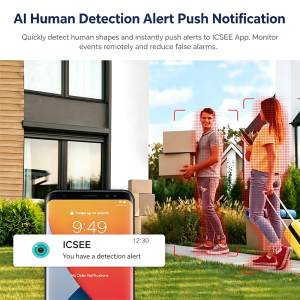
The KT-A36 isn’t just watching — it’s understanding. On-device AI human-shape detection filters out pets, leaves, headlights, and shadow movement. When a real person is detected:
Real-time alarm push sends an instant notification to the ICSEE app on your phone.
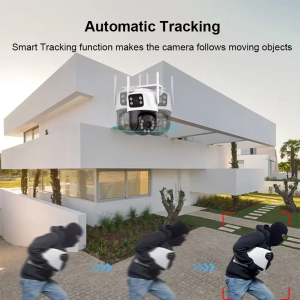
Automatic tracking kicks in: the PTZ dome lens rotates smoothly to keep the person centered in frame as they move.
You get precise alerts, fewer false alarms, and a complete visual record of the event.
Smart human detection recognizes people and sends real-time alarm push to your phone, filtering out false alerts from pets and moving objects.PTZ dome lens automatically tracks moving people, panning and tilting to keep subjects in frame for complete motion coverage.
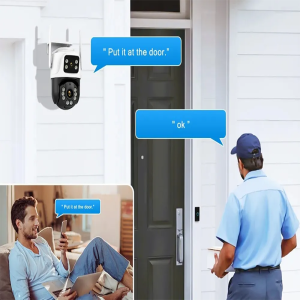
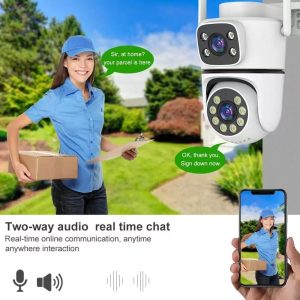
Two-Way Audio — Talk to Anyone at the Door
The built-in microphone and speaker turn the KT-A36 into a real communication device. When the delivery driver arrives, the kids get home, or an unknown visitor approaches, you can:
Greet visitors remotely through the ICSEE app.
Give instructions to delivery personnel (“Please leave it by the door”).
Deter intruders with a live voice warning.
All without being physically present.
Built-in speaker and microphone let you talk with visitors or warn intruders remotely through the ICSEE app on your phone.
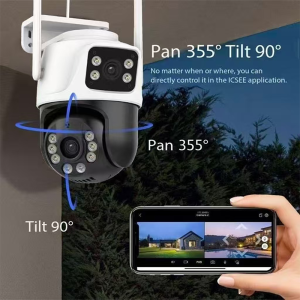
Relentless 355° / 90° PTZ Control
Take manual control whenever you need it. From the ICSEE app, you can rotate the PTZ dome lens a full 355° horizontally and 90° vertically, scanning the entire monitored area from your phone. It’s perfect for checking every corner after an alert, or following movement across a wide yard.
KT-A36 PTZ dome lens rotates 355° horizontally and 90° vertically, all controlled remotely from your phone for complete area coverage.
Flexible Storage: Cloud + TF Card
Footage is too valuable to lose. The KT-A36 supports both:
TF card (MicroSD) — local storage, no subscription required.
Use both for redundancy, or pick whichever fits your setup.
Dual Connectivity: WiFi and Wired
Install the camera where you need it. The KT-A36 supports both 2.4 GHz WiFi for flexible placement and wired Ethernet for rock-solid stability. Choose based on your site — a wired connection for a fixed storefront, WiFi for a backyard that doesn’t have network cabling.
H.265 Compression and Multi-Device Viewing
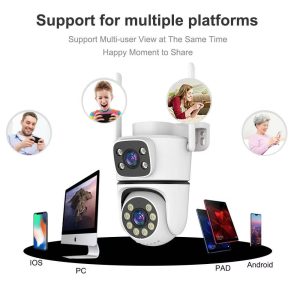
H.265 video compression cuts bandwidth and storage use by up to 50% compared with H.264, without sacrificing image quality. Share access with family members or coworkers so multiple devices and users can watch the live feed simultaneously — useful for home + shop, or manager + security team.
IP66 Weatherproof — Indoor and Outdoor
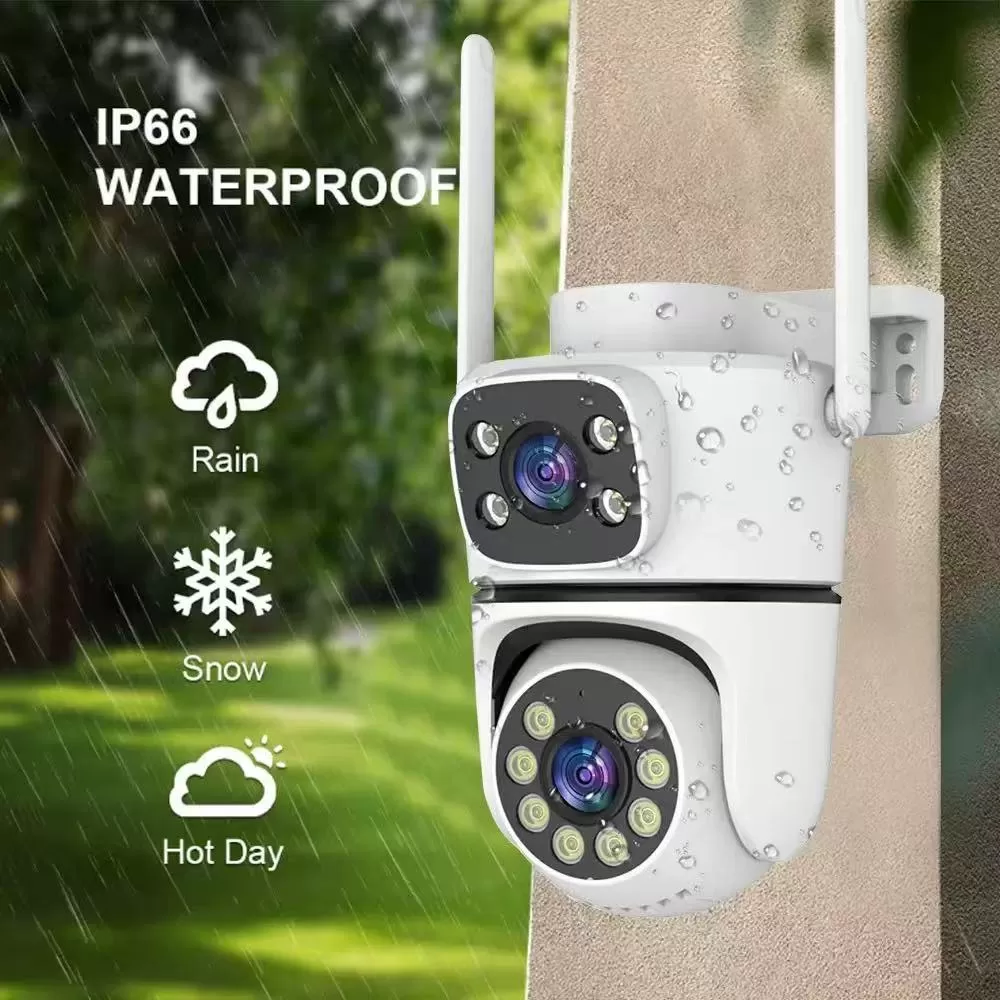
An IP66-rated plastic housing shrugs off rain, dust, and heat. Mount the KT-A36 on an exterior wall, under an eave, on a ceiling, or inside a workshop — same reliable performance.
Installation: Wall Mount or Ceiling Mount
The included adjustable bracket supports both wall-mounted and ceiling-mounted installations. Combined with 12V DC power, setup is simple for any homeowner or installer.
Who Is the KT-A36 For?
Homeowners — front door, backyard, garage, driveway.
Small business owners — shops, cafés, offices, storerooms.
Anyone who needs two views without the cost of two cameras.
Final Verdict
The KT-A36 dual-lens security camera is a smart, cost-effective solution for anyone tired of single-camera blind spots. The gun-ball dual-lens design delivers genuine simultaneous dual-view monitoring, with 3MP × 2 resolution, full-color night vision, 30 m IR, AI human detection with auto-tracking, two-way audio, and IP66 weatherproof durability — all controlled from the ICSEE app.
If you want professional-grade surveillance without the cost of a multi-camera system, the KT-A36 is hard to beat.
Looking for a smart dual-lens security camera that covers two areas at once? The KT-A36 is available now on our store — check the product page for current pricing and bundle options.
Based on the breakdown in this article, Dual Lens Security Camera offers a solid mix of features and value. If your main goal matches the key benefits described above, it is a practical choice for everyday use.
How do I choose the right dual lens security camera for my needs?
Start with your core use case, then compare battery life, compatibility, and build quality as covered above. Choosing the right dual lens security camera comes down to matching specs with how you actually use it.
Does dual lens security camera require a companion app?
Most devices of this type pair with a free companion app for setup and firmware updates. A few advanced features may sit behind a paid plan, so check the official specs page before buying.
📌 This article is part of our Complete Camera Hub — more guides and buying tips inside.
Therefore, You’ve installed a security camera. You’ve got the APP on your phone. You sleep soundly believing your property is protected. But here’s the question that keeps security professionals awake at night:
IP66 Weatherproof – Built for Outdoor Extreme Conditions
Two-Way Audio – Real-Time Voice Communication Multi-Platform Remote Access – Any Device, Anywhere
SD Card (Local)
No subscription, works offline
Limited capacity, physical theft risk
Cloud
Off-site backup, easy sharing
Subscription cost, bandwidth usage
NVR/DVR
Massive capacity, professional grade
Higher upfront cost, complex setup
Hybrid
Best of both worlds
Slightly more complex
Our recommendationHybrid. SD card for immediate local recording, cloud for backup and remote access. If someone steals the camera, you still have the footage.
The Hidden Costs of Cheap Cameras
Before you buy that $29 “4K security camera” from an unknown brand, consider:
Subscription traps — $5-15/month for basic features
Data privacy — who’s watching your footage? Where is it stored?
App quality — buggy apps that crash when you need them most
Support — no customer service when something breaks
Lifespan — cheap cameras die in 6-12 months outdoors
Real cost of a “cheap” camera over 3 years:
Camera: $29
Subscription: $15/month × 36 months = $540
Replacements (2x): $58
Total: $627
Quality camera, no subscription, 3-year warranty:
Camera: $199
No subscription
No replacements
Total: $199
Math isn’t hard. Quality pays for itself.
So, What’s the Answer? Two Lenses. One Device. Zero Blind Spots.
After testing dozens of outdoor cameras across every price point, the conclusion is unavoidable: dual lens technology isn’t the future — it’s the present.
Single-lens cameras are compromise devices. They force you to choose between wide coverage and detail zoom. Between overview and inspection. Between seeing the threat and identifying it.
Dual lens cameras refuse that compromise.
This is where the Tuya-powered dual lens security camera approach stands apart in 2026. Instead of one lens trying to do everything, it uses two specialized lenses working in harmony:
Wide-angle lens (8MP)355° panoramic coverage — sees everything happening across your property
Detail lens (8MP)10× digital zoom with auto-tracking — locks onto threats and delivers identification-grade clarity
Both recording simultaneously — never miss the big picture or the critical detail
The technical foundation:
3264×2448 resolution — true 8MP clarity, not upscaled 4MP
CMOS sensor with backlit compensation — handles challenging light conditions
F4.0 aperture with full-color night vision — see faces, license plates, and colors at midnight
IP66 weatherproofing — survives rain, dust, snow, and temperature extremes
5G WiFi + PoE dual connectivity — wireless flexibility or wired reliability, your choice
Two-way audio with noise cancellation — crystal clear communication in any weather
But the real differentiator? The ecosystem.
This isn’t just a camera — it’s a node in the Tuya Smart home network. Connect it to:
Smart door locks — see who’s at the door, unlock remotely
Motion sensors — trigger recording before motion reaches the camera
Smart lights — floodlights activate when camera detects intrusion
Alarm systems — 110dB siren triggers automatically or manually
Smart displays — view camera feed on kitchen or living room panels
Everything works through one app. One interface. One system.
Final Verdict: What Should You Buy in 2026?
If you have a small property (apartment, townhouse):
A single dual-lens camera at the main entrance covers 80% of your needs. Add a second for the rear if accessible.
If you have a medium property (suburban home, small business):
Two dual-lens cameras — front and rear — with overlapping coverage zones. The auto-tracking feature means one camera can monitor multiple entry points.
If you have a large property (estate, farm, warehouse):
Three to four dual-lens cameras at key positions, supplemented by fixed cameras for perimeter coverage. Use the PTZ cameras as “active” responders and fixed cameras as “passive” recorders.
If you care about privacy:
Demand local storage options, end-to-end encryption, and clear data policies. Tuya’s platform supports local SD recording with optional cloud backup — your choice, not forced.
If you want it to just work: Choose a camera with broad smart home compatibility. Tuya works with Alexa, Google HomeSmartThingsand thousands of third-party devices. No vendor lock-in.
The Bottom Line
Choosing an outdoor security camera in 2026 isn’t about megapixels or brand names. It’s about eliminating blind spots — both physical and technological.
Ask the hard questions:
Does this camera see everything I need it to see?
Can it identify a face at 20 meters, day or night?
Will it survive my local weather for 3+ years?
Can I access footage without paying a monthly ransom?
Does it work with the smart home devices I already own?
Get those answers right, and your camera becomes a guardiannot just a gadget.
Two lenses. One device. Zero blind spots. One decision that protects everything.
What’s your current security setup? Are you still relying on single-lens cameras, or have you upgraded to dual-lens technology? Share your experience in the comments — I’d love to hear what’s working (and what isn’t) in your area.
Ready to eliminate your blind spots? Explore the full range of Tuya-powered dual lens security cameras and find your perfect fit.
LocationShenzhen, China — Global shipping available
From 8MP dual-lens PTZ cameras to complete smart home security systems — all built on the Tuya ecosystem with One Screen One System integration.
About the author:Security technology consultant and smart home integrator with 12 years of experience designing surveillance systems for residential and commercial properties. Currently maintaining a 24-camera setup across three locations — all dual-lens, zero blind spots.
Based on the breakdown in this article, Tuya Dual Lens Camera offers a solid mix of features and value. If your main goal matches the key benefits described above, it is a practical choice for everyday use.
How do I choose the right tuya dual lens camera for my needs?
Start with your core use case, then compare battery life, compatibility, and build quality as covered above. Choosing the right tuya dual lens camera comes down to matching specs with how you actually use it.
Does tuya dual lens camera require a companion app?
Most devices of this type pair with a free companion app for setup and firmware updates. A few advanced features may sit behind a paid plan, so check the official specs page before buying.
📌 This article is part of our Complete Camera Hub — more guides and buying tips inside.
 Dual Lens Security Camera Original price was: $75.96.$56.96Current price is: $56.96.
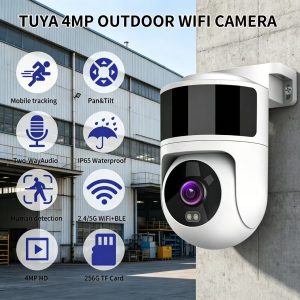 Tuya 4MP Outdoor WiFi Dual Lens PTZ Security Camera IP65 Waterproof Auto Tracking Full Color Night Vision Surveillance Camera Price range: $35.99 through $39.99
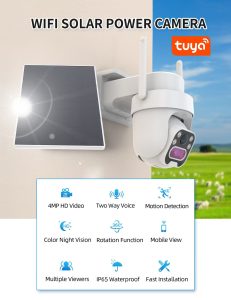 Tuya Solar WiFi PTZ Security Camera 4MP Outdoor Wireless Camera, Full Color Night Vision IP65 Waterproof Price range: $59.99 through $65.99
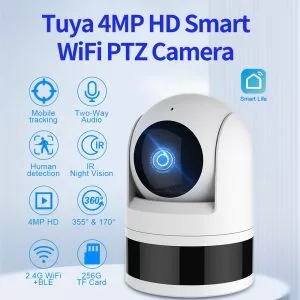
 Tuya 4MP HD Smart WiFi Indoor Security Camera Two-Way Audio Human Detection Home Surveillance Camera Price range: $29.99 through $32.99