Quick answer: a single-lens camera forces one compromise — wide enough to see the whole area, or tight enough to recognise a face, never both. A dual-lens design splits the job: one Lens holds the wide context permanently, the second covers detail and follows movement. That matters most at night and at distance, and it is the reason dual-lens units are replacing single-lens PTZ cameras at entrances, driveways and shop fronts.
The Compromise Every Single-Lens Camera Makes
A single fixed lens has one field of view. Zoom in digitally and you are enlarging pixels, not resolving detail — the plate or the face you wanted is still a blur. A single PTZ lens solves it by moving, but while it is turned towards what triggered it, it is no longer watching where it was pointed a second ago. That gap is exactly how things get missed. Smart Home Automation Scenes: 6 Practical Setups That Make Your Home Think
- Wide and fixed — you see everything, you recognise nothing.
- Narrow and fixed — great faces, blind corners.
- Single PTZ — good tracking, but coverage moves with it and the wide view is lost while it tracks.
What the Second Lens Adds on the KT-A36
The KT-A36 keeps a fixed wide lens on the scene permanently and uses the second lens for detail and tracking. In practice that buys four things: Smart Sensors Buying Guide: How to Make Your Home Feel Its Environment
- Nothing is missed while tracking. The wide view never moves, so the recording always contains context — you see what happened before and after the event, not just the event.
- Usable detail at distance. The detail lens resolves a face or a plate that the wide lens only shows as a shape.
- Better night behaviour. Two optics with different fields mean the wide lens can run the infrared fill while the detail lens holds the subject — a common single-lens failure is infrared bouncing off a nearby wall and flattening the whole frame.
- Fewer nuisance recordings. With context and detail evaluated together, moving branches and headlight sweeps trigger less often than on a single wide-angle lens pointed at a street.
Where to Mount It (and the Two Mistakes to Avoid)
Mount height and angle matter more on a dual-lens Camera than on a single one, because both lenses have to be useful. Smart Lighting Complete Guide: From Color Temperature to Automation Scenes
- 2.5–3m high, angled slightly down. High enough to be tamper-resistant, low enough that faces are not just the tops of heads.
- Cover the approach, not the horizon. Point the wide lens at the path someone Must walk — a gate, a drive, a doorway — not at open sky or a distant road.
- Mistake one: mounting under a soffit with the lens too close to the ceiling. The infrared reflects off the underside and the night picture turns milky. Leave clearance, or move the unit out from under the eave.
- Mistake two: pointing through glass. A camera behind a window loses night vision entirely. Mount outside, or accept that the unit is a daytime-only camera indoors.
Storage: What to Decide Before You Install
Recording is only useful if the clip survives. Two decisions: Home Security Systems Explained: 5 Essential Devices to Protect Your Family
- Local card vs cloud. A card is free after purchase and works with no subscription; it is also the First thing stolen with the camera. Cloud keeps footage off-site but costs monthly. Running both is the sensible answer for a business.
- Continuous vs event recording. Continuous fills cards quickly and makes finding anything slow. Event-based recording with a short pre-roll is what most people actually want — the few seconds before motion starts are what explain the clip.
When a Single-Lens Camera Is Still the Right Buy
Be honest about the use case. A dual-lens unit is not automatically better value:
- Indoor room monitoring — a single wide PTZ lens is cheaper and perfectly adequate for a living room or a nursery.
- Tight budget across many points — four single-lens cameras usually cover more of a property than two dual-lens units.
- Cameras you only glance at — if nobody reviews footage, the detail lens is being paid for and never used.
Buy the second lens where identification matters: entrances, driveways, stock rooms, tills. Buy single-lens everywhere you just need to know that something moved.
Related guides
Frequently Asked Questions
Is dual-lens just two cameras in one housing?
No — the value is that the wide lens stays fixed while the second one works the detail. Two independent cameras would not hold context during tracking.
Does it record from both lenses at once?
Yes. That is the point: the wide context and the detail are captured in the same event, so a clip is never missing the “before”.
Will it work at night without a light?
Yes, infrared handles it — but avoid mounting directly under an eave or behind glass, which are the two things that ruin night pictures on any camera.
Do I need a subscription?
No. Local card recording works out of the box; cloud is optional if you want footage stored off-site.
Related Reading
- KT-A36 dual-lens camera: full review
- KT-R13 vs KT-A36: which dual-lens model fits your site
- Indoor PTZ cameras: where they still beat a fixed dual-lens unit
Product page: KT-A36 Dual-Lens Security Camera
Related Articles
- Dual Lens Security Camera
- tuya_dual_lens_camera_guide_2026
- ABM780 Baby Monitor Setup: Night Vision, Cry Detection and What 300m Range Really Means
- Smart Home Automation Scenes: 6 Practical Setups That Make Your Home Think
- V15S Tuya Smart Watch: Alexa Voice Control, SpO2 Health Monitoring, and Smart Home Integration
You Might Also Like
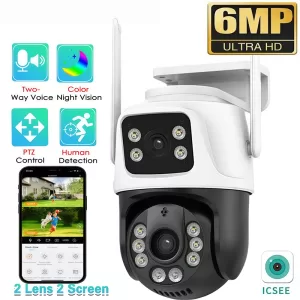 Dual Lens Security Camera Original price was: $75.96.$56.96Current price is: $56.96.
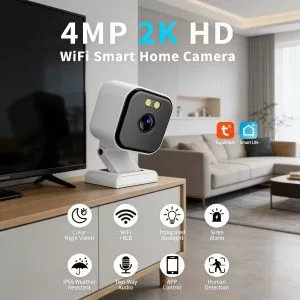 Tuya 4MP 2K HD WiFi Smart Home Camera – Indoor Color Night Vision Pet Monitor with Human Detection Original price was: $35.98.$27.96Current price is: $27.96.
 Solar Outdoor Patio Garden Light Waterproof LED Ambient Lanter… Price range: $5.96 through $9.96
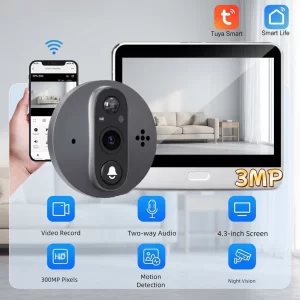 3MP WiFi Smart Peephole Video Doorbell Camera – 5000mAh Batter… Original price was: $89.86.$49.99Current price is: $49.99.
📌 This article is part of our Complete Camera Hub — more guides and buying tips inside.
