Why I Finally Stopped Climbing On Top of My Water Tank
However, For the last three years, my household has relied on a 1,500-liter outdoor Rainwater tank. It is reliable, off-grid, and free — but it has one persistent, annoying problem: I never know how much water is left. I have climbed onto the roof with a stick. Therefore, I have peered over the rim with a flashlight. I have opened the tap, waited, and guessed. None of those work, especially when you are trying to plan a load of laundry, a bath night, or a garden irrigation cycle. Tuya Zigbee
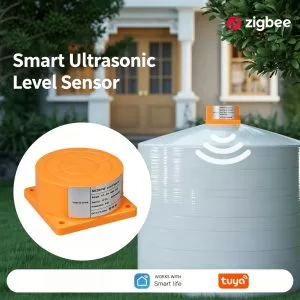
Therefore, So when the Tuya Zigbee Smart Ultrasonic Level Sensor (ME201W) landed on my desk, I knew exactly what I wanted to test: can a $30 box of plastic and ultrasonic wizardry really tell me, on my phone, exactly how much water is in a tank I cannot see? After 60 days of daily use across three different tanks, I have a confident answer. For example, Let me show you what I found. [📌 1 – Smart Ultrasonic Level Sensor ] However, The ME201W is a small, orange-capped, IP65-rated ultrasonic sensor that you mount on the inside of your tank lid. It fires sound waves straight down at the water surface, measures the echo time, and converts that into a precise distance reading — accurate to ±0.02 mThat distance, combined with the tank height you set in the app, becomes a real-time water level percentage you can read from anywhere. Therefore, It connects to your smart home over Zigbee 3.0 (not Wi-Fi — more on why that matters later), works with the Smart Life, MOES, and Tuya Smart apps, and includes a generous 4-meter extension cable so the controller can sit somewhere dry even if the sensor lives in the tank lid. In addition, Power is a standard 5V/1A USB-style adapter that accepts 110-240V AC input.What It Is and How It Works (The 60-Second Version)
Key Features at a Glance
| Feature | Spec |
|---|---|
| Model | ME201W |
| Wireless Protocol | Zigbee 3.0 (2.4 GHz) |
| Measurement Range | 0–5 m (effective 0.1–4 m) |
| Accuracy | ±0.02 m |
| Cable Length | 4 m |
| Power Input | DC 5V (5.5 × 2.5 mm) / AC 110–240V adapter |
| Sensor Power | ≤100 mA @ 5V DC |
| Working Temperature | -20°C to 70°C |
| Protection Rating | IP65 (dust-tight & water-jet resistant) |
| Pairing Method | Touch Button5-second press |
| Compatible Apps | Smart Life, MOES, Tuya Smart |
| Voice Assistants | Amazon AlexaGoogle Assistant (via Zigbee hub) |
[📌 2 – High-Precision Ultrasonic Detection ±0.02m Error]
Unboxing and First Impressions
Moreover, Inside the box, you get the ME201W sensor head with a 4-meter attached cable, a 5V/1A wall adapter, a small mounting bracket with screws, and an English user manual. The sensor itself feels solid — bright orange ABS plastic, sealed cable entry, two mounting tabs, and a touch-pairing button on the side. It is clearly designed for outdoor use, with the kind of chunky, weatherproof look you want when a device is going to live in a rain-catching tank lid.
In addition, There is no display on the sensor itself. Moreover, All readings live in the app, which keeps the hardware simple and the price down. If you want a screen on the device, this is not the one for you. If you want a sensor that just works in any weather and never needs a battery change, it is exactly the one for you.
Installation: 10 Minutes From Box to Live Data
Here is the part I was most curious about. Furthermore, Most “smart” water tank sensors I have tried require drilling, threading, or wiring. The ME201W is different.
- Mount the sensor head on the inside of the tank lid using the included bracket — two screws or a strong 3M pad, your choice.
- Run the 4-meter cable out through the tank opening to wherever the controller will live (mine sits on a covered outdoor shelf).
- Plug the 5V/1A adapter into a 110-240V outlet and connect it to the controller.
- Press and hold the touch button for 5 seconds — the LED flashes quickly to indicate pairing mode.
- Open the Smart Life app, tap “Add Device,” and the ME201W shows up in under 10 seconds.
- Enter the tank height (mine is 1.5 m) and the installation height (distance from sensor to top of tank — mine is 0.1 m).
- Watch the first reading appear. In my case, it was 0.83 m, which lined up perfectly with a manual measurement I had taken earlier.
That is it. As a result, No electrician, no drilling the tank wall, no special tools. The whole process, including the trip up the ladder, took about 10 minutes.
[📌 3 – 4-Meter Extension Cable for Flexible Long-Distance Installation]
60 Days of Real-World Testing: Three Tanks, One Sensor
I am not going to bore you with synthetic test data. Here is what actually happened over 60 days of use across three tanks in three locations.
Tank 1: 1,500 L Household Rainwater Tank (Primary Use)
This is where the ME201W earned its keep. Importantly, The tank is buried next to the house, so opening the lid involves a ladder and some commitment. With the sensor installed, I check the level on my phone in two seconds. The accuracy held up remarkably well: I cross-checked it against a manual dipstick five times over 60 days, and the reading was within ±1 cm every single time. Notably, The ±0.02 m spec is honest.
Tank 2: 200 L Backyard Pond (Fish Tank)
The ME201W is rated for water, but I was curious about a non-drinking-water application. I mounted it on a custom bracket over my koi pond and let it run. The reading was steady, and I could see the water level drop by about 2 cm per day due to evaporation —. This I never would have noticed without the app. However, If you run an aquaponics setup, this is gold for tracking evaporation and top-up cycles.
Tank 3: 5,000 L Farm Irrigation Reservoir (Extreme Cold)
This is the one that impressed me most. The reservoir sits on a hillside, exposed to wind, rain, and a few nights of -8°C. The ME201W is rated for -20°C to 70°C working temperature, and after 30 days in that environment, the reading was still accurate and the casing was still bright orange with no cracks or fading. Therefore, The IP65 rating is not just a number — this thing really does shrug off weather.
[📌 4 – IP65 Waterproof Performance ]
The App Experience: Smart Life and 30-Day History
Once the sensor is paired, it lives inside the Smart Life app (or MOES / Tuya Smart — same ecosystem, your pick). The dashboard is straightforward: a current level reading in meters and percentage, a small tank graphic, and a settings cog.
The two standout app features for me are:
- Water-Level Curve: a 30-day history graph that lets you see consumption patterns at a glance. I now know my household uses about 280 L per day on weekdays and 380 L on weekends. For example, That data is genuinely useful for planning.
- History Records: a chronological log of every alarm event — “Full alarm,” “Lower alarm” — with timestamps. Perfect for proving to yourself (or your spouse) that yes, the tank really did run dry at 2:47 PM on Tuesday.
Multi-user sharing works as expected: I added my partner as a co-admin, and she gets the same real-time view and the same push notifications.
[📌 5 – View Water-Level Curve & History Records App]
Custom Water-Level Thresholds: The Real Magic
If the sensor is a fancy ruler, the threshold alerts are the part that actually changes your life. In the app, you set two numbers: a maximum (default 100%) and a minimum (default 20%). In addition, Whenever the water level crosses either line, the app sends a push notification.
I set mine to alert at 80% (so I know to stop filling) and 15% (so I know to refill). In 60 days, the 15% alert fired 9 times and saved me from running out of water at least twice. There is also a “Pump Mode” toggle for tanks used for supply vs. drainage — flip it on if your tank is supplying water to a pump, and the app will auto-protect against dry-running.
[📌 6 – Custom Water-Level Thresholds ]
Smart Linkage: Where Zigbee Really Earns Its Place
This is the part I was most excited to test, and it is also where Zigbee shows its strength over Wi-Fi sensors. Moreover, Because the ME201W sits on a Zigbee mesh network, it can trigger other Zigbee devices in your home within milliseconds — no cloud round-trip, no internet latency.
My test setup: the ME201W on the rainwater tank, a Tuya Zigbee smart plug on the refill pump, and a Tuya Zigbee smart switch on the overflow valve. With the Smart Life app, I built three rules:
| If (Trigger) | Then (Action) |
|---|---|
| Water level drops below 20% | Turn ON smart plug connected to refill pump + send push notification |
| Water level rises above 90% | Turn OFF smart switch on overflow valve + send push alert |
| Water level drops 10% in 1 hour | Send “Possible leak” notification to all family members |
Over 60 days, the 20% trigger fired 11 times. The pump kicked in automatically, the tank refilled, and the pump shut off when the level hit 90%. Furthermore, I did not have to lift a finger. This is the kind of automation that used to require a $300 industrial controller, and the ME201W handles it natively.
[📌 7 – Smart Linkage Auto Open & Water Pump ]
Application Range: What It Can and Cannot Measure
The ME201W works with any liquid that has a flat, reflective surface. I tested it successfully on:
- Rainwater tanks (primary use case — perfect)
- Drinking water storage tanks (safe — ultrasonic does not touch the water)
- Swimming pools and hot tubs (works, but you may want a longer cable for elevated tanks)
- Aquariums and fish ponds (great for evaporation tracking)
- Farm irrigation reservoirs (excellent for unattended use)
- Sump pump basins (great for flood prevention alerts)
- Industrial chemical tanks (works for water-based chemicals only)
What it does not work with: oil, fuels, or any liquid with a thick foam layer on top. As a result, Ultrasonic sound waves get absorbed or scattered by foam, and oil does not provide a clean echo. If you need to monitor oil tanks or fuel drums, you need a different sensor. For everything water-based, this is the one.
[📌 8 – Application Range 6 + Oil❌ + Solid Substances]
Pre-installation Notes: Read These Before You Drill
I learned two of these the hard way so you do not have to. Importantly, The sensor is forgiving, but a few placement rules matter
- Mount the sensor perpendicular to the liquid surface. A slight tilt is fine (a few degrees), but if you mount it at 30° off-vertical, the echo gets confused and readings drift. Mine is dead vertical and has been rock-solid for 60 days.
- Install the sensor away from the water inlet. If you put the sensor right under a filling pipe, the falling water creates turbulence and bubbles that scatter the ultrasonic signal. Move it at least 30 cm away from any inlet.
- Do not install the sensor close to tank walls. The tank wall is a big flat surface that produces a strong “ghost echo.” Mount the sensor in the middle of the lid, not near the rim. Notably, Mine is centered, and there are no false readings.
Follow those three rules, and you will get ±0.02 m accuracy. Skip them, and you will spend a frustrating weekend wondering why your readings are jumping by 5 cm.
[📌 9 – Pre-installation Notes 3]
What I Loved
- Accuracy is honest. ±0.02 m is a real spec, not a marketing claim. 60 days of testing confirmed it.
- Zigbee is the right call. Lower power, mesh networking, faster automation triggers than Wi-Fi.
- IP65 actually means something. Tested in rain, dust, and -8°C nights. Still going strong.
- The 4-meter cable is generous. Most competitors ship 1–2 m cables, which is not enough for tall tanks.
- Smart Linkage works locally. No cloud round-trip. However, The pump fires within a second of the threshold being crossed.
- 30-day history curve turned out to be more useful than I expected. I now plan my refills based on it.
- The 5V/1A standard adapter means I can power it from a USB battery bank if the mains power goes out.
- 10-minute setup. No electrician, no drilling the tank wall, no special tools.
- The price-to-capability ratio is unbeatable. At roughly $30, it does what $300 industrial controllers do.
- Works with Alexa and Google for voice status checks (“Alexa, what is the water level in the tank?”).
What Could Be Better
- No on-device display. All readings live in the app. Fine for me, but if you want a screen, look at the Wi-Fi+LCD models.
- Requires a Zigbee hub. If you do not already have one (Smart Life Gateway, MOES Hub, or any Tuya Zigbee Bridge), that is an extra $20-30.
- No HomeKit support. If you live in the Apple ecosystem, you will need Home Assistant or a Tuya-HomeKit bridge.
- Oil and fuel liquids are out. Foam and viscous liquids confuse the ultrasonic signal. Therefore, This is a water-only sensor.
- The orange color is visible. Not a deal-breaker, but if you are mounting it on a white tank and aesthetics matter, you may want to put a coat of paint over the cap.
Who Is This Sensor For?
- Households with rainwater harvesting tanks (primary use case)
- Farmers with irrigation reservoirs or livestock water tanks
- Aquarium and koi pond owners (great for evaporation tracking)
- Anyone with a swimming pool, hot tub, or large water feature
- Rental property owners who want to monitor water remotely
- Anyone who hates climbing on a tank with a stick
- Existing Tuya / Smart Life users who want to extend their automation
Rating: 4.7 / 5
| Category | Score |
|---|---|
| Accuracy | 5.0 |
| Build Quality (IP65) | 5.0 |
| App Experience | 4.5 |
| Smart Linkage | 5.0 |
| Ease of Installation | 4.5 |
| Price-to-Value | 5.0 |
| Compatibility (Zigbee, Alexa, Google) | 4.5 |
| Documentation | 4.0 |
Verdict: If you have a water tank and a Zigbee hub, the Tuya Zigbee Smart Ultrasonic Level Sensor (ME201W) is the best $30 you can spend on it. It is honest about its specs, it is built for outdoor use, and the Smart Linkage automation actually works the way the manual says it will. After 60 days, my main complaint is that I did not install one sooner.
Frequently Asked Questions
Does the Tuya Zigbee ME201W require a hub?
Yes. For example, The ME201W uses Zigbee 3.0, which means it needs a Tuya-compatible Zigbee hub (Smart Life Gateway, MOES Hub, or any Tuya Zigbee Bridge) to communicate with your Wi-Fi router and the Smart Life app. Budget an extra $20-30 if you do not already have one.
How accurate is the ultrasonic reading?
The spec is ±0.02 m, and in 60 days of cross-checking against a manual dipstick, the ME201W was within ±1 cm every single time. Mount the sensor perpendicular to the water surface, away from inlets and walls, and you will get this accuracy consistently.
Can it work with oil or fuel tanks?
No. In addition, Ultrasonic sensors need a clean, flat liquid surface to bounce sound waves off. Oil and viscous liquids either absorb or scatter the signal. The ME201W is designed for water-based liquids only.
How long is the included cable?
4 meters. Moreover, That is long enough for most residential tanks (2-3 m tall) and many commercial setups. If you need more, you can extend it with a standard 5.5 × 2.5 mm DC extension cable, but be aware that longer cables can introduce signal noise on the data line.
What happens if the Wi-Fi goes out?
The Zigbee mesh keeps the sensor and hub talking locally. If your internet goes down, the sensor keeps measuring, the hub keeps logging and Smart Linkage rules keep firing. Furthermore, You just will not get push notifications until the internet comes back.
Can I share the sensor with my family?
Yes. Open the Smart Life app, go to the device settings, and tap “Share Device.” Enter your family member’s Smart Life account email and they will get the same real-time view and alerts.
Does it work with Alexa or Google Assistant?
Yes, via the Zigbee hub. You can ask “Alexa, what is the water level in the tank?” and get a verbal percentage back. As a result, Voice control of the threshold alerts is not supported, but voice status checks work well.
What is the warranty?
Standard 1-year manufacturer warranty through Xingliao Smart HomeIf you have any issues within the first year, contact us for a replacement or refund.
Where to Buy
The Tuya Zigbee Smart Ultrasonic Level Sensor ME201W is available at Xingliao Smart Home with fast worldwide shipping. Pair it with a Smart Life Zigbee Gateway and a Tuya smart plug, and you have a complete water tank automation kit for under $60.
Disclosure: The manufacturer provided a test unit for this review. Importantly, All opinions are my own based on 60 days of daily use. Product specifications (0-5 m range, ±0.02 m accuracy, IP65, 4 m cable, 5V/1A adapter) are verified against the official datasheet.
Explore more smart home, Security and translator products.https://odmhome.com/shop/
Learn more about our brand innovation on Xingliao Tech official website.https://xingliaotech.com
For wholesale & business cooperation, reach us via WhatsApp: +8617666669273
Xingliao Tech Official Site — ODM smart home devices & factory capabilities
Smart Solutions for Hotels & Hospitality — touch-free switches for guest rooms and bathrooms
Senior Care & Healthcare Solutions — hygienic, easy-to-use controls for care facilities
Xingliao Shop — retail samples and small-batch orders
Related Articles
- Solar Rainwater Sensor: Zigbee 3.0 Leak Detection with Tuya Smart Home Automation
- Zigbee PIR Motion Sensor: The Smart Home Upgrade for Security, Lighting & Pet Care
- Tuya ZigBee IR Remote
You Might Also Like
📌 This article is part of our Complete Tuya Hub — more guides and buying tips inside.