Fit at least one smoke alarm on every floor, inside and directly outside each bedroom, and in the room with the heating Appliance. Put them on the ceiling, at least 30 cm from any wall and from any light fitting, and away from kitchens and bathrooms Where steam and cooking fumes cause false alarms. For carbon monoxide, fit an alarm in any room with a boiler, stove, fire or a flue passing through it, roughly 1–3 m from the source and at head height or on the ceiling as the manufacturer specifies.
Placement is not decoration: a few tens of centimetres decide whether an alarm wakes you in time or after the escape route is already smoky.
The minimum that works
- One per storey, in the circulation space (hall or landing) so it is audible from bedrooms.
- Inside every bedroom if doors are normally shut at night — a closed door cuts a hallway alarm by 10–20 dB, which can be the difference between waking and not.
- In the living room if it has a fireplace, a wood burner or a lot of upholstered furniture and chargers.
- In the kitchen-adjacent hall, not inside the kitchen — cooking fumes are the number one cause of nuisance alarms, and a nuisance alarm is the number one reason people remove the battery.
- In the loft or basement if it houses a boiler, a consumer unit or stored lithium batteries.
Where exactly on the ceiling
- Centre of the room or ceiling-mounted where possible. Smoke rises and spreads across the ceiling, so dead spots are in corners and at the apex of a pitched roof.
- At least 30 cm from a wall or light fitting, and at least 30 cm from the apex of a pitched ceiling.
- Away from draughts: not next to an extractor fan, an air vent, a window that is kept open, or a doorway — moving air dilutes smoke before it reaches the chamber.
- On a sloping ceiling over 30°, place within 90 cm of the ridge.
- Wall mounting is allowed by some standards as a last resort: 15–30 cm below the ceiling, never above it.
Carbon monoxide: different rules
CO is produced by incomplete combustion in boilers, stoves, fires and blocked flues, and it does not reliably rise — it mixes with room air. So placement follows the appliance, not the ceiling:
- In the same room as any fuel-burning appliance, 1–3 m away from it.
- At head height (on a shelf) or on the ceiling, exactly as the manufacturer states — this varies, so follow the leaflet.
- Above or beside a boiler in a cupboard: mount outside the cupboard on the wall, at breathing height, unless the instructions say otherwise.
- In bedrooms if the appliance is in or adjacent to the sleeping space (a boat, a caravan, a studio flat).
Interconnection and testing
The single biggest upgrade is interlinking: when one alarm sounds, all of them do. Without it, a fire in the kitchen may not wake someone two floors up. Interlinking is available as hardwired (a third core between units), as radio-frequency wireless interlink, or via a Smart hub that broadcasts the trigger to other alarms and to your phone.
- Test monthly using the test button — not by burning toast.
- Replace batteries when the unit chirps; do not silence the chirp by removing the battery.
- Vacuum the vents once or twice a year; plaster dust and insects cause false alarms and dead sensors.
- Replace the whole unit every 10 years (most have a date label); the sensing chamber degrades.
- Check your insurer’s requirement — some policies specify interlinked alarms, particularly in rented properties.
Frequently Asked Questions
Where should smoke alarms be placed?
On the ceiling of every floor, inside and just outside each bedroom, at least 30 cm from walls, light fittings and pitched-ceiling apexes, and clear of kitchens, bathrooms and draughty spots.
How many smoke alarms do I need?
At least one per storey plus one in each bedroom if doors are closed at night. A typical three-bedroom house ends up with four to six alarms, all interlinked.
Can I put a smoke alarm in the kitchen?
Better not. Cooking fumes cause nuisance alarms, and people then disable the unit. Use a heat alarm in or just outside the kitchen instead — it responds to temperature rise rather than smoke particles.
Smoke alarm or heat alarm in the kitchen?
Heat alarm. It triggers at a fixed temperature (commonly 54–58 °C) rather than reacting to cooking aerosols, so it will not go off every time you sear something.
Where does a carbon monoxide alarm go?
In the same room as the fuel-burning appliance, 1–3 m from it, at the height the manufacturer specifies — sometimes head height on a shelf, sometimes ceiling mounted. Follow the instructions for that model.
How often should alarms be replaced?
Every ten years for the whole unit, regardless of whether it still tests OK. Test monthly, and replace batteries as soon as a low-battery chirp starts.
Related guides
- Where to place water leak sensors
- Zigbee vs WiFi: which to use for each device
- Motion sensors: PIR motion detectors for smart homes
- How to choose a security camera for your home
- How to set up a CCTV camera system at home
Browse smoke, CO and leak sensors · Ask us for a placement plan
Related Articles
- Where to Place Water Leak Sensors in a House
- Smart Home Devices for Seniors: Easy Tech for Aging in Place
- Smart Zigbee Smoke Alarm: The Connected Fire Safety Device Every Smart Home Needs
- WiFi Smoke & CO Detector
- The X6 Visual Intelligent Doorbell: No WiFi Two-Way Video Doorbell Guide
You Might Also Like
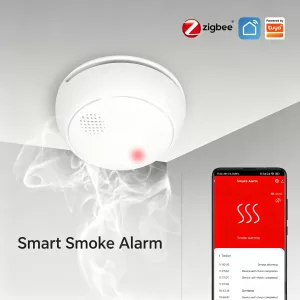 Tuya Zigbee Smart Smoke Alarm Detector – Photoelectric Smoke S… Original price was: $75.96.$56.96Current price is: $56.96.
 X7 Intelligent Visual Doorbell Set, 4.3 Inch IPS Screen Wireless Video Intercom Door Bell Original price was: $39.96.$32.96Current price is: $32.96.
 X3 Smart Visual Doorbell – 4.5 Inch Screen, 300K Pixels, Wide Angle Lens, Two-Way Voice, Full Color Night Vision Original price was: $79.96.$67.96Current price is: $67.96.
 Wearable Ionic Air Purifier Mini Neck Hung Portable Car Home Fresh Air Original price was: $35.59.$15.96Current price is: $15.96.
