Posted on — Leave a comment

Behind a XingLiao Brand Clip: Samples, Branding and Pre-Shipment Checks

Not every clip from our channel is a product teardown. This one is a short brand piece from the team – no spec sheets, no close-ups. We are using it here as a starting point to answer the question buyers actually ask after watching: what happens between “send me a sample” and a production order with our name on it?

Watch: XingLiao Brand Clip – November 2026

Short brand and lifestyle clip from the XingLiao team.

Also on YouTube · Channel: Shenzhen Xingliao Intelligent Technology Co

What the clip shows

  • A brand and lifestyle clip from the XingLiao team, published in November 2026.
  • No product claims are made in the clip; it is context about the people behind the factory, not a specification.
  • The rest of this article is the written version of what our sales engineers walk through on a first call.

The path from sample to production

Step one is a paid sample of five pieces. We charge for samples because they are built on the same line as production, and we credit the fee against the first production order. You test the sample in your own market, with your own router and your own app account.

Step two is branding. A silk-printed logo starts at ten pieces, laser engraving at 300, custom packaging at 500-1,000. If you need your own product ID in the Tuya cloud – the app panel, firmware identity and cloud listing – that starts at 1,000 pieces. New tooling and industrial design start at 2,000-3,000 pieces, with prototyping in 7-15 days and tooling in 25-40 days.

Step three is pre-shipment inspection: function test, label and QR traceability, packaging check, and a signed inspection sheet. We work under NDA by default, on 30/70 payment terms.

Order terms buyers ask about

  • Silk-print logo from 10 pcs, laser-engraved logo from 300 pcs, custom packaging from 500-1,000 pcs.
  • Your own product ID (private PID – app panel, firmware identity, cloud listing) from 1,000 pcs.
  • New tooling and industrial design from 2,000-3,000 pcs; prototyping 7-15 days, tooling 25-40 days.
  • Standard MOQ 5 pcs per color, samples 5 pcs paid and creditable. Payment 30/70, NDA by default.

Related reading

Need pricing, a sample or a private-label proposal? Tell us the model, market and quantity. Email xingliaoshop@gmail.com or WhatsApp / WeChat +86 176 6666 9273. We reply within one business day. Contact form
Posted on — Leave a comment

Tuya Window Camera: Eight Product Photos, Annotated for Buyers

Our channel post published a full image set for a Tuya window camera – the kind of material usually sent only to distributors. We are reproducing it here with notes, because a product sheet is a claim and a buyer needs to know which claims are testable. The camera is an indoor, through-glass model: it mounts on the inside of a window and looks out, which is why anti-reflection processing matters more than an outdoor housing rating.

Product images, annotated

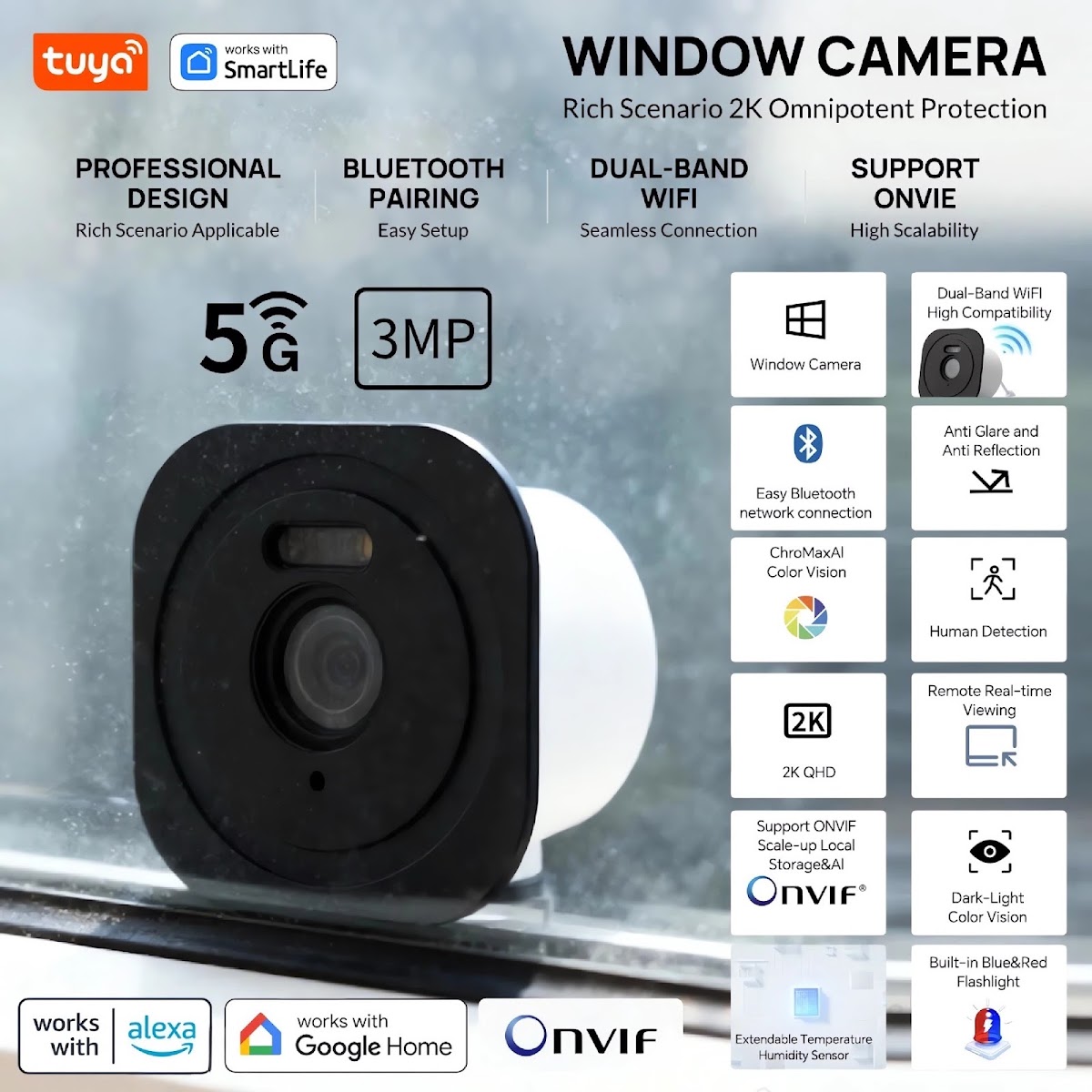
Tuya window camera specification panel showing 3MP 2K QHD, dual-band WiFi, ONVIF and assistant compatibility
The spec panel: 3MP / 2K QHD, dual-band Wi-Fi, Bluetooth pairing, ONVIF, and Smart Life / Alexa / Google Home compatibility. Note that compatibility logos describe ecosystem support, not certification files.
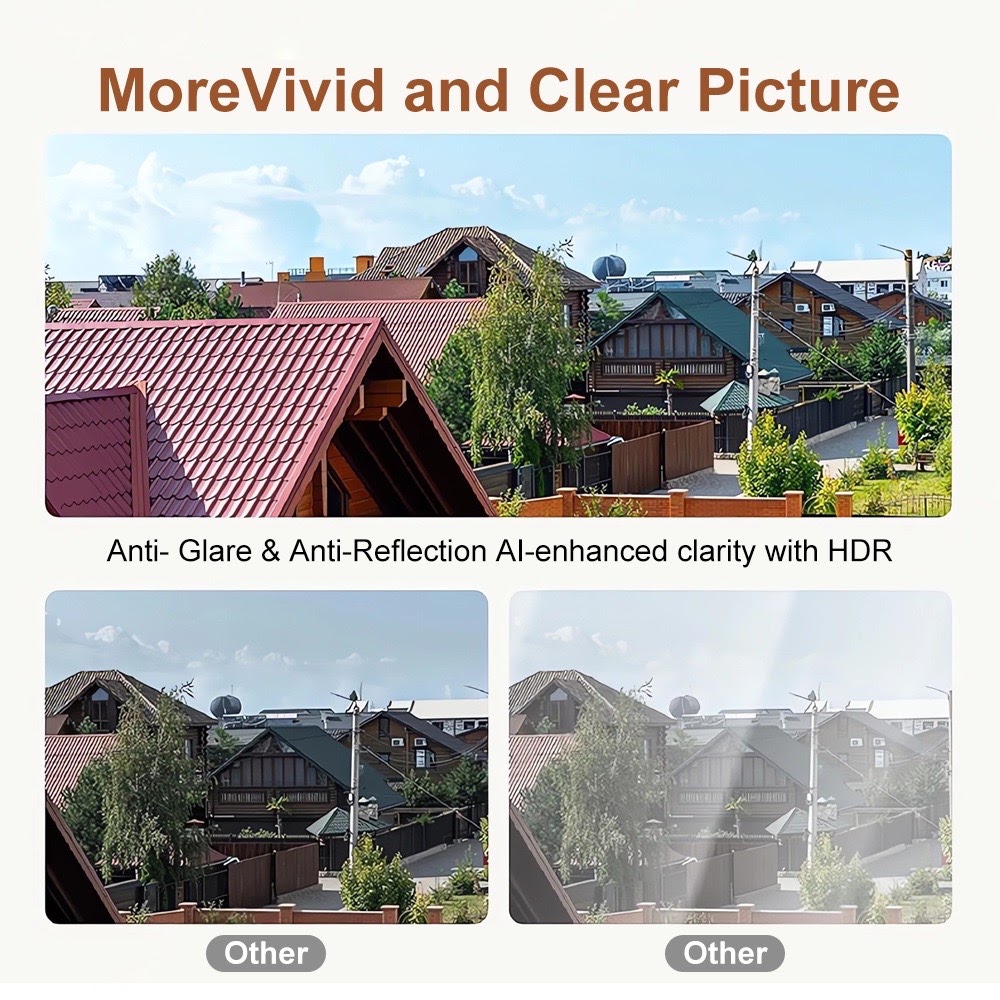
Before and after comparison of window camera anti-glare and anti-reflection image processing
The anti-glare comparison. This is the feature to test on a real window, at dusk and at noon, with a bright street behind the glass.
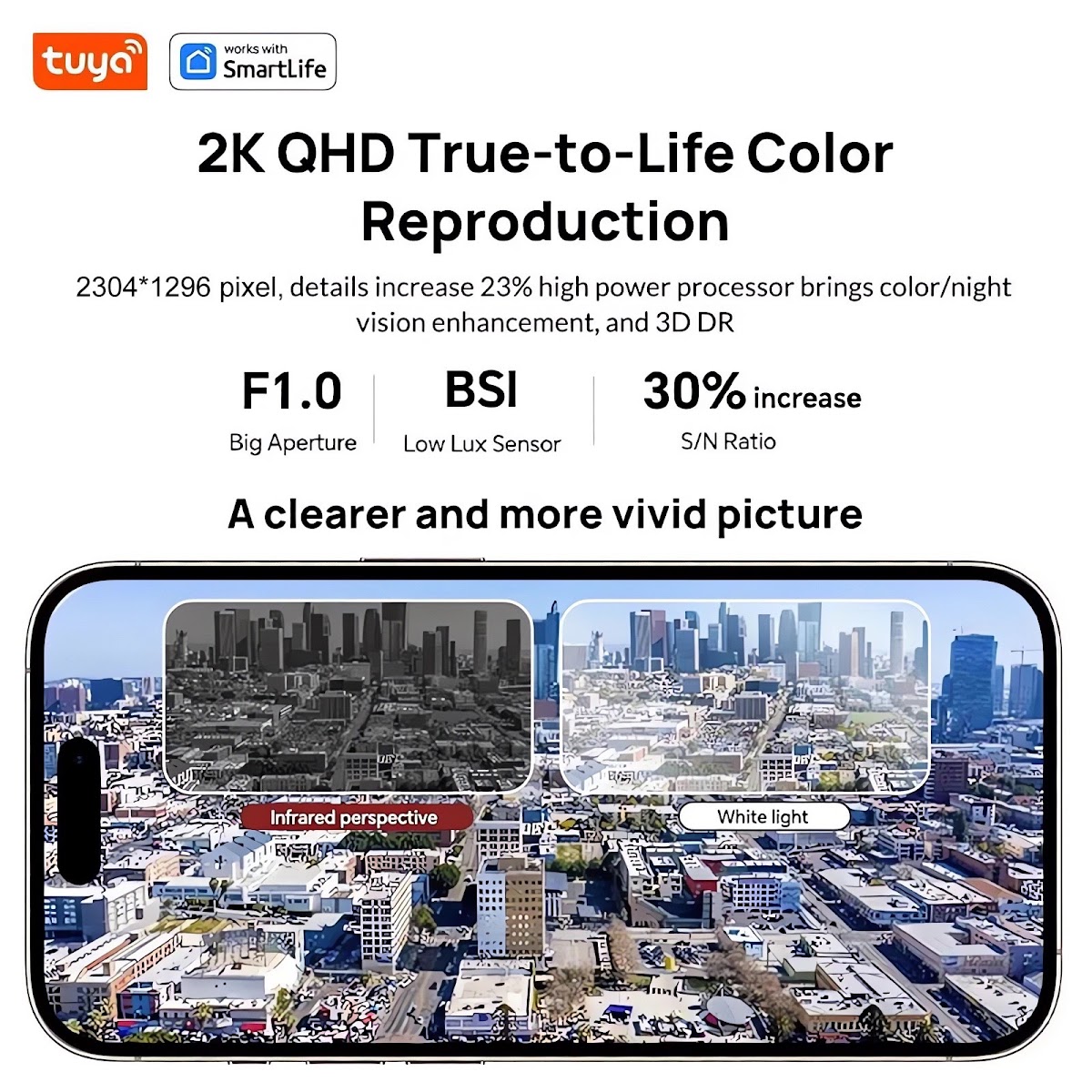
Window camera 2K QHD imaging panel with F1.0 aperture and BSI sensor claims
The imaging panel quotes F1.0, a BSI sensor and 2304×1296 output. Ask for the actual sensor part number and sample footage before repeating these numbers in your own listing.
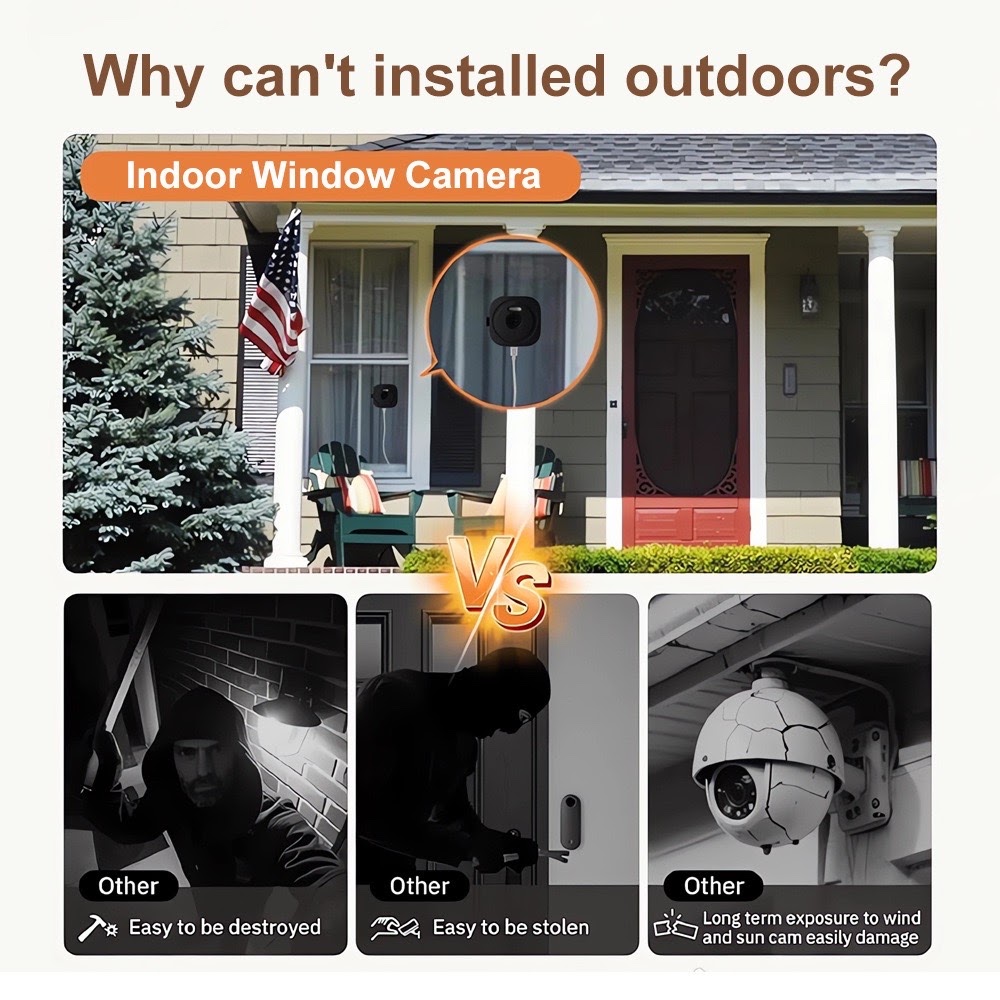
Diagram explaining why a window camera is installed indoors behind glass rather than outdoors
Why indoor-only: the camera sits behind the glass, protected from weather and tampering. It is not an outdoor bullet camera, and the mounting surface is part of the optical path.
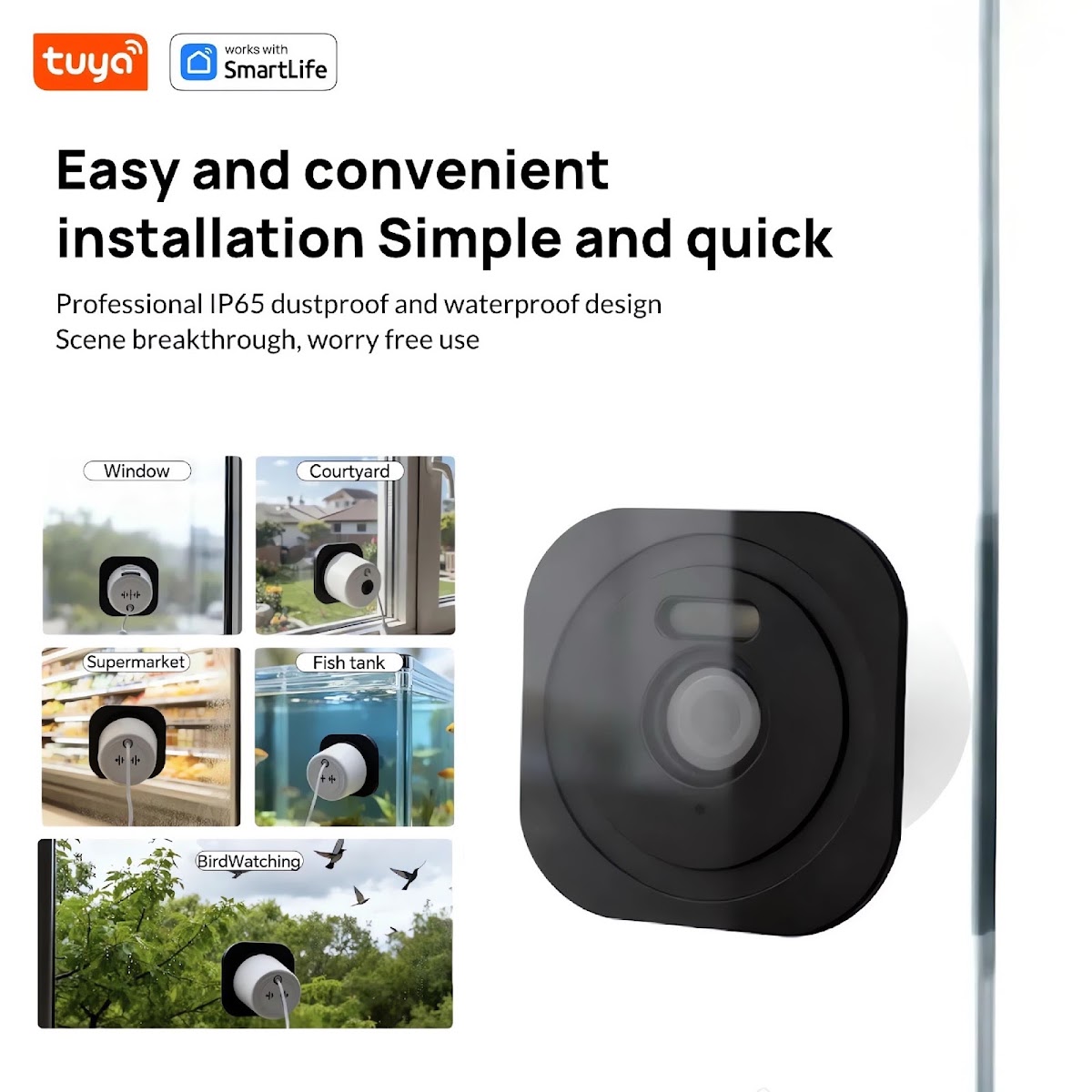
Window camera installation scenarios including window, courtyard, supermarket, fish tank and bird watching
Suggested scenes from the sheet: windows, courtyards, shopfronts, fish tanks and bird watching. For each one, check the glass type and the reflection angle on site.
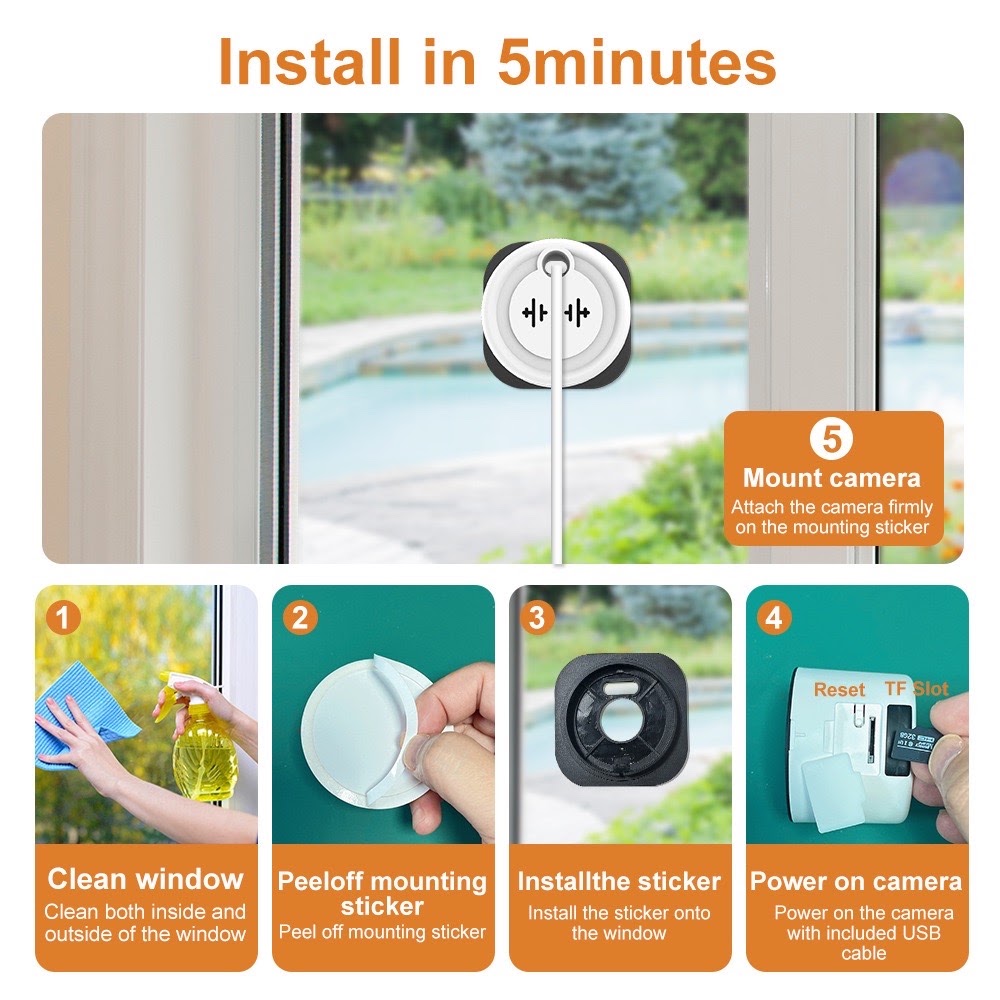
Five-step no-drill installation guide for a window camera
The five-step no-drill installation: clean the glass, peel the mounting sticker, apply it, power the unit by USB, then mount the camera. No drilling is the main installation advantage.
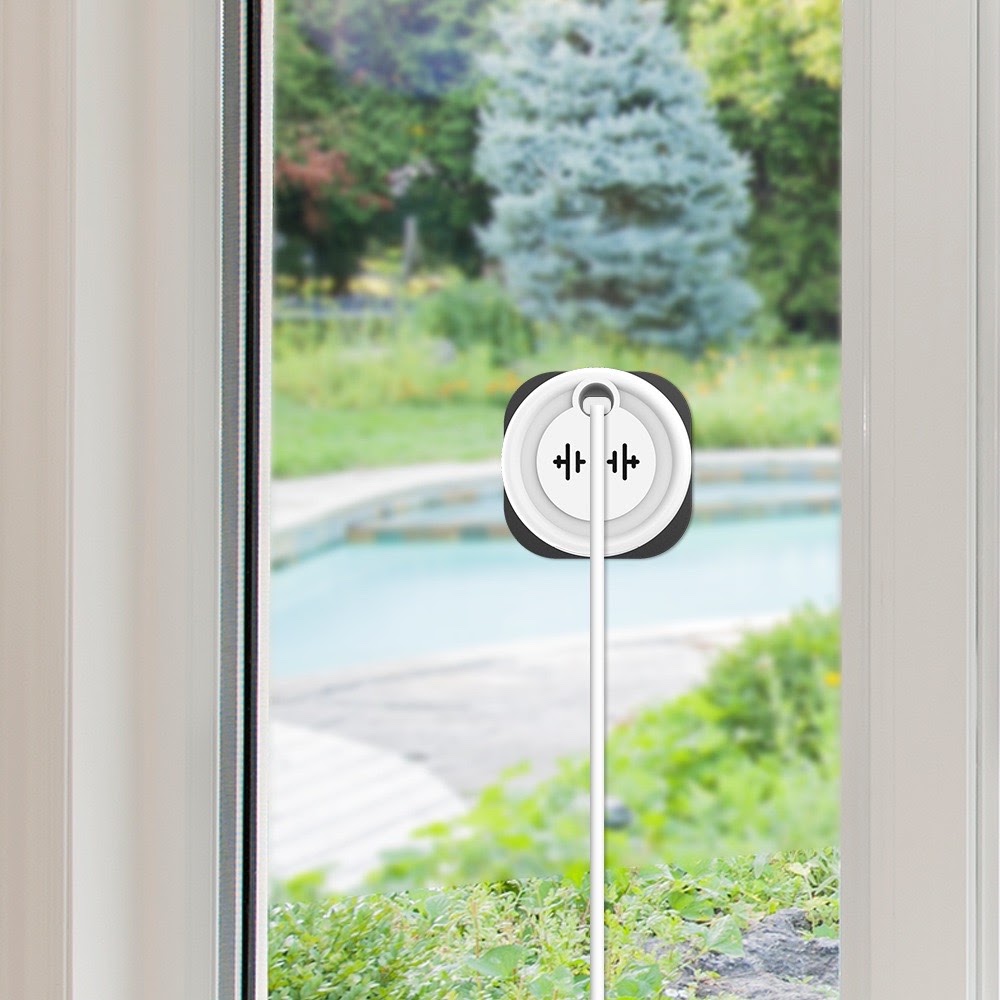
Window camera attached to a glass pane with a mounting sticker and USB cable
The camera on glass with its USB lead. Confirm cable length and plug standard for your market before a bulk order.
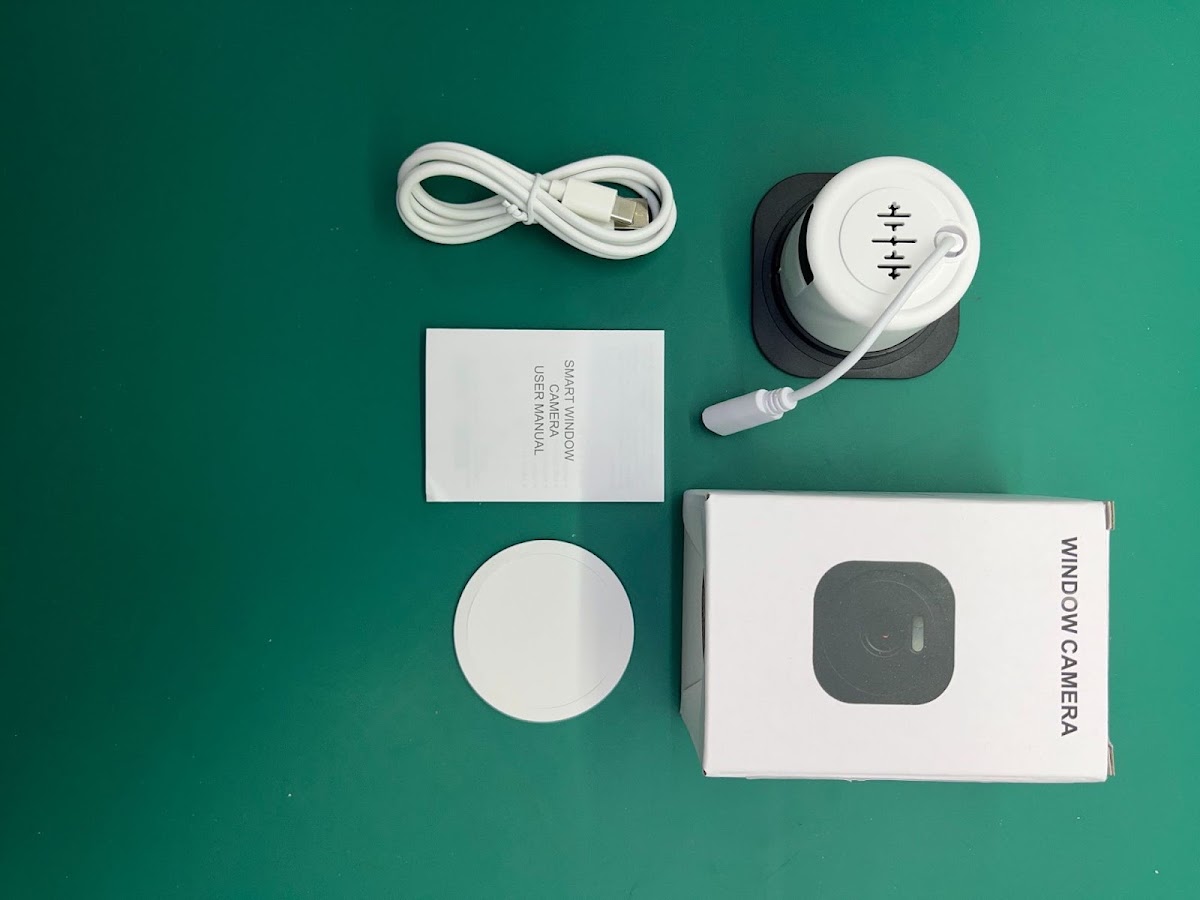
Window camera retail package contents with USB cable, manual, mounting sticker and box
Box contents: camera, USB cable, mounting sticker, user manual and carton. For private label, this is the layer that changes at 500-1,000 pcs.

What the image set does not tell you

The panels are marketing artwork, not a test report. They do not state the glass types used, the low-light frame rate, the storage behavior when the internet drops, or which certification files apply to the current PCBA. Ask for those four in writing.

ONVIF support and voice-assistant logos describe interoperability. They are separate from the CE / FCC / RoHS / UKCA / CCC / PSE file set we support; we do not hold UL or ETL listings and confirm North American files case by case.

Sample checklist for a through-glass camera

Test reflection at three times of day, focus through double glazing, human detection at the far side of the pane, and two-way audio if offered. Record the delay from tap to first frame on both Wi-Fi and 4G.

Then check what survives a power cut: local recording, event history and reconnection. These are firmware behaviors, not features you can add after packaging is printed.

Order terms

  • Standard models: MOQ 5 pcs per color. Samples: 5 pcs, paid, credited against the first production order.
  • Logo: silk print from 10 pcs, laser engraving from 300 pcs. Custom packaging: 500-1,000 pcs. Your own product ID (private PID – app panel, firmware identity, cloud listing): from 1,000 pcs.
  • New tooling: 2,000-3,000 pcs. Prototyping 7-15 days, tooling 25-40 days. Payment 30/70, NDA available by default, one-year warranty with lifetime technical support.
Related reading

Need pricing, a sample or a private-label proposal? Tell us the model, market and quantity. Email xingliaoshop@gmail.com or WhatsApp / WeChat +86 176 6666 9273. We reply within one business day. Contact form
Posted on — Leave a comment

Tuya Smart Curtain Motor Installation: Belt, Buckles and Travel Limits

This short clip from our bench shows the least glamorous and most important part of a Tuya smart curtain motor installation: cutting the toothed belt, joining it, and setting the buckles that define the travel limits. Most support tickets we see on curtain motors trace back to this five-minute step, not to the motor or the app.

Watch: Tuya Smart Curtain Motor Installation Guide

Close-up walkthrough of fitting the belt and buckles on a Tuya smart curtain motor track.

Also on YouTube · Channel: Shenzhen Xingliao Intelligent Technology Co

What the clip shows
  • The belt is cut square and joined with a metal buckle; a second buckle is placed exactly one tooth away, as the on-screen caption in the clip instructs.
  • Both buckles sit on the same side of the track, so the carriage does not foul the join as it travels.
  • The track is aligned on a flat surface before the motor is powered – a twisted track will look like a calibration fault in the app.
  • Limit setting happens after the mechanical fit, by running the carriage end to end and letting the motor learn the stops.

What installers should verify on a sample unit

When you evaluate a curtain motor, run at least fifty full open/close cycles before you judge the app. Belt tension changes during the first cycles, and a limit learned too early will drift. Check the noise level at the slowest speed, and confirm that the motor stops on an obstruction rather than forcing the belt.

For an OEM order, specify track length, belt type, load rating, plug standard and the app panel language in the purchase order. These are the five variables that change the BOM; resolution-style marketing numbers are not what determines whether the unit survives a two-year installation.

Order terms buyers ask about
  • Standard models: MOQ 5 pcs per color.
  • Samples: 5 pcs, paid, and the sample fee is credited against the first production order.
  • Logo: silk print from 10 pcs, laser engraving from 300 pcs.
  • Custom packaging: 500-1,000 pcs. Your own product ID (private PID – app panel, firmware identity, cloud listing): from 1,000 pcs.
  • Tooling / new industrial design: 2,000-3,000 pcs. Prototyping 7-15 days, tooling 25-40 days.
  • Payment: 30% deposit, 70% before shipment. NDA available by default. One-year warranty with lifetime technical support.
Related reading

Need pricing, a sample or a private-label proposal? Tell us the model, market and quantity. Email xingliaoshop@gmail.com or WhatsApp / WeChat +86 176 6666 9273. We reply within one business day. Contact form
Posted on

IP65 Camera Claims: What Paperwork to Ask For

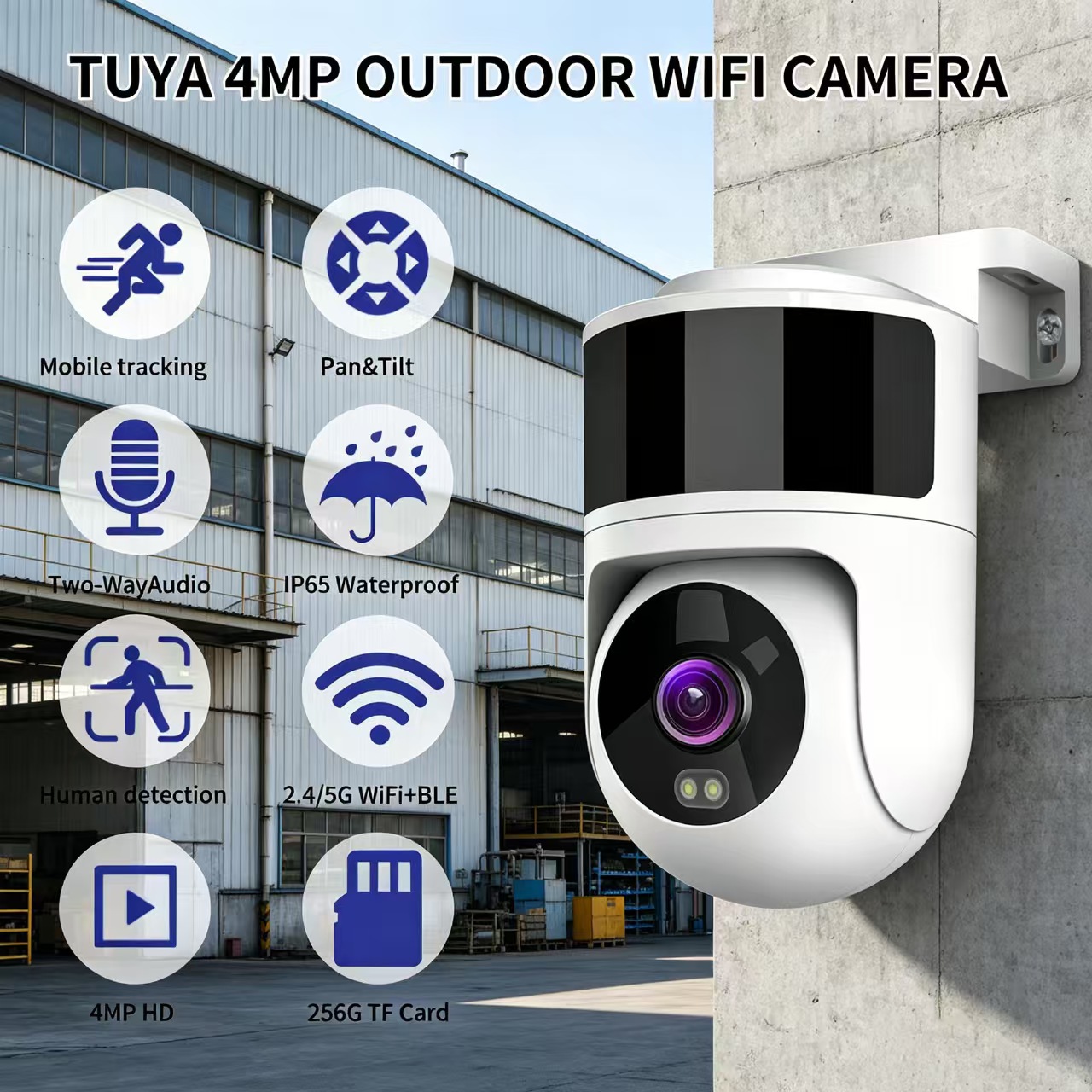
Outdoor dual-lens PTZ WiFi camera

Outdoor cameras fail in the wet season far more often than buyers expect, and the failure is rarely the sensor. Water enters along the cable, through a poorly sealed gland or past a cover that was assembled without a gasket. The IP number on the datasheet is meant to describe resistance to that ingress, but only if a test report stands behind it.

Ask for the report, not the badge. IP65 means dust-tight and protected against low-pressure water jets from any direction. A supplier who can produce a test report with the exact model number on it has had the housing evaluated. A supplier who sends a rendered image of a camera under a tap has not. Ask for the report before you approve the artwork, not after the first return.

Check the cable gland. Water travels along cables rather than through the case wall. A housing with an excellent seal around the cover still floods if the cable entry is loose or the gland is the wrong size for the cable. Ask how the gland is torqued in production and whether the kit includes a spare or a sealing ring. This is a line-process question, not a design claim.

Separate the housing rating from the installation. An IP65 camera installed with the connector facing upward, or with a cable loop that drains back into the gland, will fail regardless of the rating. Include mounting guidance in your own installation sheet. Your customer will read that sheet when the camera is on a ladder, not when they place the order.

Resolution claims need the same treatment. A 4 MP sensor with a narrow lens reads a plate worse than a 2 MP sensor with the right focal length. Ask for the lens specification and a clip taken at the distance that matters for the installation. Weatherproofing and image quality are separate checks, and neither is visible in a product photo.

Private label adds another document question. A logo from 10 pcs, a custom box from 500–1,000 pcs and a private Tuya product ID from 1,000 pcs are three different tiers. For an outdoor camera, the private product ID should carry the same model identity as the test report. If the report names a generic model and the app panel names yours, ask the factory to explain the link in writing.

Off-grid models need a band check. Solar plus 4G LTE cameras work on farms and building sites with no mains power or WiFi, but the modem bands must match the destination country. Get the modem model and verify the band list against the local carrier before you commit to a container.

Every Tuya camera records to a TF card and cloud is optional, so a subscription is not a hidden cost of the hardware. Standard MOQ is 5 pcs per colour with 5 pcs paid samples credited against the first order. The security camera manufacturers in china checklist covers the certificate and Incoterms checks that usually decide the order.

Posted on

480P vs 1080P Video Doorbell: What “HD” Really Costs You

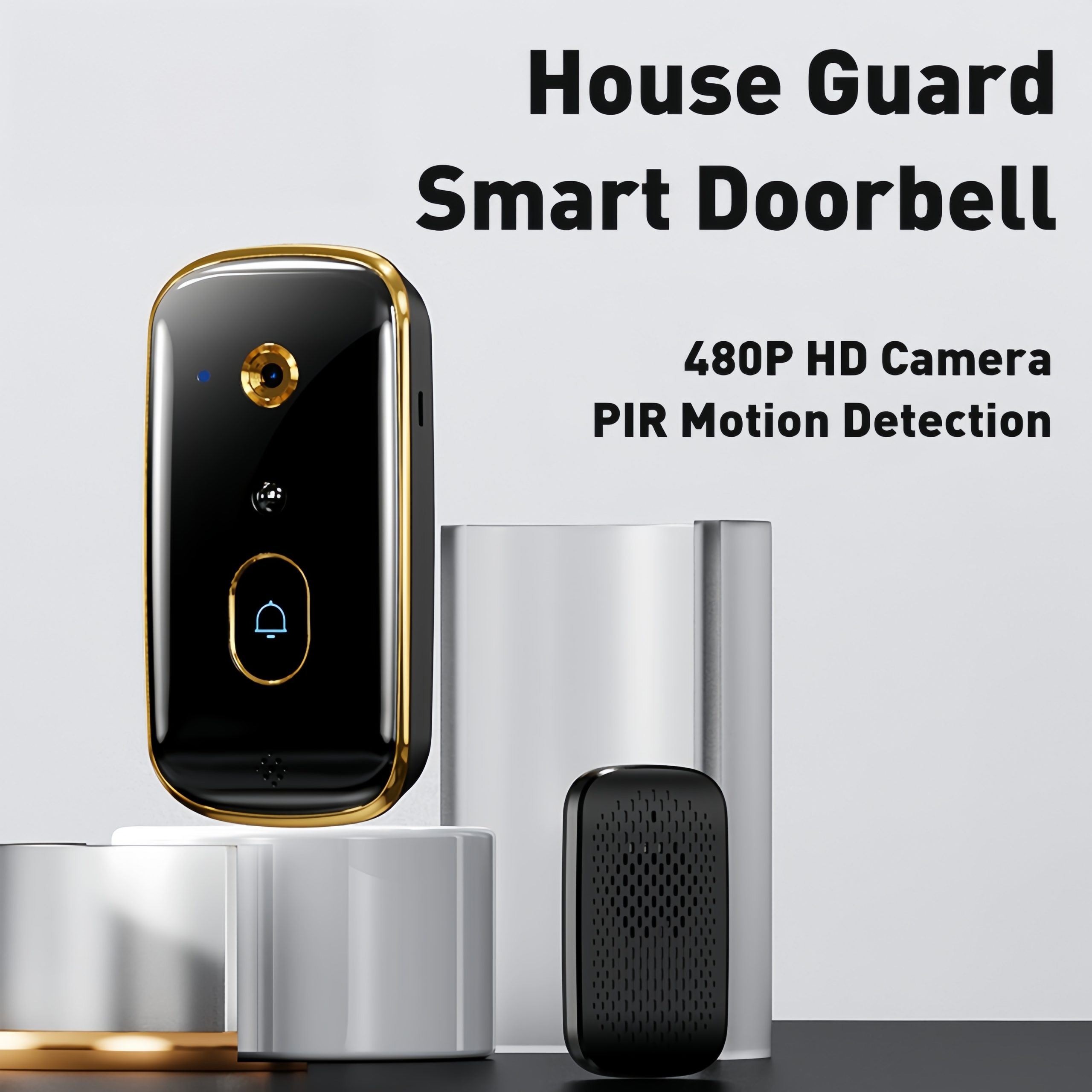
480P PIR wireless video doorbell

The word “HD” appears on almost every video doorbell listing, from the cheapest 480P panel to a full 1080P camera. It is not a specification. Two suppliers can use the same adjective for products with four times the pixel count, and only one of them is charging accordingly. The fix is simple: ask for pixels and a sample clip.

Pixels are a starting point, not the whole image. A 4 MP sensor behind a narrow lens reads a number plate worse than a well-matched 2 MP module. Ask for the lens focal length and the field of view, then look at a clip taken at the distance of a real doorway. A wide-angle lens gives you the whole porch but makes a face small; a narrow lens gives detail but misses the package on the step.

Low light separates the panels. A 480P sensor with a good infrared array can outperform a 1080P sensor with weak night vision. Ask for a night clip, not a daytime catalogue photo. Check whether the infrared cuts off when the subject moves close to the lens, and whether the image flips to black and white at a sensible threshold.

Match resolution to the market price band. A 480P doorbell is a perfectly valid product for a price-sensitive market. It becomes a problem only when it is sold and priced as 1080P. Decide the tier your channel can support, then write that number into the specification and the artwork rather than leaving the adjective in place.

Cloud clips depend on upload bandwidth. A higher-resolution stream needs more uplink. If the customer’s router has a slow upload path, the app may show a low-bitrate version even though the camera can capture more. Ask the supplier what bitrate the cloud upload uses and whether the local TF recording keeps the full resolution.

Certificates follow the exact model. CE, FCC, RoHS and UKCA are the normal set for EU and US orders; UL and ETL are confirmed case by case. A certificate for a sibling model with a different sensor does not cover your shipment. Ask for the test report that names the model you are buying.

Power architecture affects the image too. Battery models often reduce frame rate to save power. Wired two-wire systems hold a steadier stream, and solar kits sit between the two. Confirm the duty cycle in writing if your customer expects continuous live view rather than event clips.

MOQ on standard models is 5 pcs per colour and 5 pcs paid samples are credited against the first order. Before you pay a deposit, work through the video doorbell suppliers and ask for the clip that proves the claim.

Posted on

Video Doorbell Cloud vs TF Card: What Survives a Theft

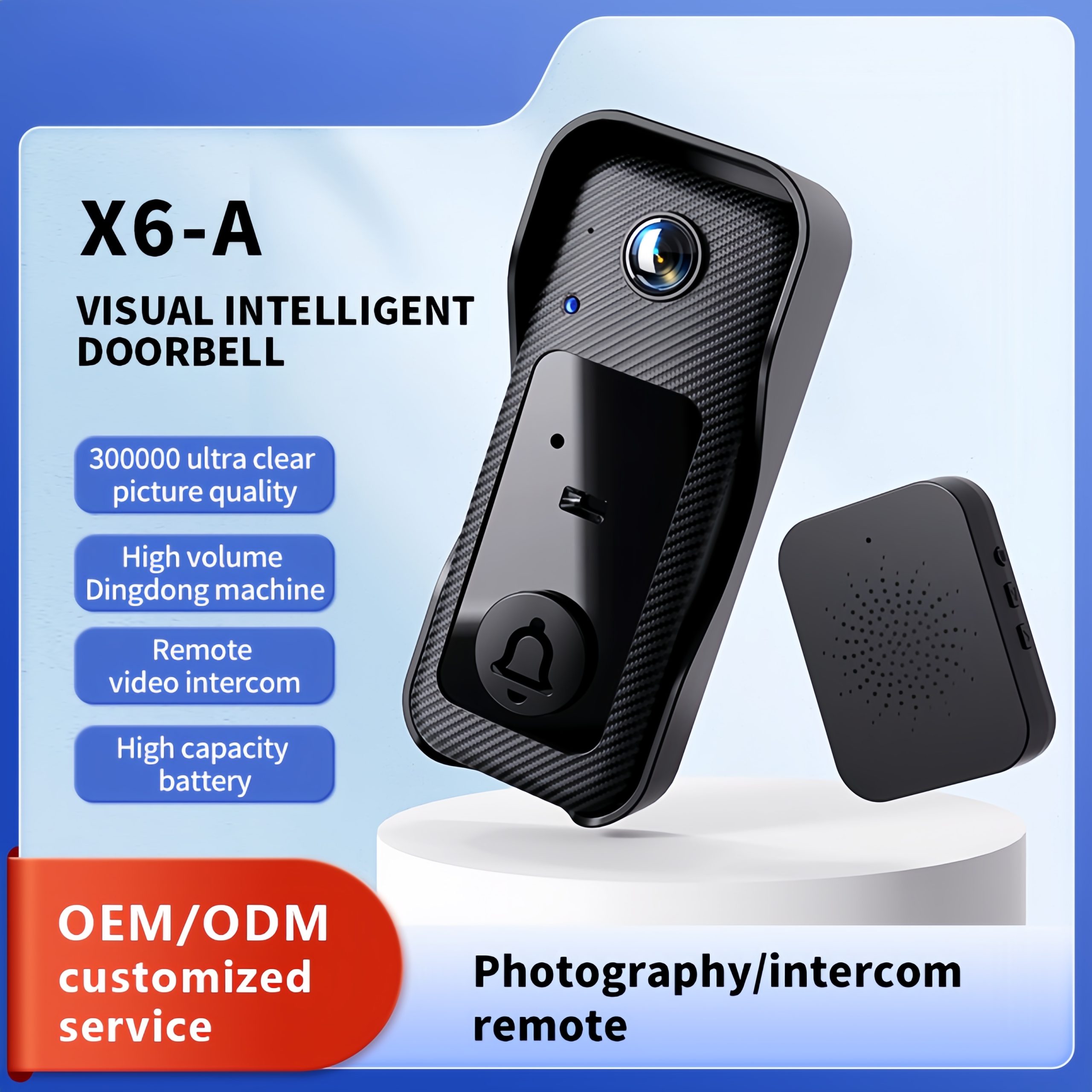
X6A wireless video doorbell

A video doorbell is mounted outside the front door, which makes it the first thing a thief removes. Where the recording lives decides whether you still have evidence afterwards. A clip stored on a TF card inside the unit disappears with the unit. A clip uploaded to a cloud account remains available on your phone. This single line in a specification sheet changes the value of the product.

Get the exact cloud name. Many suppliers write “cloud storage” on a datasheet and mean a third-party service with a paid subscription that the end customer discovers after installation. Ask for the exact service name, who operates it and what happens after the first year. If the supplier cannot name it, they are reselling hardware without a support agreement.

Ask what the subscription covers. On some platforms basic event recording is free and the paid tier only adds person detection or longer history. On others the camera is effectively useless without a monthly fee. Your customers will blame you for that fee, not the factory. Confirm the split in writing and show the app screen during the sample review.

Keep the TF card as a fallback. A cloud service can be unavailable, a router can fail and a subscription can lapse. A doorbell that also records to a local TF card keeps working in those cases. Confirm the maximum supported card size and whether loop recording overwrites old clips automatically. A card that fills and stops is a support call waiting to happen.

Offline behaviour is a separate question. RF intercom models pair directly to an indoor monitor and continue to work when the internet is down. App-only models need a 2.4 GHz router and a working connection to reach the chime. Both are valid products. Only one suits a site with unreliable broadband, and that site is exactly where a stolen unit is most likely.

Resolution and certificates still matter. “HD” can mean 480P. Ask for pixels and a sample clip taken at a real doorway distance. CE, FCC, RoHS and UKCA are the normal set; UL and ETL need case-by-case confirmation. Match the certificate to the exact model rather than a sibling in the catalogue.

Order terms. MOQ on standard models is 5 pcs per colour, with 5 pcs paid samples credited against the first order. EU and US chimes use different plugs and frequencies, so confirm the chime type before approving packaging artwork. The full checklist is on the video doorbell suppliers page, with the factory comparison on the video doorbell manufacturers.

Posted on

No-Neutral Smart Switch: When It Works and When It Flickers

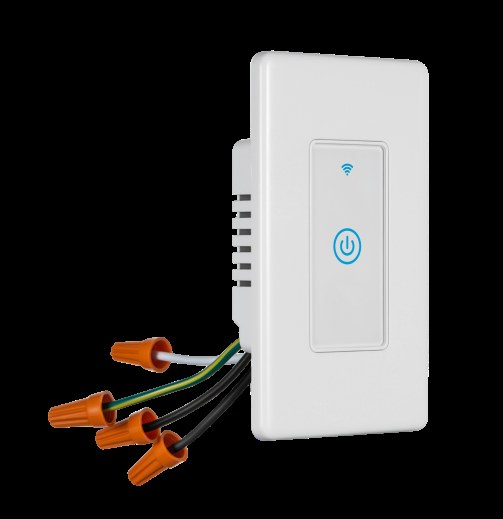
3-way eWeLink WiFi touch switch

In older housing the switch box often carries only a live feed. There is no neutral conductor for the smart switch to power its own electronics. A no-neutral product solves this by drawing a small standby current through the lamp circuit, and that solution works well with some loads and badly with others. Understanding the mechanism is the difference between a repeat order and a return rate.

Why flicker happens. The switch keeps a trickle of current flowing through the LED driver even when the lamp is off. A driver with a low minimum load treats that trickle as a signal and glows or blinks. Cheap LED bulbs and some dimmable drivers are the most common offenders. The switch itself is usually behaving correctly; the pairing is the problem.

Test with your actual bulbs. Ask the supplier for a compatibility list, then ignore it and run your own test with the lamps sold in your market. Fit one sample switch, leave it off for an hour in a dark room and watch. Repeat with the three best-selling bulb models in your channel. This takes an afternoon and catches the problem before a container arrives.

Read the per-gang derating. No-neutral universal relays typically rate around 500 W per gang rather than the higher figure a neutral-wire relay can carry. That number is a design limit, not a marketing suggestion. For a fan or an inductive load, keep at least 20 percent headroom. A two-gang panel with two heavy loads is a different engineering question from a single-gang lighting circuit.

Companion switches are not the same hardware. US multi-way installations often use a master unit plus companion switches that associate through the app rather than a traveller wire. The master carries the load; the companions only send commands. Ask which unit is in the box and whether your quote covers the correct ratio for a three-way installation.

Certification still follows the model. CE, FCC, RoHS and UKCA are the standard set for EU and US shipments, with UL and ETL confirmed case by case. Ask for the report matching the exact model and the final firmware. A universal wiring product has more operating states to certify than a single-mode one.

When to choose a neutral-wire model instead. New-build housing with a neutral in the box is a better match for a neutral-wire relay: higher load capacity, no trickle current and no LED compatibility question. If your market is mostly new construction, paying for the simpler product reduces support calls.

Samples are 5 pcs, charged and credited against the first order; standard MOQ is 5 pcs per colour. The tuya smart switch oem page explains the branding tiers, and the smart switch manufacturers in china checklist covers the factory questions to ask before sampling.

Posted on

86×86, 118×76 or 147×86: Choosing the Right Switch Panel Standard

147 ZigBee multi-gang touch switch

A smart switch is sold as a specification sheet and installed into a wall box that was built decades before the product existed. The panel standard is the first line of a quotation and the first reason a shipment ends up in a warehouse. Three formats cover most export orders.

86 x 86 mm. The European 230 V format with 60 mm hole spacing. It is also used across many Asian markets. Products in this format are commonly specified with neutral wire or universal wiring, and the deep wall boxes in new-build housing make installation straightforward. If your destination is the EU or UK, start here and confirm the back-box depth before you approve samples.

118 x 76 mm. The common North American and several Asian export formats. It is wider and shorter than 86 x 86, and it is the format most often installed without a neutral wire in older housing. No-neutral switching works by drawing a small standby current through the lamp circuit, which is why LED compatibility has to be tested with the bulbs actually used in your market.

147 x 86 mm. A larger panel used in Pakistan and parts of the Middle East. It looks similar to 86 x 86 from the front but does not fit the same box. Buyers who order from a catalogue photograph alone regularly mix the two. Name the standard explicitly in the purchase order.

UK orders need a separate check. A 86 mm panel sold into the UK market must be paired with the right back box and certification for the local wiring accessory rules. UKCA is the expected mark. Do not assume an EU CE file covers a UK installation without checking the current requirements.

Wiring is part of the standard decision. Ask which variant the quotation covers: neutral wire, no neutral, or universal. Universal SKUs cover both wiring patterns in one product, which helps a distributor serving mixed housing stock, but they may carry a lower per-gang load rating. Read the derating note rather than the headline wattage.

Get the MOQ in writing per colour. 5 pcs per colour is typical for standard models; 5 pcs paid samples are credited against the first order. Mixed colours in one container are often negotiable, mixed models usually are not. Tooling for a genuinely new panel starts at 2,000–3,000 pcs with 25–40 days of lead time.

Ask for the panel standard, the wiring variant and the certificate model in the same email. The smart switch manufacturers in china guide covers the branding levels and the tuya smart switch oem page explains how the app panel and cloud listing are assigned.

Posted on

Tuya ZigBee vs Plain ZigBee: What Changes in the App and the Cloud

Tuya WiFi touch switch panel

Two quotations can name the same radio and still describe different products. “Tuya ZigBee” arrives with a certified module, an app ecosystem and a cloud listing under a product ID. “Plain ZigBee” is a radio board that expects you to supply the gateway, the app and the cloud integration yourself. The unit price difference is real, but so is the engineering bill that follows the cheaper board.

What the buyer actually gets. With a Tuya module, pairing, schedules, scenes and voice-assistant links are already built. Your team configures the product panel, uploads the artwork and ships. With a bare ZigBee board, someone has to write or license a gateway bridge, maintain a device model and run a cloud endpoint. That is a software project, not a line item on a switch quote.

Check the product ID, not the logo. Ask the supplier to show the product ID on a live Tuya account. Confirm the panel, the firmware identity and the cloud listing name. A printed logo without a private product ID is a white-label product, not an own-brand one. The distinction matters most when you plan to sell through retail or a distributor who will inspect the app experience.

Budget for the gateway question. ZigBee is not Wi-Fi. A ZigBee device needs a hub or a gateway to reach a phone app. Tuya gateways are widely available and buyers are used to them; a custom gateway means your customers need hardware that only you supply. Ask whether the quoted price includes a gateway and who supports it after sale.

Certification follows the radio and the firmware. CE, FCC, RoHS and UKCA are the normal set for EU and US shipments. UL and ETL need case-by-case confirmation. Ask for the report that carries the exact model number and the final firmware version, because a certificate for an earlier board revision does not automatically cover a changed module.

When plain ZigBee still makes sense. If you already run your own hub platform with an installed app base and an engineering team, a bare module can be the right choice. You keep control of the stack and avoid a platform dependency. For a distributor or a brand launching its first smart home line, the Tuya route is usually faster to market.

Ask for the level in writing before comparing unit prices. A supplier who can show the panel, name the cloud and match the certificate to the model is quoting a finished product. One who cannot is quoting a component. See the tuya smart switch oem breakdown for the branding tiers and the smart switch manufacturers in china checklist for the factory-side questions.

Posted on

Private Label Security Cameras: The Three Branding Levels

Indoor 4MP WiFi pan-tilt security camera

Private label is not one thing. Three levels, three price bands. Buyers who ask for “custom cameras” without naming the level get quoted the highest tier and assume the factory is expensive. Name the level in the enquiry and the quotes become comparable.

Logo only — silk-print from 10 pcs for samples, laser engraving from 300 pcs. This changes the housing, not the firmware or the app. It is enough for a distributor who sells on price and does not intend to build a brand.

Packaging — a custom retail box from 500–1,000 pcs. This changes the unboxing experience but the app still shows the default platform. Useful when you sell through retail shelves and the box carries the purchase decision.

Private product ID — from 1,000 pcs, your own Tuya product ID puts your panel, firmware identity and cloud listing inside the app. This is the level most buyers actually mean when they say “own brand”. Ask to see the panel on a live account before you approve the artwork, and confirm who owns the cloud listing after the contract ends.

Outdoor claims need paperwork. IP65 should come with a test report, not a marketing image. Ask how the cable gland is sealed — water travels along cables, not through housings. A camera with a good housing but a poorly sealed gland will fail in the first wet season, and that failure shows up as returns against your brand.

No subscription required. Every Tuya camera records to a TF card. Cloud is optional. If a supplier says cloud is mandatory, they are selling a service, not a camera. Confirm the maximum supported card size and whether loop recording overwrites old clips without user action.

Off-grid projects. Solar plus 4G LTE models work on farms and construction sites with no WiFi or mains power. Check the supported bands for your destination country — a module that works in Europe may not attach to a network in North America. Ask for the actual modem model and verify the band list against the local carrier before you commit to a container order.

Standard MOQ is 5 pcs per colour and 5 pcs paid samples are credited against the first order. Tooling starts at 2,000–3,000 pcs with 25–40 days of lead time. The full importer checklist: security camera manufacturers in china.